High School Finding the Point: Unveiling Euclid's 'Elements' Redux

  • Thread starter Thread starter murshid_islam
  • Start date Start date
  • Tags Tags
    Elements Point
Click For Summary
The discussion centers on a proof from Euclid's "Elements" Redux, questioning the necessity of point D and triangle ABD in the context of a geometric argument. The user proposes an alternative approach using a line segment AB and point C, asserting that it suffices to demonstrate the relationship between the segments without the additional elements. There is confusion regarding the distinction between geometric and algebraic representations, particularly in the expression (2x)²=4x². The conversation also notes the existence of multiple versions of the textbook, which may lead to discrepancies in interpretations. Ultimately, the relevance of triangle ABD and point D remains unclear to the participants.
murshid_islam
Messages
468
Reaction score
21
TL;DR
Question about a proof from Euclid's "Elements" Redux (by Daniel Callahan and John Casey)
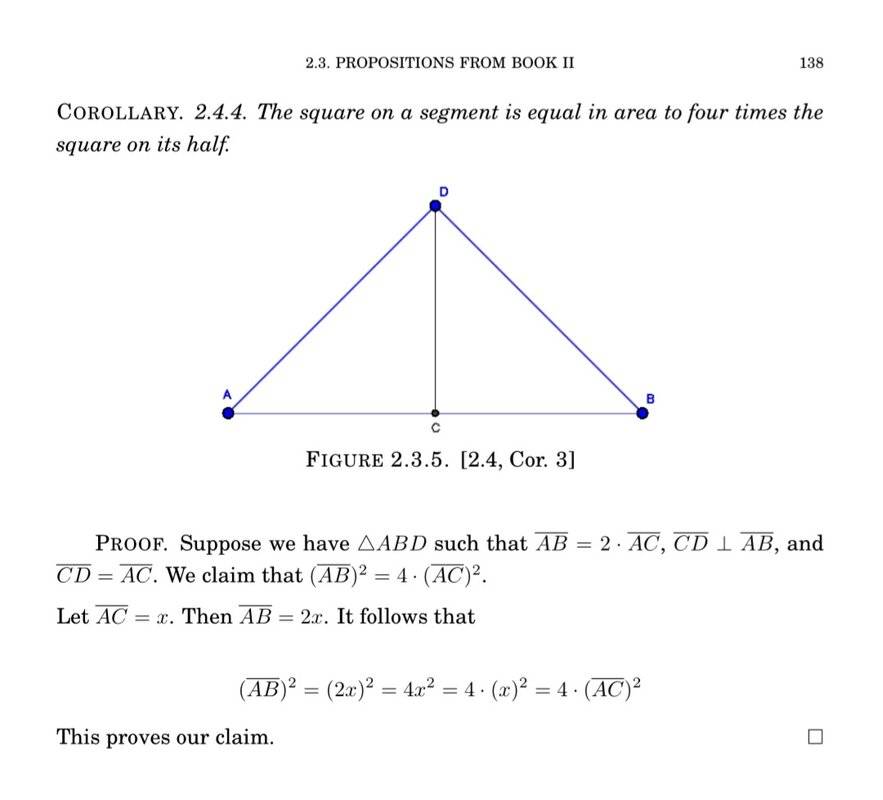
The following proof (in the image below) is from the book Euclid's "Elements" Redux (by Daniel Callahan and John Casey). I did not understand why the point D or the ##\triangle \rm ABD## was necessary. (I mean, what was the "point" of D? :-p) Joking apart, wasn't this sufficient: suppose we have a line segment AB and a point C on AB such that AB=2AC. Let AC = x. Then AB = 2x. Therefore, AB2 = (2x)2 = 4(x)2 = 4(AC)2
Screenshot_20210115-135147.jpg
 
Last edited:
Mathematics news on Phys.org
anuttarasammyak said:
I see Euclid, Elements II 4 at https://web.calstatela.edu/faculty/hmendel/Ancient Mathematics/Euclid/Euclid II/Euclid 2.4/Euclid.2.4.html .
I assume the corollary you refer, though I cannot find it in above linked page, is the special case AG=GB there.
Since this is a open textbook, it has been updated several times I guess. So, there are several versions of the book available on the internet. Maybe that's what causes the discrepancies between versions.

anuttarasammyak said:
I think he, Euclid or the author, says about geometry not algebra of ##(2x)^2=4x^2##.
In that case, shouldn't it deal with a square instead of a triangle? I still do not understand the relevance of the triangle and point D.
 
Here is a little puzzle from the book 100 Geometric Games by Pierre Berloquin. The side of a small square is one meter long and the side of a larger square one and a half meters long. One vertex of the large square is at the center of the small square. The side of the large square cuts two sides of the small square into one- third parts and two-thirds parts. What is the area where the squares overlap?

Similar threads

  • · Replies 4 ·
Replies
4
Views
2K
  • · Replies 1 ·
Replies
1
Views
2K
  • · Replies 1 ·
Replies
1
Views
2K
  • · Replies 4 ·
Replies
4
Views
4K
  • · Replies 40 ·
2
Replies
40
Views
5K
  • · Replies 1 ·
Replies
1
Views
2K
Replies
1
Views
1K
Replies
4
Views
2K
  • · Replies 3 ·
Replies
3
Views
2K
Replies
6
Views
4K