gnits
- 137
- 46
- Homework Statement
- To find the magnitude of the resultant of forces around a triangle
- Relevant Equations
- Resolving forces and calculating moments
Could I please ask for advice with the following:
ABC is a right-angled triangle in which AB = 4a; BC = 3a. Forces of magnitudes P, Q and R act along the directed sides AB, BC and CA respectively.
a) Find the ratios P:Q:R if their resultant is a couple.
b) If the force along the directed line AC is now reversed, find in terms of P the magnitude of the resultant of the new system.
Part a) is done (with the help of others on this forum) but I'm stuck on part b)
Book abswer is: 35P/12
Here's my working:
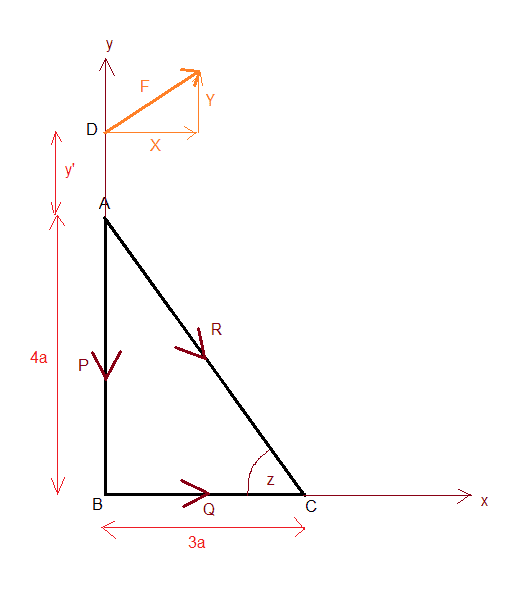
In the diagram F is the resultant. I assume it's line of action to pass through (0, 4a + y').
Hypotenuse = 5a
cos(z) = 3/5
sin(z) = 4/5
Resolving horizontally:
Q + 3R/5 = X
Resolving vertically:
P + 4R/5 + Y
So I need to calculate sqrt(X^2 + Y^2) in terms of P only, so ideally I would replace R and Q with equivalents in terms of P.
Taking moments about A:
4aQ=-Xy'
Taking moments about B:
-3R/5*4a = -X(4a+y')
which gives:
12Ra/5 = X(4a+y')
Taking moments about C:
3aP=-X(4a+y')
EDIT. I see that my moments about C are wrong, I failed to take into account the moment of Y about this point. Am continuing to work on this. Should be 3aP = -X(4a+y') - 3aY. Still leads me to R = -5P/4
These last two lead to R = -15P/12 = -5P/4
So I have R in terms of P but I still need Q in terms of P and this I can't see how to do. I tried moments about D but all derived relationships lead me to 0 = 0.
Thanks for any help.
ABC is a right-angled triangle in which AB = 4a; BC = 3a. Forces of magnitudes P, Q and R act along the directed sides AB, BC and CA respectively.
a) Find the ratios P:Q:R if their resultant is a couple.
b) If the force along the directed line AC is now reversed, find in terms of P the magnitude of the resultant of the new system.
Part a) is done (with the help of others on this forum) but I'm stuck on part b)
Book abswer is: 35P/12
Here's my working:
In the diagram F is the resultant. I assume it's line of action to pass through (0, 4a + y').
Hypotenuse = 5a
cos(z) = 3/5
sin(z) = 4/5
Resolving horizontally:
Q + 3R/5 = X
Resolving vertically:
P + 4R/5 + Y
So I need to calculate sqrt(X^2 + Y^2) in terms of P only, so ideally I would replace R and Q with equivalents in terms of P.
Taking moments about A:
4aQ=-Xy'
Taking moments about B:
-3R/5*4a = -X(4a+y')
which gives:
12Ra/5 = X(4a+y')
Taking moments about C:
3aP=-X(4a+y')
EDIT. I see that my moments about C are wrong, I failed to take into account the moment of Y about this point. Am continuing to work on this. Should be 3aP = -X(4a+y') - 3aY. Still leads me to R = -5P/4
These last two lead to R = -15P/12 = -5P/4
So I have R in terms of P but I still need Q in terms of P and this I can't see how to do. I tried moments about D but all derived relationships lead me to 0 = 0.
Thanks for any help.
Last edited: