sherrellbc
- 83
- 0
https://www.khanacademy.org/math/calculus/derivative_applications/rates_of_change/v/falling-ladder-related-rates
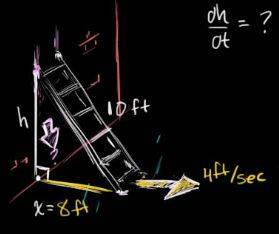
Essentially, the question states that a ladder, with length 10ft, is laid up against a wall with its bottom 8ft out. The ladder begins to slip, on a friction-less surface, at a rate of 4 ft/s. The problem asks to find the rate of change of height at that particular instant in time.
Now, my question to you is ..
Given that this ladder is on a friction-less surface, and the falling action is not affected by gravity, wouldn't the rate of change of the height be constant? Similarly, the rate of change of the angle should also be constant, given that the height is changing at a constant rate.
Correct me where I went wrong.
The base of the triangle, as a function of time, can be written as (8 + 4t)
The hypotenuse remains 10, and the height is, of course, h.
Solve for h using the pythagorean theorem =>
h² = 100 - (8+4t)²
h = ±√(100 - (8+4t)²)
dh/dt = -(t+32)/(-t²-64t+36)^½
If you evaluate at 0, the correct answer is derived. But this function is undefined for any integer number > 0, and any rational number less than 0 really doesn't make any sense for this problem. What kind of a result is that? Although, you can get real values for rational numbers approximately 0 < x < 1. That shows that the height is changing as a function of time?!
However, if one were to execute the necessary steps to determine how the angle(bottom right) was changing with respect to time, you would resolve a constant!
cos(Θ) = (8+4t)/10
-sin(Θ) * dΘ/dt = 4/10
dΘ/dt = -2/(5sin(36.87°))
This result is most certainly a constant. What am I doing wrong?
Essentially, the question states that a ladder, with length 10ft, is laid up against a wall with its bottom 8ft out. The ladder begins to slip, on a friction-less surface, at a rate of 4 ft/s. The problem asks to find the rate of change of height at that particular instant in time.
Now, my question to you is ..
Given that this ladder is on a friction-less surface, and the falling action is not affected by gravity, wouldn't the rate of change of the height be constant? Similarly, the rate of change of the angle should also be constant, given that the height is changing at a constant rate.
Correct me where I went wrong.
The base of the triangle, as a function of time, can be written as (8 + 4t)
The hypotenuse remains 10, and the height is, of course, h.
Solve for h using the pythagorean theorem =>
h² = 100 - (8+4t)²
h = ±√(100 - (8+4t)²)
dh/dt = -(t+32)/(-t²-64t+36)^½
If you evaluate at 0, the correct answer is derived. But this function is undefined for any integer number > 0, and any rational number less than 0 really doesn't make any sense for this problem. What kind of a result is that? Although, you can get real values for rational numbers approximately 0 < x < 1. That shows that the height is changing as a function of time?!
However, if one were to execute the necessary steps to determine how the angle(bottom right) was changing with respect to time, you would resolve a constant!
cos(Θ) = (8+4t)/10
-sin(Θ) * dΘ/dt = 4/10
dΘ/dt = -2/(5sin(36.87°))
This result is most certainly a constant. What am I doing wrong?
Last edited: