Finding the resultant of two forces in 3d

Click For Summary
SUMMARY

The discussion focuses on calculating the resultant of two forces in a 3D space, specifically addressing the breakdown of forces P and Q into their components. The user initially struggles with obtaining the correct resultant force of 940N, as referenced in their textbook. Key errors identified include incorrect projections of forces onto the x-z plane and misapplication of the cosine formula, particularly regarding angles with respect to the axes. The correct calculations for the components of Q and P are emphasized, highlighting the importance of accurately defining angles in relation to the coordinate axes.

PREREQUISITES
  • Understanding of vector decomposition in 3D space
  • Knowledge of trigonometric functions, particularly cosine
  • Familiarity with force projections onto coordinate planes
  • Basic principles of static equilibrium in physics
NEXT STEPS
  • Study vector decomposition techniques in 3D physics problems
  • Learn about the correct application of the cosine law in vector analysis
  • Explore the concept of force projections onto different coordinate planes
  • Review static equilibrium conditions and their mathematical representations
USEFUL FOR

Students in physics, engineers working with force analysis, and anyone involved in vector mathematics will benefit from this discussion.

CivilSigma
Messages
227
Reaction score
58
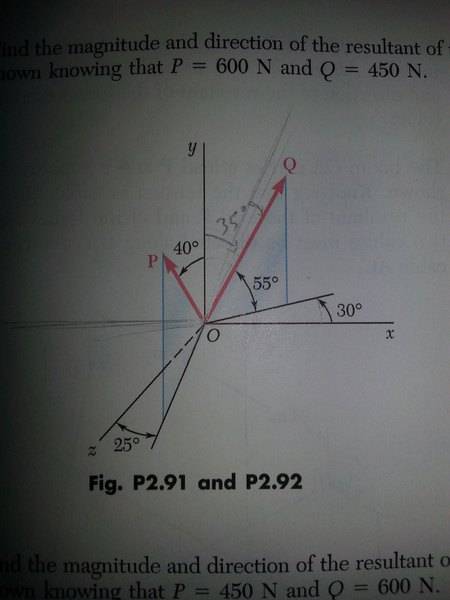
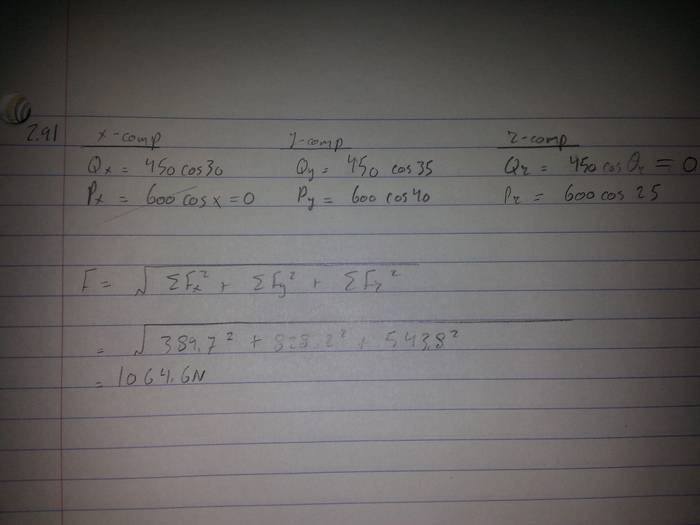
Hi, For the following image, we have to calculate the resultant of those two forces. I have broken them down to their components. Did I do this correctly because when I actually solve for the force I am not getting the correct answer of 940N in the back of my book.

Also, I tried calculating the direction of force P in the x plane , Q in the z plane and when I used the cosine formula I got
cos^2 theta = -0.4 ( a negative number) does that imply that our vector does not exist in the x plane and therefore is 0 for P? and 0 for Q in the z plane?
s5924p.jpg

2hx14zn.jpg
 
Physics news on Phys.org
The photograph does not clearly define the vectors, far as I can see.
 
They are not defined by x,y,z co-ordinates but by their coordinate angles?
 
sakonpure6 said:
They are not defined by x,y,z co-ordinates but by their coordinate angles?

Yeah, but the angles are not well defined as I see it. It's not clear whether the angles are with the x, y or z axes. Maybe with some effort I could figure it out, but a verbal description would have been a big help.
 
sakonpure6 said:
Hi, For the following image, we have to calculate the resultant of those two forces. I have broken them down to their components. Did I do this correctly because when I actually solve for the force I am not getting the correct answer of 940N in the back of my book.

Also, I tried calculating the direction of force P in the x plane , Q in the z plane and when I used the cosine formula I got
cos^2 theta = -0.4 ( a negative number) does that imply that our vector does not exist in the x plane and therefore is 0 for P? and 0 for Q in the z plane?

s5924p.jpg

2hx14zn.jpg

Your calculations show the Qx = Q cos 30. This is incorrect. The projection of Q onto the x-z plane makes an angle of 30 degrees to the x-axis.
The magnitude of the projection of Q onto the x-z plane is not equal to the magnitude of Q.

Your calculation of Qy is correct.

You have a similar situation with the force P. The projection of P onto the x-z plane makes an angle of 25 degrees to the z-axis.
Again, the magnitude of the projection of P onto the x-z plane is not equal to the magnitude of P.
 
  • Like
Likes   Reactions: CivilSigma
Doesn't look too confusing but I think...

Qx = 450*Cos55*Cos30
Qz = 450*Cos55*Cos60

Haven't checked them all.

Cross posted with the reply by Steamking.
 
  • Like
Likes   Reactions: CivilSigma

Similar threads

  • · Replies 6 ·
Replies
6
Views
4K
  • · Replies 9 ·
Replies
9
Views
2K
  • · Replies 9 ·
Replies
9
Views
3K
  • · Replies 1 ·
Replies
1
Views
2K
Replies
1
Views
3K
  • · Replies 1 ·
Replies
1
Views
2K
  • · Replies 3 ·
Replies
3
Views
2K
  • · Replies 6 ·
Replies
6
Views
847
  • · Replies 2 ·
Replies
2
Views
1K
Replies
17
Views
3K