Finding the resultant of two forces in 3d

Click For Summary

Discussion Overview

The discussion revolves around calculating the resultant of two forces in a three-dimensional space, focusing on the breakdown of these forces into their components. Participants are examining the correctness of their calculations and the implications of the angles involved in the force projections.

Discussion Character

  • Technical explanation
  • Debate/contested
  • Mathematical reasoning

Main Points Raised

  • One participant questions the accuracy of their component breakdown and the resultant force, noting a discrepancy with a reference value of 940N.
  • Another participant points out that the vectors are not clearly defined in the provided image, leading to confusion about their coordinates.
  • A participant emphasizes that the angles defining the forces are not well specified, which complicates the calculations.
  • One participant corrects another's calculation of the projection of force Q onto the x-z plane, stating that the angle used was incorrect and that the magnitude of the projection does not equal the magnitude of Q.
  • Another participant suggests a calculation for Qx and Qz but notes they have not verified all calculations.

Areas of Agreement / Disagreement

Participants express disagreement regarding the clarity of the vector definitions and the correctness of the calculations. There is no consensus on the correct approach to resolving the discrepancies in the calculations.

Contextual Notes

Participants highlight limitations in the clarity of the angles and vector definitions, which may affect the accuracy of their calculations. There are unresolved mathematical steps regarding the projections of the forces.

CivilSigma
Messages
227
Reaction score
58
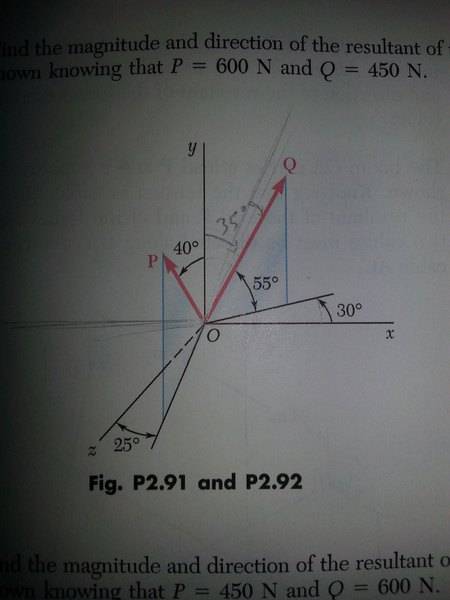
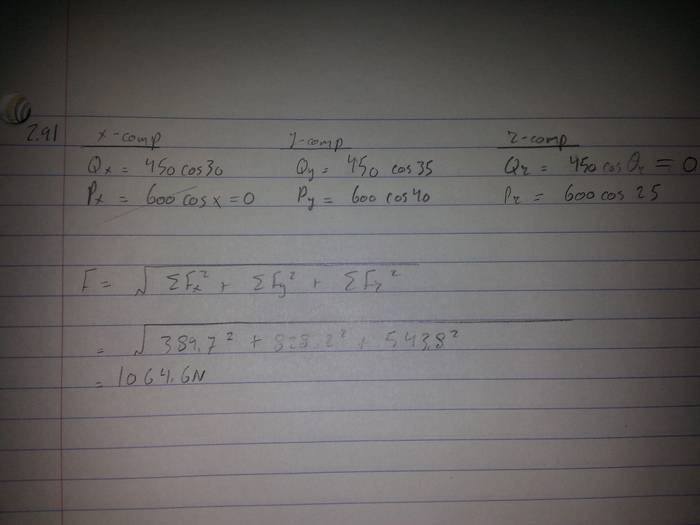
Hi, For the following image, we have to calculate the resultant of those two forces. I have broken them down to their components. Did I do this correctly because when I actually solve for the force I am not getting the correct answer of 940N in the back of my book.

Also, I tried calculating the direction of force P in the x plane , Q in the z plane and when I used the cosine formula I got
cos^2 theta = -0.4 ( a negative number) does that imply that our vector does not exist in the x plane and therefore is 0 for P? and 0 for Q in the z plane?
s5924p.jpg

2hx14zn.jpg
 
Physics news on Phys.org
The photograph does not clearly define the vectors, far as I can see.
 
They are not defined by x,y,z co-ordinates but by their coordinate angles?
 
sakonpure6 said:
They are not defined by x,y,z co-ordinates but by their coordinate angles?

Yeah, but the angles are not well defined as I see it. It's not clear whether the angles are with the x, y or z axes. Maybe with some effort I could figure it out, but a verbal description would have been a big help.
 
sakonpure6 said:
Hi, For the following image, we have to calculate the resultant of those two forces. I have broken them down to their components. Did I do this correctly because when I actually solve for the force I am not getting the correct answer of 940N in the back of my book.

Also, I tried calculating the direction of force P in the x plane , Q in the z plane and when I used the cosine formula I got
cos^2 theta = -0.4 ( a negative number) does that imply that our vector does not exist in the x plane and therefore is 0 for P? and 0 for Q in the z plane?

s5924p.jpg

2hx14zn.jpg

Your calculations show the Qx = Q cos 30. This is incorrect. The projection of Q onto the x-z plane makes an angle of 30 degrees to the x-axis.
The magnitude of the projection of Q onto the x-z plane is not equal to the magnitude of Q.

Your calculation of Qy is correct.

You have a similar situation with the force P. The projection of P onto the x-z plane makes an angle of 25 degrees to the z-axis.
Again, the magnitude of the projection of P onto the x-z plane is not equal to the magnitude of P.
 
  • Like
Likes   Reactions: CivilSigma
Doesn't look too confusing but I think...

Qx = 450*Cos55*Cos30
Qz = 450*Cos55*Cos60

Haven't checked them all.

Cross posted with the reply by Steamking.
 
  • Like
Likes   Reactions: CivilSigma

Similar threads

  • · Replies 6 ·
Replies
6
Views
4K
  • · Replies 9 ·
Replies
9
Views
2K
  • · Replies 9 ·
Replies
9
Views
3K
  • · Replies 1 ·
Replies
1
Views
2K
Replies
1
Views
3K
  • · Replies 1 ·
Replies
1
Views
2K
  • · Replies 3 ·
Replies
3
Views
2K
  • · Replies 6 ·
Replies
6
Views
1K
  • · Replies 2 ·
Replies
2
Views
1K
Replies
17
Views
3K