Finding the total charge from the graph

Click For Summary

Discussion Overview

The discussion revolves around calculating total charge from a graph representing current over time. Participants explore the relationship between current, time, and charge, particularly focusing on constant versus non-constant current scenarios.

Discussion Character

  • Technical explanation
  • Mathematical reasoning

Main Points Raised

  • One participant states that a current of 1 A for one second corresponds to 1 Coulomb of charge, suggesting that charge can be calculated by multiplying current and time when the current is constant.
  • Another participant calculates the charge for a constant current of 10 mA over 1 ms as 10 µC, relating this to the area under the graph for that time interval.
  • A question arises regarding the calculation for the first millisecond, where the current is not constant, leading to confusion about the factor of 1/2 in the area calculation.
  • A later reply clarifies that during the first millisecond, the current increases from 0 to 10 mA, and thus the average current is 5 mA, explaining that the factor of 2 accounts for this average in the area calculation.
  • There is a mention of integrating to find the total charge, indicating that the process involves summing small bits of charge over time.

Areas of Agreement / Disagreement

Participants express varying levels of understanding regarding the calculation of charge from the graph, particularly in the context of non-constant current. There is no consensus on the clarity of the explanation provided for the area calculation in the first millisecond.

Contextual Notes

Some participants may have differing familiarity with concepts such as integrals and the geometric interpretation of area under a curve, which could affect their understanding of the discussion.

red1312
Messages
20
Reaction score
1
Hi
I hope this the right place to put my question
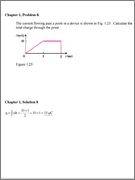
image.jpg


I didn't understand how it became like this

Thank you
 
Engineering news on Phys.org
A current of 1 A during one second means that 1 Coulomb has passed by.
If the current is constant, all you have to do is multiply current and time to get charge.
For example in the period 1-2 ms the current is constant, so the charge is 1 ms x 10 mA = 10 ##\mu##C
Which is also the area in the graph under the red line from 1-2 ms.

For 0-1 you have a non-constant current and the area under the red line is 10 x 1 /2 in mA x ms .

--

Does this help ?
 
Thank you very much
I understood the first part
But sorry I didn't get it the last part which is the 1/2 ,,,

Thank you again
 
In the first msec the current increases from 0 to 10 mA. It isn't 10 mA all through this msec, so 10 x 1 would be too much by a factor of about 2 as you can see from geometry.
In this case the average current during the first msec is 5 mA and the factor of 2 is exact.
Could it be that you aren't all that familiar with integrals and that integrals represent an area ?

Basically all that's done is that we add up all the little bits of charge = ##\ \ ## i x ##\Delta##t ##\ \ ## for the period 0 - 1 ms and do so for very small time steps. In the limit ##\Delta##t ##\downarrow ##0, this becomes the integral ##\int i \ dt##
 
  • Like
Likes   Reactions: red1312

Similar threads

  • · Replies 3 ·
Replies
3
Views
1K
  • · Replies 13 ·
Replies
13
Views
3K
  • · Replies 3 ·
Replies
3
Views
2K
Replies
23
Views
5K
  • · Replies 6 ·
Replies
6
Views
3K
  • · Replies 5 ·
Replies
5
Views
2K
Replies
11
Views
2K
  • · Replies 4 ·
Replies
4
Views
2K
  • · Replies 10 ·
Replies
10
Views
2K
  • · Replies 2 ·
Replies
2
Views
2K