Finding the value of A and B (Another problem)

  • Context: Undergrad 
  • Thread starter Thread starter shayaan_musta
  • Start date Start date
  • Tags Tags
    Value
Click For Summary

Discussion Overview

The discussion revolves around a trigonometric problem involving the calculation of angles α and β in a triangle using the law of sines. Participants explore the implications of their calculations, particularly focusing on the value of α and its negative result, while attempting to reconcile this with the geometric representation of the triangle.

Discussion Character

  • Exploratory
  • Technical explanation
  • Debate/contested
  • Mathematical reasoning

Main Points Raised

  • One participant calculates α using the law of sines and finds α = -63.86°, questioning the validity of this result given the geometric context of the triangle.
  • Another participant asks about the existence of other solutions for cot(α) = -0.49, indicating that multiple angles can yield the same cotangent value.
  • There is a discussion about the implications of having a negative cotangent and how it relates to the quadrant in which the angle lies.
  • Participants express confusion about why the calculated value of α does not seem to match the expected geometric interpretation, particularly regarding the need to adjust the angle based on its quadrant.
  • One participant suggests that the calculation of α could be reconciled with the triangle by considering the angle's position in the second quadrant.
  • Another participant emphasizes the importance of understanding the relationship between the calculated angle and the triangle's geometry, noting that different triangles can yield different angle values.
  • There is a mention of the need to review trigonometric concepts to better understand the problem, with some participants expressing frustration over the lack of clarity in the discussion.

Areas of Agreement / Disagreement

Participants generally agree that the calculation of α is problematic due to its negative value, but there is no consensus on how to resolve this issue or what the correct value of α should be. Multiple competing views on the interpretation of the angle and its relationship to the triangle remain unresolved.

Contextual Notes

Participants reference previous problems and calculations, indicating that the context of the triangle and the specific angles involved may differ from earlier discussions, which adds to the confusion. The discussion reflects a lack of clarity regarding how to properly interpret the results of trigonometric calculations in relation to the geometry of the triangle.

Who May Find This Useful

This discussion may be useful for students and individuals interested in trigonometry, particularly those grappling with angle calculations in geometric contexts and the implications of different quadrants on trigonometric functions.

shayaan_musta
Messages
208
Reaction score
2
Hello experts,
I have attached the figure below kindly see it. And here is my calculation,
Using law of sine,
from figure we can say that α+β=120°
and β=120°-α
and sin(β)/sin(α)=PA/PB=3/40=0.075

so,
sin(120°-α)=sin(120°)cos(α)-cos(120°)sin(α)
since, sin(β)=sin(120°-α)
so,
sin(β)=sin(120°)cos(α)-cos(120°)sin(α)
dividing both sides by sin(α)
so,
sin(β)/sin(α)=sin(120°)cos(α)/sin(α)-cos(120°)sin(α)/sin(α)
sin(β)/sin(α)=sin(120°)cos(α)/sin(α)-cos(120°)
sin(β)/sin(α)=0.866*cos(α)/sin(α)-(-0.5)
3/40=0.866*cot(α)+0.5
0.075=0.866*cot(α)+0.5
-0.425=0.866*cot(α)
cot(α)=-0.425/0.866
cot(α)=-0.49
α=-63.86°

What is this? Why α is -ve? Where I have gone wrong? From figure we can clearly see that it is more than 90°. But calculation says it is -63.86°.

According to the book point A is at -3.70 and B is at -53.35. But I am not getting my angle correct. HElp
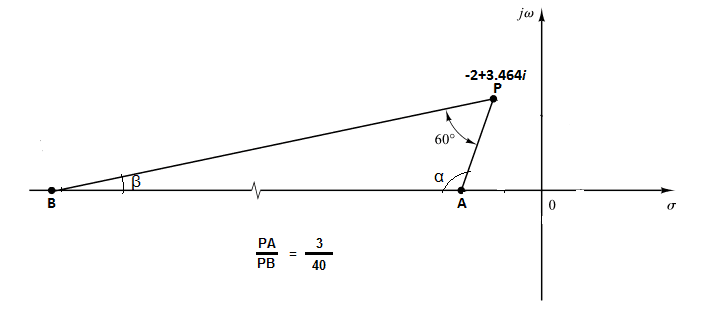
Capture.PNG
 
Mathematics news on Phys.org
shayaan_musta said:
cot(α)=-0.49
α=-63.86°
What other solutions are there to cot(α)=-0.49?
 
shayaan_musta said:
Hello experts,
I have attached the figure below kindly see it. And here is my calculation,
Using law of sine,
from figure we can say that α+β=120°
and β=120°-α
and sin(β)/sin(α)=PA/PB=3/40=0.075

so,
sin(120°-α)=sin(120°)cos(α)-cos(120°)sin(α)
since, sin(β)=sin(120°-α)
so,
sin(β)=sin(120°)cos(α)-cos(120°)sin(α)
dividing both sides by sin(α)
so,
sin(β)/sin(α)=sin(120°)cos(α)/sin(α)-cos(120°)sin(α)/sin(α)
sin(β)/sin(α)=sin(120°)cos(α)/sin(α)-cos(120°)
sin(β)/sin(α)=0.866*cos(α)/sin(α)-(-0.5)
3/40=0.866*cot(α)+0.5
0.075=0.866*cot(α)+0.5
-0.425=0.866*cot(α)
cot(α)=-0.425/0.866
cot(α)=-0.49
α=-63.86°

What is this? Why α is -ve? Where I have gone wrong? From figure we can clearly see that it is more than 90°. But calculation says it is -63.86°.

According to the book point A is at -3.70 and B is at -53.35. But I am not getting my angle correct. HElpView attachment 92565
Nope, I don't see any figure.
 
haruspex said:
What other solutions are there to cot(α)=-0.49?
Other solutions mean?
 
SteamKing said:
Nope, I don't see any figure.
Don't you see the figure of triangle?
 

Attachments

  • Capture.PNG
    Capture.PNG
    3.4 KB · Views: 462
shayaan_musta said:
Other solutions mean?
There's more than one angle in a 360 degree range with a cotangent equal to a given value. For a positive value, there will be one in the first quadrant and one in the third. Here you have a negative value.
 
No. I don't understand your point of view about more than one angle. Please elaborate with example.
 
shayaan_musta said:
Don't you see the figure of triangle?
I do now that you have posted the figure.
 
haruspex said:
What other solutions are there to cot(α)=-0.49?
This figure shows the geometric representation of the cotangent:

http://www.regentsprep.org/regents/math/algtrig/att5/unitcircletriglabel.jpg
This particular figure shows the cotangent for an angle θ which is in the first quadrant. Like its cousin the tangent, cotangent is positive for angles in the first and third quadrants, but negative for angles in the second and fourth quadrants.

You have to figure out how your result relates to your original triangle.
 
  • #10
  • #11
shayaan_musta said:
My cot angle is negative because it is in second quadrant. Right?
But look on https://www.physicsforums.com/threads/find-the-value-of-point-a-and-b.845250/#post-5302286 this thread. I worked on it yesterday and it is same question as I posted in this current thread.

In the previous thread, I don't have cot angle to be negative although my triangle is in second quadrant. So why in this current question it is giving me negative value?
You have different triangles.

In the first problem, angle α was less than 90°. In the current problem, angle α is greater than 90°. Don't you think that makes a difference in the value of cot(α)?
 
  • #12
Yes, you are right. I have already observed it. But I my calculation is for α so why my α is not correct?
If 180-63.86=116.14

This is greater than 90. And from figure we can see that α is also greater than 90.

If 116.14 is the value for what I am looking for then I don't that understand that why this time I should subtract it from 180. why not in the last question I did this.

Much confusion :'(
 
  • #13
shayaan_musta said:
Yes, you are right. I have already observed it. But I my calculation is for α so why my α is not correct?
If 180-63.86=116.14

This is greater than 90. And from figure we can see that α is also greater than 90.

If 116.14 is the value for what I am looking for then I don't that understand that why this time I should subtract it from 180. why not in the last question I did this.

Much confusion :'(
I don't think anyone is suggesting that angle α be subtracted from 180°. It's just that your original value of α = -63.86°. What you must do is reconcile this result with the triangle which shows that α > 90°. :wink:
 
  • #14
No. I really don't understand.

I have calculated the value of α, then what should be further can I do with it?

And you are true no one suggested me to subtract it. But I don't see any further solution.
 
  • #15
shayaan_musta said:
No. I really don't understand.

I have calculated the value of α, then what should be further can I do with it?

And you are true no one suggested me to subtract it. But I don't see any further solution.
What if you added angle α algebraically to 180°? Wouldn't that give you a result which satisfies the triangle? When figuring angles, references are important.
 
  • #16
I don't want to lost in the maze. Kindly let me follow the light not to the darkness.

I am closing thread. I don't find any solution to my question.

Thank you for your time.
 
  • #17
shayaan_musta said:
I don't want to lost in the maze. Kindly let me follow the light not to the darkness.

I am closing thread. I don't find any solution to my question.

Thank you for your time.
That's too bad. You really should review trigonometry to get a better handle on it. Trig pops up in all kinds of math and engineering.
 
  • #18
I don't have time to review it. I have exam tomorrow on 30th November, 2015. 3 years ago we have trigonometry as a subject. After 3 years it comes again and in this 3 years we only have integration more than trigonometry.
 
  • #19
shayaan_musta said:
I don't have time to review it. I have exam tomorrow on 30th November, 2015. 3 years ago we have trigonometry as a subject. After 3 years it comes again and in this 3 years we only have integration more than trigonometry.
Doesn't matter. Trig is one of those things which you use frequently. It doesn't matter if you studied it 3 years ago or 40 years ago like I did. You have to keep on top of it or you could risk blowing an exam. :frown:
 
  • #20
OK just solve me this problem to the value of α then further I will try on my own. But kindly find the exact value for me of α
 
  • #21
As in your previous exercise, draw the line from P perpendicular to the horizontal axis, and let Q be the point where it intersects the horizontal axis.

You already have ##\cot(\alpha)=-0.49##.
As others have explained, you have two solutions for this, and you obviously need the one in the second quadrant.
So ##\alpha=2.027## (in radians, something like 116°).

In the right triangle APQ:
##|AQ|=\cot(\pi-\alpha)*|PQ|=0.49*3.464=1.7##
So the coordinates of A are ##(-2-1.7,0)=(-3.7,0)##.

Use the triangle BPQ to get the coordinates of B.
 
  • Like
Likes   Reactions: shayaan_musta
  • #22
Hello Samy_A,

I was looking your way before my eyes. hehehehehe...

Thank you very much once again.

One problem still drowning me into the sea of confusion from the starting of this thread is that what does two solutions meant as everybody said and you also said that. I don't get it. Can you elaborate in simple way?
 
  • #23
shayaan_musta said:
One problem still drowning me into the sea of confusion from the starting of this thread is that what does two solutions meant as everybody said and you also said that. I don't get it. Can you elaborate in simple way?
There is not much to elaborate on.

The cotagent is negative in the second and fourth quadrant, so in your case ##\cot(\alpha)=-0.49## implied that ##\alpha=2.027## (close to d116°) or that ##\alpha=-1.11## (close to -63°). By inspection, only the first solution makes sense for you triangle.
 
Last edited:
  • Like
Likes   Reactions: shayaan_musta
  • #24
In the previous problem we have α=88° and it is positive as it should be in second quadrant. That's why we have not subtracted it from 180° anymore.

But here we have α=-63.853° and it is negative as it should not be in the second quadrant. That's why we have this 180°-63.853°=116.147°(in radians, 2.027rad)

Am I getting it right @Samy_A?
 
  • #25
shayaan_musta said:
In the previous problem we have α=88° and it is positive as it should be in second quadrant. That's why we have not subtracted it from 180° anymore.

But here we have α=-63.853° and it is negative as it should not be in the second quadrant. That's why we have this 180°-63.853°=116.147°(in radians, 2.027rad)

Am I getting it right @Samy_A?
Both angles are mathematically correct solutions of the ##\cot (\alpha)=-0.49## equation. But only the second one makes sense in your specific situation.
 
  • Like
Likes   Reactions: shayaan_musta
  • #26
Awesome. Thank you very much.
You are genius.
 
  • #27
shayaan_musta said:
Awesome. Thank you very much.
You are genius.
I'm glad you are happy with the thread, but I feel you may be not much further forward in being able to solve this sort of question by yourself.
Samy told you what the other solution is, but can you now find all the solutions of f(x)=a for a given value a and given trig function f?
Some simple rules you should know:
##\sin(\alpha)=-\sin(\pi+\alpha)=-\sin(-\alpha)##
##\cos(\alpha)=-\cos(\pi+\alpha)=\cos(-\alpha)##
From those, you should be able to deduce easily ##\tan(\pi+\alpha)##, ##\sin(\pi-\alpha)##, etc.
If in doubt, sketch the curve of the trig function and put a horizontal line through it for the value.
 
  • Like
Likes   Reactions: shayaan_musta and Samy_A
  • #28
Hi, @haruspex

Thank you for your contribution in teaching me.

Meow meow :D

Regards,
Majesty :D
 

Similar threads

  • · Replies 2 ·
Replies
2
Views
1K
  • · Replies 9 ·
Replies
9
Views
2K
Replies
9
Views
2K
Replies
3
Views
12K
  • · Replies 21 ·
Replies
21
Views
4K
Replies
9
Views
3K
  • · Replies 2 ·
Replies
2
Views
2K
  • · Replies 7 ·
Replies
7
Views
1K
  • · Replies 2 ·
Replies
2
Views
2K
Replies
1
Views
3K