Saladsamurai
- 3,009
- 7
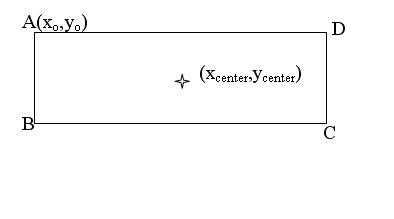
I am hoping to find the coordiantes of all 4 vertices when the rectangle is in any orientaion knowing the length l, the width b, the coordinate of its center mark (xcen,ycen), and the coordinate of vertex A as shown below:
This is NOT HOMEWORK so although I think it is possible to do, I am not sure that it is.
Any ideas?
I am thinking of using the vector that points from A to the center somehow... I know that if I double its length then I have arrived at the vertex C... but how to extract those coordinates, I cannot see.
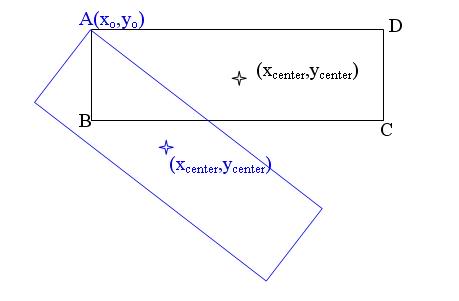
EDIT: Here is a drawing that better illustrates what I am thinking. The Blue Rectangle is the one I want to to find the vertices for. I know all information in blue.
The Black Rectangle shares the same A vertex and is in what I have DEFINED to be standard reference position (SRP).
I could find the angle of the vector that points from A to the center rc of the black rectangle and compare it with the angle of that of the blue rectangle r'c
I know that the difference [itex]\theta - \theta '[/itex] should be the angle that all vertices should carve out. I just can't see how to make the actual calculations of their cartesian coordinates?
This is NOT HOMEWORK so although I think it is possible to do, I am not sure that it is.
Any ideas?
I am thinking of using the vector that points from A to the center somehow... I know that if I double its length then I have arrived at the vertex C... but how to extract those coordinates, I cannot see.
EDIT: Here is a drawing that better illustrates what I am thinking. The Blue Rectangle is the one I want to to find the vertices for. I know all information in blue.
The Black Rectangle shares the same A vertex and is in what I have DEFINED to be standard reference position (SRP).
I could find the angle of the vector that points from A to the center rc of the black rectangle and compare it with the angle of that of the blue rectangle r'c
I know that the difference [itex]\theta - \theta '[/itex] should be the angle that all vertices should carve out. I just can't see how to make the actual calculations of their cartesian coordinates?
Last edited:
 Here is where I am at: Updated Diagram for reference: