Finding this power series -- Where is my error?

Click For Summary
The user is experiencing an issue with their math homework platform regarding a power series notation, mistakenly using ##\sim## instead of the correct ##\sum_{k=0}^\infty##. They tested their result with Desmos, which matched, but the platform requires a specific input format. The user notes that transforming their result with ##k=k'+1## would lead to a sum starting from ##-1##, contrary to the platform's requirement to start from ##0##. A participant pointed out that the first term equals zero due to a factor of ##k=0##, allowing the sum to start at zero. The user plans to contact their professor for clarification on the issue.
archaic
Messages
688
Reaction score
214
Homework Statement
Find the power series representation of $$\frac{x}{(1+13x^2)^2}$$
Relevant Equations
N/A
I have used ##\sim## but meant ##\sum_{k=0}^\infty##
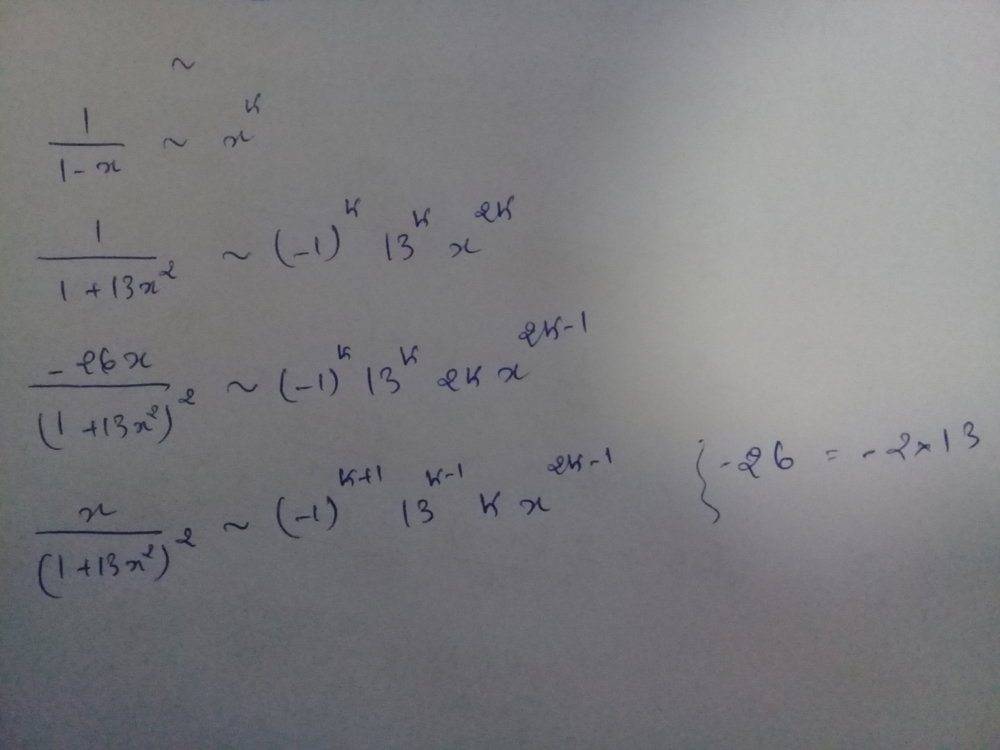
20200416_230932.jpg

my math homework platform is telling me that this is wrong. I've tried using desmos to test it and it was a perfect match. Any ideas on where I went wrong?
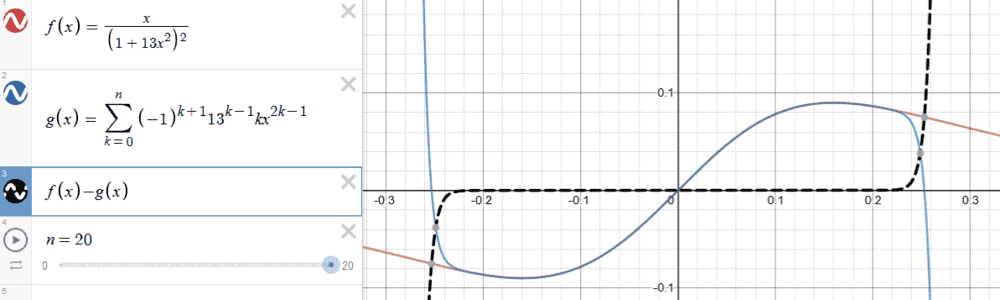
ihb.PNG
 
Last edited by a moderator:
Physics news on Phys.org
What type of input does the platform require? It is possible that it has written it on a different form and only accepts that form.
 
Orodruin said:
What type of input does the platform require? It is possible that it has written it on a different form and only accepts that form.
Capture.PNG

This is what they are giving me. If you put ##k=k'+1## in my result, then you'd get theirs, but then the sum should start from ##-1##. They have specifically asked me to have it start from ##0##, though, as is shown.
I've used power series instead of differentiating ##f(x)## because it is faster. The result should still be the same normally. I remember our professor saying something about trivial functions having unique taylor polynomials.
 
archaic said:
View attachment 260819
This is what they are giving me. If you put ##k=k'+1## in my result, then you'd get theirs, but then the sum should start from ##-1##. They have specifically asked me to have it start from ##0##, though, as is shown.
Your first term is equal to zero (it has a factor ##k = 0## in it). So even if you put ##k = k'+1## you can have your sum start at zero.
 
  • Like
Likes archaic
I've emailed my professor, maybe he'll fix it. Thank you @Orodruin I've missed the ##k## factor ^^'.
 
Question: A clock's minute hand has length 4 and its hour hand has length 3. What is the distance between the tips at the moment when it is increasing most rapidly?(Putnam Exam Question) Answer: Making assumption that both the hands moves at constant angular velocities, the answer is ## \sqrt{7} .## But don't you think this assumption is somewhat doubtful and wrong?

Similar threads

  • · Replies 2 ·
Replies
2
Views
2K
Replies
8
Views
3K
  • · Replies 17 ·
Replies
17
Views
2K
  • · Replies 11 ·
Replies
11
Views
3K
  • · Replies 9 ·
Replies
9
Views
3K
  • · Replies 1 ·
Replies
1
Views
2K
  • · Replies 2 ·
Replies
2
Views
1K
  • · Replies 7 ·
Replies
7
Views
2K
  • · Replies 4 ·
Replies
4
Views
2K
  • · Replies 3 ·
Replies
3
Views
2K