Finding where I went wrong with this anti-derivative problem

  • Thread starter Thread starter groundpilots
  • Start date Start date
Join the discussion
Registration is free. Ask a follow-up in this thread, or start your own.
3 replies · 1K views
groundpilots
Messages
2
Reaction score
0
Anti-Derivatives Please Help!

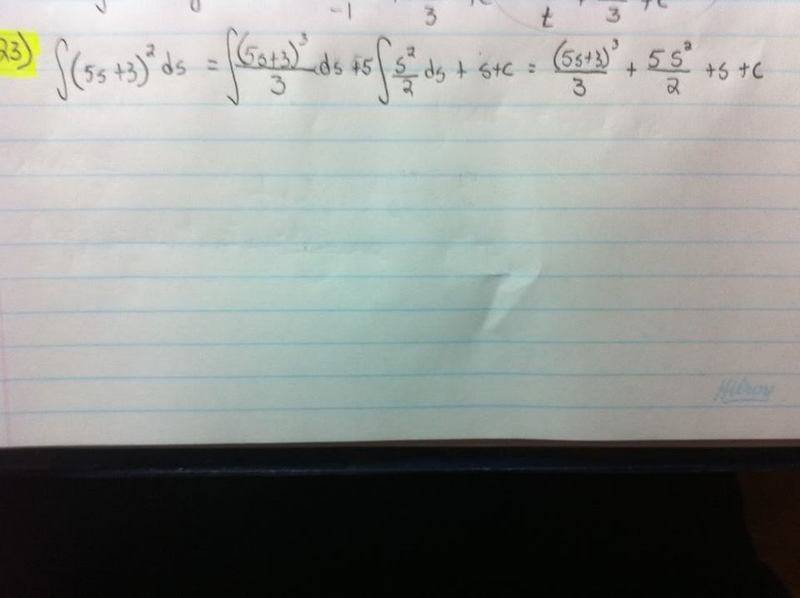
So I am having trouble understanding where I went wrong here, the question is highlighted, then it clearly states my answer, and the answer the book gave, my work is posted in the second image, care to help??
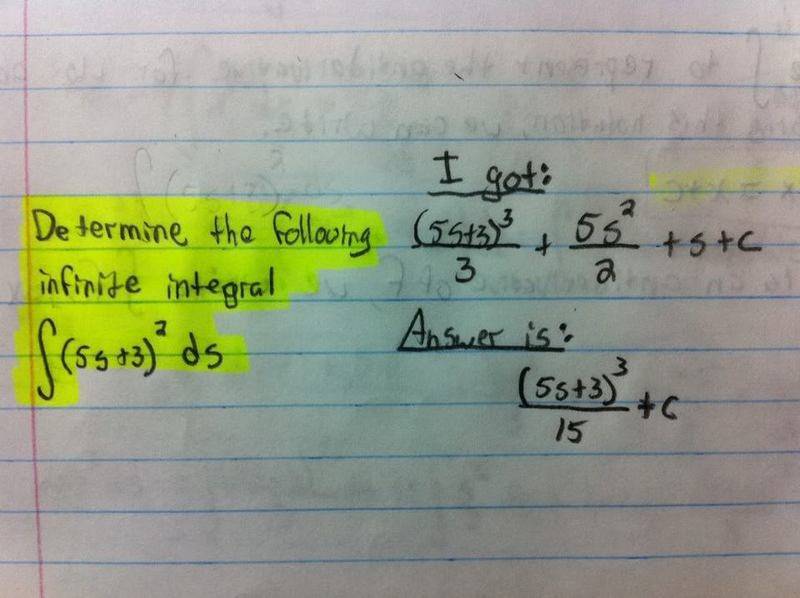
Homework Statement


193081_10150114570475418_508690417_6587379_3018337_o1.jpg


The Attempt at a Solution


191525_10150114570890418_508690417_6587380_7031413_o.jpg

 
Physics news on Phys.org


Hi groundpilots! :)

[tex]\frac{d}{ds}(a+bs)^{n+1}=(n+1)(b)(a+bs)^{n}[/tex]
<===>
[tex](a+bs)^{n+1} + c =\int(n+1)(b)(a+bs)^{n} ds[/tex]

With this can u tell me how u do the antiderivatives ?

If u notice b=5 and n=2 ...


so I tried to do the antiderivative using the formulas you gave and I still can't seem to get it...ughhhhh
here's what I tried, still not right =(

iug.jpg


[tex]\int (5s + 3)^2~ds[/tex]

Let u = 5s + 3, then du = 5ds

Using this substitution, the integral above becomes:
[tex]\frac{1}{5}\int (5s + 3)^2~5ds = \frac{1}{5}\int u^2~du[/tex]

Can you take it from here?

BTW, this is an indefinite integral, not an infinite integral.