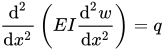
Finding Young’s modulus by bending a beam

Click For Summary
SUMMARY

The discussion focuses on determining Young's modulus using an end-loaded cantilever beam setup, referencing the Euler–Bernoulli beam theory. The participant seeks clarity on deriving the relationship between applied load and beam deflection, specifically using the equation E = (4mgl^3)/(bd^3 δ). Key recommendations include using a longer, thinner rectangular strip for improved results and ensuring a rigid holding system for accurate measurements. The discussion emphasizes the importance of proper experimental design and measurement techniques to achieve reliable results.

PREREQUISITES
  • Understanding of Euler–Bernoulli beam theory
  • Familiarity with cantilever beam setups
  • Knowledge of deflection measurement techniques
  • Basic physics concepts related to Young's modulus
NEXT STEPS
  • Research the derivation of the equation E = (4mgl^3)/(bd^3 δ)
  • Explore advanced deflection measurement methods for beams
  • Learn about experimental design principles for physics experiments
  • Investigate the effects of beam dimensions on Young's modulus calculations
USEFUL FOR

Physics students, experimental physicists, and educators involved in materials science or mechanics who are interested in accurately measuring Young's modulus through practical experiments.

Fraser MacDonald
Messages
11
Reaction score
1
I have a question regarding finding the Young’s modulus of a rod by loading a weight to the end and measuring the change in displacement.
The experiment is part of my advanced higher physics project on Young’s modulus however it is the only experiment that I’m doing that the book “Tyler” does not cover, and so I am slightly confused as to how I actually derive the relationship through this method.
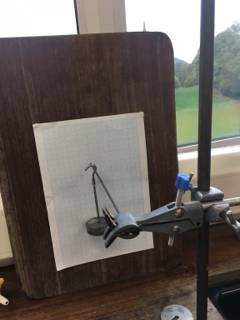
IMG_8397.JPG
IMG_8397.JPG

I know it isn’t a great set up but it’s all I can do with the equipment I have.

So my question is how do I calculate it via this method?
Thanks
 

Attachments

  • IMG_8397.JPG
    IMG_8397.JPG
    8.9 KB · Views: 5,339
Engineering news on Phys.org
Not with the set up shown though . The holding system needs to be much more rigid and the rod needs to be set horizontal .There also needs to be a more accurate deflection measurement method employed .

If you have some freedom to design this experiment properly then I suggest that you use a much longer thin rectangular strip as the test object . Clamp one end of this tightly to the edge of a solid bench and - if nothing better is available - use a metre rule to measure the deflection . The rule being held in a retort stand sitting on the floor . The much larger deflection for given loads and the improved rigidity of the set up should allow you to get better results and a reasonably accurate value for Young's modulus .
 
  • Like
Likes Fraser MacDonald
Once the experiment is set up correctly would the equation to find Young’s modulus be y=(4mgl^3)/(bd^3 δ) and if so, how do I derive this?
 
Fraser MacDonald said:
how do I derive this?
The equation you need is:

b2c4731cd266ae5023e98fd55e105409a13d51d0

Where ##E## is what you are looking for and is the only unknown in your case.

It can be derived from this equation:

5c32a9812311ffed238176820bd8c4863bcc5ae1

Both of these equations can be found in the links from my previous post and since it seems to be part of school work, I will let you do some reading to find out the meaning of the variables and the derivation. If you have questions along the way, show your work and ask a specific question.
 
IMG_8505.JPG

Is this the correct derivation?
 

Attachments

  • IMG_8505.JPG
    IMG_8505.JPG
    21 KB · Views: 4,684
The image is too blurry to read it. But if you begun with the initial equation and ended up with the last one, chances are you are correct.
 

Similar threads

  • · Replies 5 ·
Replies
5
Views
2K
Replies
2
Views
9K
  • · Replies 30 ·
2
Replies
30
Views
7K
Replies
3
Views
3K
  • · Replies 6 ·
Replies
6
Views
4K
  • · Replies 9 ·
Replies
9
Views
2K
  • · Replies 8 ·
Replies
8
Views
2K
  • · Replies 17 ·
Replies
17
Views
2K
  • · Replies 2 ·
Replies
2
Views
2K
  • · Replies 9 ·
Replies
9
Views
2K