Undergrad Finitely Generated Modules and Their Submodules ....

  • Thread starter Thread starter Math Amateur
  • Start date Start date
  • Tags Tags
    Modules
Click For Summary
SUMMARY

The discussion centers on the proof of Lemma 1.2.21 from "An Introduction to Rings and Modules With K-Theory in View" by A.J. Berrick and M.E. Keating. Participants clarify that a finitely generated module M can be expressed as M = x_0R + ... + x_sR + L, where L is a submodule of M. The existence of a minimal subset {x_0, ..., x_s} is established through the selection of the shortest representation of M. Additionally, the set S of submodules containing {x_1, ..., x_s} but not x_0 is shown to be inductive, allowing for the construction of chains within S.

PREREQUISITES
  • Understanding of finitely generated modules in algebra
  • Familiarity with submodules and their properties
  • Knowledge of induction in set theory
  • Basic concepts of ring theory as applied to modules
NEXT STEPS
  • Study the concept of finitely generated modules in more depth
  • Learn about the properties of submodules and their maximal elements
  • Explore the principles of induction in mathematical proofs
  • Investigate examples of modules over different rings, such as integers and polynomial rings
USEFUL FOR

Mathematicians, particularly those specializing in algebra, module theory, and anyone seeking to understand the structure and properties of finitely generated modules and their submodules.

Math Amateur
Gold Member
MHB
Messages
3,920
Reaction score
48
I am reading An Introduction to Rings and Modules With K-Theory in View by A.J. Berrick and M.E. Keating (B&K).

I need help with the proof of Lemma 1.2.21 ...

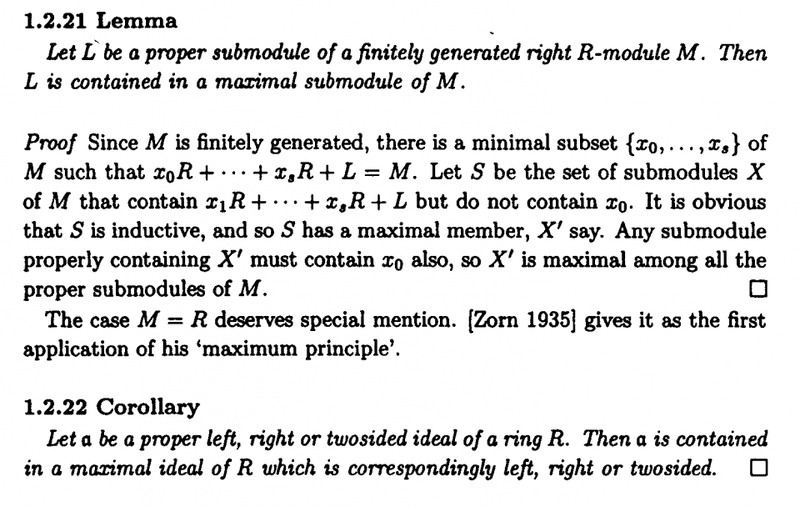
Lemma 1.2.21 and its proof reads as follows:
?temp_hash=2b03ea2a6903b537f414d9093d924e5b.png

Question 1In the above text by Berrick and Keating, we read the following:"... ... Since ##M## is finitely generated, there is a minimal subset ##\{ x_0, \ ... \ ... \ , x_s \}## of ##M## such that

##x_0 R + \ ... \ ... \ , x_s R + L = M. \ ... \ ... \ ...## "My problem is as follows:

I cannot see exactly why there exists a minimal subset ##\{ x_0, \ ... \ ... \ , x_s \}## of ##M## such that

##x_0 R + \ ... \ ... \ , x_s R + L = M##. ... ... ...Can someone please demonstrate, rigorously and formally, that there exists a minimal subset ##\{ x_0, \ ... \ ... \ , x_s \}## of ##M## such that

##x_0 R + \ ... \ ... \ , x_s R + L = M##?

Question 2In the above text by Berrick and Keating, we read the following:"... ... Let ##S## be the set of submodules ##X## of M that contain ##x_1 R + \ ... \ ... \ , x_s R + L## but do not contain ##x_0##. It is obvious that ##S## is inductive ... ...Can someone please explain exactly why ##S## is inductive ... ... ?Hope someone can help ...

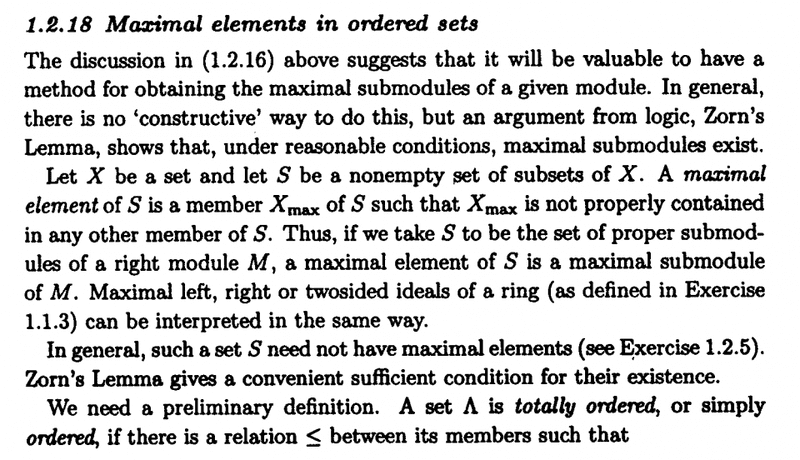
Peter========================================================================B&K's definition of "inductive" is contained in section 1.2.18 ... ... . which reads as follows:
?temp_hash=2b03ea2a6903b537f414d9093d924e5b.png

?temp_hash=2b03ea2a6903b537f414d9093d924e5b.png
 

Attachments

  • B&K - Lemma 1.2.21 ... ....png
    B&K - Lemma 1.2.21 ... ....png
    62.3 KB · Views: 776
  • B&K - 1 - 1.2.18 Maximal elements in ... ... ... PART 1 ....png
    B&K - 1 - 1.2.18 Maximal elements in ... ... ... PART 1 ....png
    70.1 KB · Views: 779
  • B&K - 2 - 1.2.18 Maximal elements in ... ... ... PART 2 ....png
    B&K - 2 - 1.2.18 Maximal elements in ... ... ... PART 2 ....png
    55.4 KB · Views: 733
Physics news on Phys.org
To your first question.

##M## is finitely generated, so it can be written ##x_0R+\dots +x_mR=M##. Furthermore ##L \subseteq M##, so ##M=x_0R +\dots +x_mR +L##. (I simply added it, not bothering about minimality or so.) This means ##M## can be written in such a way. Now chose among all possible ways to do this a shortest ## \{x_0, \dots , x_s\}##, that is with the smallest ##s## needed. It doesn't have to be unique, only with the fewest elements such that ##M=x_0R +\dots +x_sR +L##.
##m## would do, but it might not be the smallest number. However, we only have numbers ##1## to ##m##. Somewhere has to be the smallest which we call ##s##.

To the second part.

We have submodules that contain ##\{x_1 , \dots , x_s\}## and ##L##. ##S## is the set of these submodules. ##S## is partially ordered by inclusion. Either ##X \subseteq Y## or ##X \nsubseteq Y## for any two ##X,Y \in S##.
Therefore we can build chains ##X_0 \subseteq X_1 \subseteq \dots \subseteq X_n## in ##S##. The condition to belong to ##S## is to contain ##x_1, \dots , x_s## and ##L## and not ##x_0##. This is true for all ##X_i## and it is also true for ##\cup_i X_i##. Therefore ##\cup_i X_i \in S##, which is the condition to be inductive. Because we only deal with indices ##1, \dots ,s## we can take ##\Lambda =\{1, \dots ,s\}## as ordered index set.
 
  • Like
Likes Math Amateur
fresh_42 said:
To your first question.

##M## is finitely generated, so it can be written ##x_0R+\dots +x_mR=M##. Furthermore ##L \subseteq M##, so ##M=x_0R +\dots +x_mR +L##. (I simply added it, not bothering about minimality or so.) This means ##M## can be written in such a way. Now chose among all possible ways to do this a shortest ## \{x_0, \dots , x_s\}##, that is with the smallest ##s## needed. It doesn't have to be unique, only with the fewest elements such that ##M=x_0R +\dots +x_sR +L##.
##m## would do, but it might not be the smallest number. However, we only have numbers ##1## to ##m##. Somewhere has to be the smallest which we call ##s##.

To the second part.

We have submodules that contain ##\{x_1 , \dots , x_s\}## and ##L##. ##S## is the set of these submodules. ##S## is partially ordered by inclusion. Either ##X \subseteq Y## or ##X \nsubseteq Y## for any two ##X,Y \in S##.
Therefore we can build chains ##X_0 \subseteq X_1 \subseteq \dots \subseteq X_n## in ##S##. The condition to belong to ##S## is to contain ##x_1, \dots , x_s## and ##L## and not ##x_0##. This is true for all ##X_i## and it is also true for ##\cup_i X_i##. Therefore ##\cup_i X_i \in S##, which is the condition to be inductive. Because we only deal with indices ##1, \dots ,s## we can take ##\Lambda =\{1, \dots ,s\}## as ordered index set.
Thanks for the reply, fresh_42 ... ... but i do not follow you when you write:

"... ... ##M## is finitely generated, so it can be written ##x_0R+\dots +x_mR=M##. Furthermore ##L \subseteq M##, so ##M=x_0R +\dots +x_mR +L##. ... ...Why is this true ... ?

Specifically, how, exactly, do we get from ##L \subseteq M## to the conclusion that ##M=x_0R +\dots +x_mR +L## ... how do we justify this ...

Peter
 
Math Amateur said:
Thanks for the reply, fresh_42 ... ... but i do not follow you when you write:

"... ... ##M## is finitely generated, so it can be written ##x_0R+\dots +x_mR=M##. Furthermore ##L \subseteq M##, so ##M=x_0R +\dots +x_mR +L##. ... ...Why is this true ... ?

Peter
What does it mean that ##M## is finitely generated?
 
##M## is finitely generated if we have ##M = x_0 R + x_1 R + \ ... \ ... \ + x_m R## for some finite set ##X = \{ x_0, x_1, \ ... \ ... \, x_m \}##

Peter
 
Math Amateur said:
##M## is finitely generated if we have ##M = x_0 R + x_1 R + \ ... \ ... \ + x_m R## for some finite set ##X = \{ x_0, x_1, \ ... \ ... \, x_m \}##

Peter
Yes, so ##M = x_0 R + x_1 R + \ ... \ ... \ + x_m R## and ##L## is a submodule of ##M##.
So ##L \subseteq M = x_0 R + x_1 R + \ ... \ ... \ + x_m R## and ##M=M+L= x_0 R + x_1 R + \ ... \ ... \ + x_m R+L##.

The crucial point here is ##M=M+L##, which is true because
a) ##M \subseteq M+L##
b) ##L \subseteq M \, \wedge \, M \subseteq M \, \Rightarrow \, M+L \subseteq M## since ##M## is closed under addition. You can't escape ##M## by addition.

Edit: A simple example is ## R=\mathbb{Z}\, , \,M=6\mathbb{Z}\, , \,L=36\mathbb{Z}##. What is a maximal submodule of ##M=6\mathbb{Z}## that isn't ##M## itself and contains ##L=36\mathbb{Z}##? And is there only one maximal submodule?
 
Last edited:
  • Like
Likes Math Amateur
fresh_42 said:
Yes, so ##M = x_0 R + x_1 R + \ ... \ ... \ + x_m R## and ##L## is a submodule of ##M##.
So ##L \subseteq M = x_0 R + x_1 R + \ ... \ ... \ + x_m R## and ##M=M+L= x_0 R + x_1 R + \ ... \ ... \ + x_m R+L##.

The crucial point here is ##M=M+L##, which is true because
a) ##M \subseteq M+L##
b) ##L \subseteq M \, \wedge \, M \subseteq M \, \Rightarrow \, M+L \subseteq M## since ##M## is closed under addition. You can't escape ##M## by addition.

Edit: A simple example is ## R=\mathbb{Z}\, , \,M=6\mathbb{Z}\, , \,L=36\mathbb{Z}##. What is a maximal submodule of ##M=6\mathbb{Z}## that isn't ##M## itself and contains ##L=36\mathbb{Z}##? And is there only one maximal submodule?
Thanks again, fresh_42 ... ...

You write: "" ... ... The crucial point here is ##M=M+L## ... ...

Indeed that is crucial ... ... would not have guessed that ...

Now, catching on to your thoughts ... but just a quick question ...

You write:

"... ... ##L \subseteq M \, \wedge \, M \subseteq M## ... ...

what do you mean by ## M \, \wedge \, M## ... ?

Peter
 
Math Amateur said:
"... ... ##L \subseteq M \, \wedge \, M \subseteq M ... ...##

what do you mean by ##M \, \wedge \, M## ... ?
No, the ## \wedge ## isn't prior to ##\subseteq##.
It is a logical symbol and stands for ##\text{ and } ##.

So it reads ##(L \subseteq M) \, \text{ and } \, (M \subseteq M) \, \Longrightarrow \, (L+M) \subseteq M##.

(For the record: ## \vee## stands for the logical ##\text{ or }##. The similarity to ##\cap## and ##\cup## isn't accidental.)
 
  • Like
Likes Math Amateur
Thanks for your help fresh_42 ... I doubt I would have understood this issue without your help ...

Most grateful ...

Peter
 
  • #10
Math Amateur said:
Thanks for your help fresh_42 ... I doubt I would have understood this issue without your help ...

Most grateful ...

Peter
You're welcome, Peter!
But have a thought or two on my example:
##R=\mathbb{Z}\, , \,M=6\mathbb{Z}\, , \,L=36\mathbb{Z}##.
What is a maximal submodule of ##M=6\mathbb{Z}## that (isn't ##M## itself and) contains ##L=36\mathbb{Z}##?
And is there only one maximal submodule?
 
  • #11
Hi fresh_42 ...

I have to confess that I have no idea how to, formally and rigorously determine the maximal submodule of ##6 \mathbb{Z}## ... but intuitively it seems that the maximal submodule would be ##N = 12 \mathbb{Z}## ... is that correct ...?

How would you go about formally and rigorously determining the maximal submodule of ##6 \mathbb{Z}## ... ?

Peter
 
  • #12
Math Amateur said:
Hi fresh_42 ...

I have to confess that I have no idea how to, formally and rigorously determine the maximal submodule of ##6 \mathbb{Z}## ... but intuitively it seems that the maximal submodule would be ##N = 12 \mathbb{Z}## ... is that correct ...?

How would you go about formally and rigorously determining the maximal submodule of ##6 \mathbb{Z}## ... ?

Peter
It is about the maximal submodules, that contain ##L##.
Since each element of ##M=6\mathbb{Z}## is a multiple of six, submodules can also only contain multiples of six. Starting with six, we get ##M##. So other multiples, like ##N=12\mathbb{Z}## are proper submodules. And ##N## contains ##L=36\mathbb{Z}##, that is also correct, since multiples of ##36## are also multiples of ##12##. But there is another proper submodule, ##N'##, which also contains ##L##. And it is maximal, too. It should show you, that maximal submodules of ##M## which contain ##L## don't need to be unique.

Maximality (of ## N##) in general is shown by the pattern ##N \subseteq P \subseteq M \, \Longrightarrow \, P=N \text{ or } P=M## that is nothing fits between a maximal element and the entire module. In the case of integers it is quite simple because one must only deal with multiples and divisors and all can be generated by only one element.
 
  • Like
Likes Math Amateur
  • #13
Thanks for the helpful example fresh_42 ...

I suspect that the other maximal submodule of ##M## containing ##L## is ##18 \mathbb{Z}## ... is that correct?

Peter
 
  • Like
Likes fresh_42
  • #14
Math Amateur said:
Thanks for the helpful example fresh_42 ...

I suspect that the other maximal submodule of ##M## containing ##L## is ##18 \mathbb{Z}## ... is that correct?

Peter
You get for each prime number ##p## a maximal submodule ##6p\mathbb{Z} \subseteq 6\mathbb{Z}##. Of course only ##p\in\{2,3\}## contain ##L=36\mathbb{Z}## because all other primes don't contribute to the second ##6## which is needed for ##36##.
 
  • Like
Likes Math Amateur

Similar threads

Replies
2
Views
1K
  • · Replies 5 ·
Replies
5
Views
2K
  • · Replies 1 ·
Replies
1
Views
1K
  • · Replies 4 ·
Replies
4
Views
2K
Replies
2
Views
1K
  • · Replies 3 ·
Replies
3
Views
1K
  • · Replies 12 ·
Replies
12
Views
3K
  • · Replies 3 ·
Replies
3
Views
3K
  • · Replies 2 ·
Replies
2
Views
2K
  • · Replies 5 ·
Replies
5
Views
2K