davidwinth
- 108
- 10
- TL;DR
- I have experimental data but I think I must account for losses
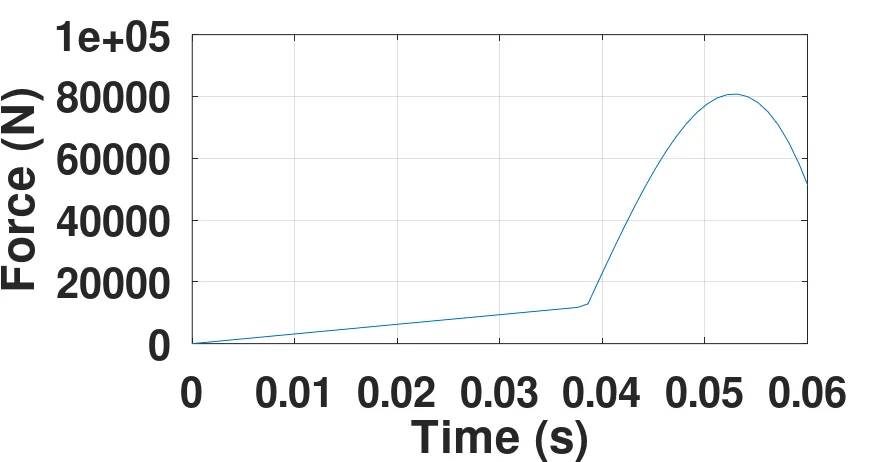
I have some experimental data of a force recording through transducer vs time. The data has a 10000 kg mass hitting a wall. By looking at the data, it seems clear I can treat the impact as two springs in series where the weaker one stops compressing after a certain point. The problem is that no combination of springs in my models fit this data. If I make the springs stiffer, the force is too large. If I make the springs softer, they take to long to stop the object. Matching max force in time is the issue.
The situation makes me think there are losses along the way, but I am not sure how to model them. Does anyone have any input on how to approach this? Thanks.
The situation makes me think there are losses along the way, but I am not sure how to model them. Does anyone have any input on how to approach this? Thanks.