Flooding in Nepal - Glacier Collapse

  • Thread starter Thread starter Point Conception
  • Start date Start date
  • Tags Tags
    flooding in nepal
Join the discussion
Registration is free. Ask a follow-up in this thread, or start your own.
8 replies · 437 views
Point Conception
Gold Member
Messages
1,176
Reaction score
1,942
TL;DR
Hundreds of Trekkers Missing in Nepal Flooding
https://www.yahoo.com/news/world/articles/foreign-tourists-missing-nepals-flash-155744585.html.
Screenshot_20260827_083401_Google.webp
Screenshot_20260827_083446_Google.webp
Screenshot_20260827_083459_Google.webp
 
Reply
  • Informative
  • Sad
  • Like
Likes   Reactions: sbrothy, 256bits, Borg and 1 other person
Earth sciences news on Phys.org
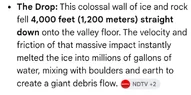
You might want to factual check for sensationalism in this one paragraph:

1787830670760.webp


Equations
1. Potential Energy of 1 kg of water at height
E = m g h --> mass 1 kg, g = 9.81 m/s/s, h = 1200 m ( Assuming 1200m as height, and not glacial path length )
E = 11.8 kJ

Temperature rise of 1 kg water from heat addition Q
dt = Q / ( m Cp ) Q = 11.8 kJ, , = 1 kg, Cp = 4.2kJ / ( kg C )
dt = 2.8 C


Edit:
dt = Q / ( m Cp ) Q = 11.8 kJ, , = 1 kg, Cp = 2.050 kJ / ( kg C )
dt = 5.76 C


I would take the 2.8 C 5.76 C temperature increase due to conversion of potential energy to heat energy to mean that the chunk of glacier ice had already approached melting temperature, lost its cohesive strength and broke away, travelled down the glacial valley on the incline ( not straight down ) and completely liquified into a slush ( ie disintegrated into a mixture of ice particles and water ) during decent.

Reaching warmer temperatures along the path 50 km further down the valley, all of the slush would become water.
 

Attachments

  • 1787830647545.webp
    1787830647545.webp
    39.1 KB · Views: 1
Last edited:
Point Conception said:
If the mass of the glacier that fell is estimated to be 5 000 000 000 kg from 1200 m then v =153 m/s. And with KE = 1/2 mv^2 . joules at impact= 58x10^9. The phase change from ice to water=334000 joules. So only about 173,653 kg of ice converted to water at impact.
Right. I incorrectly used the Cp for change in degree for water, instead of that for ice.

Equations
1. Potential Energy of 1 kg of water at height
E = m g h --> mass 1 kg, g = 9.81 m/s/s, h = 1200 m ( Assuming 1200m as height, and not glacial path length )
E = 11.8 kJ

Temperature rise of 1 kg water from heat addition Q
dt = Q / ( m Cp ) Q = 11.8 kJ, , = 1 kg, Cp = 2.050 kJ / ( kg C )
dt = 5.76 C

The chunk of ice would have risen in temperature of 5.76 degrees C from the drop.

And then there is the phase change to water, as you have expressed.

Post #3 edited
 
Reply
  • Like
Likes   Reactions: BillTre
Some discussion from Jakob Steiner, a geoscientist at the University of Graz in Austria
and Glaciologist Simon Cook, University of Dundee, Scotland.


Satellite image at the 1:42 mark.
 
Some video of the deluge. Viewer beware.
( I find she babbles a bit much, but that's just me, 229 subscribers she has )


1. Question of where all the water came from.
2. Blocked lake upriver posing a risk of secondary water cascade
3. Seismic recordings were that of the deluge ( not an earthquake in the normal sense )