M7.8 offshore southern Mindanao, Phillipines

  • Thread starter Thread starter davenn
  • Start date Start date
Click For Summary

SUMMARY

The M7.8 earthquake occurred offshore 26 km southwest of Kablalan, Philippines, at a depth of 55.2 km on June 7, 2026, marking the strongest seismic event in the region this year. Multiple significant aftershocks followed, including magnitudes 6.5 and 6.0 at varying depths near Balangonan and Pangyan. The Philippine Institute of Volcanology and Seismology (Phivolcs) reported over 6,000 aftershocks and documented a coastal uplift of approximately 2 meters, extending shorelines by up to 200 meters due to movement along the Cotabato Trench. The earthquake caused severe damage, resulting in 61 fatalities, hundreds injured, thousands of collapsed structures, and displacement of about 20,000 people. Historical context links the Cotabato Trench to the devastating 1976 Moro Gulf earthquake and tsunami, emphasizing the region's seismic vulnerability.

PREREQUISITES

  • Seismology and earthquake magnitude scales (Moment Magnitude Scale)
  • Geological concepts of coastal uplift and tectonic trench dynamics
  • Philippine Sea Plate tectonics and regional fault systems
  • Use of seismic monitoring tools such as high gain and low gain sensors

NEXT STEPS

  • Study the Cotabato Trench tectonic behavior and its seismic history
  • Analyze aftershock patterns using USGS earthquake event pages and Phivolcs data
  • Research coastal uplift impacts on marine ecosystems and shoreline morphology
  • Review disaster response and structural resilience in earthquake-prone regions of the Philippines

USEFUL FOR

Seismologists, geologists, disaster management professionals, and regional planners focused on earthquake risk assessment and mitigation in the Philippines and similar tectonically active zones.

davenn
Science Advisor
Gold Member
Messages
9,729
Reaction score
11,859
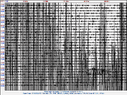
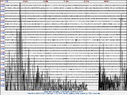
Off my Sydney seismo this morning ......

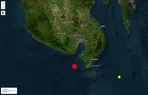
M 7.8 - 26 km SW of Kablalan, Philippines​

    • 2026-06-07 23:37:41 (UTC)
    • 5.592°N 125.047°E
    • 55.2 km depth
High gain and low gain sensors
 

Attachments

  • 260607 2337UT M7.8 offshr sthrn tip of Mindanao zhi.gif
    260607 2337UT M7.8 offshr sthrn tip of Mindanao zhi.gif
    264.2 KB · Views: 3
  • 260607 2337UT M7.8 offshr sthrn tip of Mindanao zlo1.gif
    260607 2337UT M7.8 offshr sthrn tip of Mindanao zlo1.gif
    188 KB · Views: 5
  • 20260607 2337UT M7.8  ofshr sthrn tip of Mindanao, Phils1.webp
    20260607 2337UT M7.8 ofshr sthrn tip of Mindanao, Phils1.webp
    38.3 KB · Views: 2
  • 20260607 2337UT M7.8  ofshr sthrn tip of Mindanao, Phils2.webp
    20260607 2337UT M7.8 ofshr sthrn tip of Mindanao, Phils2.webp
    62.3 KB · Views: 6
  • Like
Likes   Reactions: BillTre and Astronuc
Earth sciences news on Phys.org
davenn said:
55.2 km depth
Fortunately, moderately deep.
https://earthquake.usgs.gov/earthquakes/eventpage/us7000srb1/executive

A 6.5 Mag aftershock in the same region at a greater depth
https://earthquake.usgs.gov/earthquakes/eventpage/us7000srcg/executive

M 6.5 - 19 km SW of Balangonan, Philippines​

  • 2026-06-08 00:55:12 (UTC)
  • 5.472°N 125.205°E
  • 65.6 km depth
A 6.0 Mag aftershock on land
https://earthquake.usgs.gov/earthquakes/eventpage/us7000src3/executive

M 6.0 - 4 km ENE of Pangyan, Philippines​

  • 2026-06-07 23:49:13 (UTC)
  • 5.715°N 125.320°E
  • 35.0 km depth
https://earthquake.usgs.gov/earthquakes/eventpage/us7000srbe/executive

M 6.0 - 16 km WSW of Balangonan, Philippines​

(close to the 6.5 Mag site)
  • 2026-06-07 23:48:11 (UTC)
  • 5.522°N 125.210°E
  • 81.8 km depth
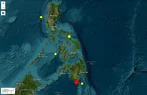
All quakes on land or off the coast of the southern tip of Mindanao Island, Philippines.
 
  • Like
Likes   Reactions: davenn
The Mag 7.8 earthquake was the strongest so far this year. I heard some discussion of the geological consequences yesterday on a BBC broadcast.

Over 6,000 aftershocks have been recorded following the massive quake as of 11am local time, the Philippine Institute of Volcanology and Seismology (Phivolcs) said on Monday.
. . . .

Residents reported a geological phenomenon known as “coastal uplift” after the quake, with the shoreline extending by as much as 200 metres in many places.

During the earthquake, the Cotabato trench off the southwestern coast of Philippines “pushed part of the coastlines of Sarangani and Davao [provinces]” and exposed the seabed that was originally submerged, Phivolcs said.

The seabed uplift has been estimated to be about 2 metres.

“Preliminary field observations indicate approximately 2 metres of coastal uplift and about 200 metres of shoreline retreat,” Phivolcs said.

In several regions, “formerly submerged corals are now exposed”, the agency said, adding that coastal landslides were also observed between the municipalities of Barangays Burias and Glan in Sarangani.

Images released by Phivolcs show large numbers of corals, seagrass, dead fish and other aquatic life on the exposed seafloor.
https://www.the-independent.com/new...eabed-raise-shoreline-extension-b2995719.html

The Independent reports that 61 people were killed and injuring hundreds. Other media report thousands of structures collapsed or severely damaged, and about 20,000 people are displaced.

Movement of the Cotabato Trench also caused the 1976 Moro Gulf earthquake and tsunami, which killed 8,000 people.

Seismic activity along the boundaries of the Philippine Sea Plate has produced seven major earthquakes of magnitude greater than 8, and 250 large ones of over 7 magnitude, as well as a number of tsunami-generating events, according to the US Geological Survey.
 
  • Like
Likes   Reactions: davenn and BillTre

Similar threads

  • · Replies 5 ·
Replies
5
Views
2K
  • · Replies 4 ·
Replies
4
Views
4K
Replies
0
Views
2K
  • · Replies 2 ·
Replies
2
Views
3K
  • · Replies 1 ·
Replies
1
Views
2K
  • · Replies 5 ·
Replies
5
Views
4K
  • · Replies 4 ·
Replies
4
Views
4K
  • · Replies 3 ·
Replies
3
Views
6K
  • · Replies 7 ·
Replies
7
Views
8K