Understanding Backpressure Effects on Flow Meter Calibration

Click For Summary
SUMMARY

This discussion centers on the effects of backpressure on flow meter calibration, specifically in a setup involving a flow meter with upstream and downstream pressure measurements (P1 and P2). The calibration process utilizes hot-wire anemometry to determine mass flow rates at varying pressure differentials (ΔP). It is established that backpressure from downstream resistance alters the relationship between ΔP and mass flow rate (m-dot), indicating that m-dot is not solely determined by P1-P2 when backpressure is present. The conversation emphasizes the importance of understanding flow dynamics, particularly in turbulent conditions, to accurately interpret calibration data.

PREREQUISITES
  • Understanding of flow meter calibration techniques
  • Knowledge of hot-wire anemometry for velocity measurement
  • Familiarity with pressure differential concepts (ΔP)
  • Basic principles of fluid dynamics, particularly turbulent flow
NEXT STEPS
  • Research the impact of backpressure on flow meter accuracy and calibration
  • Study the ideal gas law and its application in flow measurement
  • Explore the relationship between pressure drop and flow rate in turbulent vs. laminar flow
  • Examine calibration fitting techniques using empirical data, such as the equation Q = K * (ΔP / ρ)^0.5
USEFUL FOR

Engineers, researchers, and technicians involved in fluid dynamics, flow measurement, and calibration processes, particularly those working with turbulent flow systems and backpressure effects.

ca2n
Messages
10
Reaction score
0
Hello all,

I have an in-house designed flow meter with roughly the configuration in the figure. In the setup, a restriction is placed in the flow stream (the rows of horizontal lines in the figure). Pressure measurements upstream and downstream of the restriction, P1 and P2, respectively are continuously monitored.

For calibration (determining the relationship between P1-P2 and the mass flow rate), the air flowing through the system is supplied to a nozzle with a flow straightener upstream of the nozzle exit. Velocity measurements with hot-wire anemometry allows me to calculate the mass flow rate at the exit of the nozzle at discrete P1-P2 values.
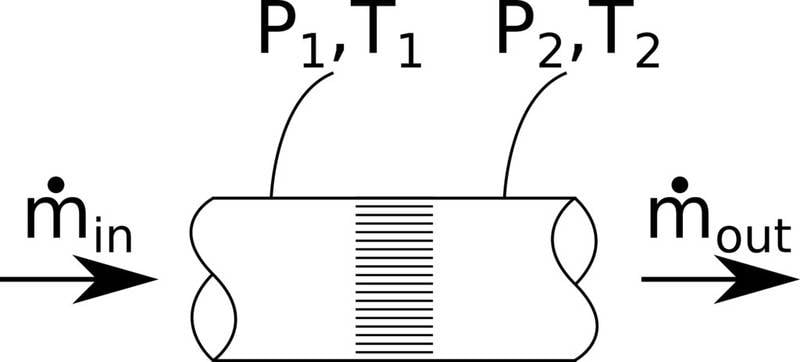
38159109296_00225e9f7e_b.jpg


So that's how far the calibration goes. Now on to how it's used in experiments.

For some of the experiments that I am conducting there can be a rather significant resistance in the flow (a filter). The backpressure created by this resistance is monitored by a pressure gauge mounted just upstream of P1 and may reach up to 1 bar (gauge). I am uncertain as to how this backpressure affects the flowmeter calibration. For example:

Let's say from the flow meter calibration, a mass flow rate, m-dota is provided by P1-P2 = Pa.

If a resistance is fitted downstream, causing backpressure, is m-dota still provided by Pa?

Thank you in advanced for any response.
 

Attachments

  • 38159109296_00225e9f7e_b.jpg
    38159109296_00225e9f7e_b.jpg
    16.7 KB · Views: 991
Engineering news on Phys.org
I think that if the difference ΔP is the same, the m-dota will almost be the same.

In your case, practically the volumetric flow (Q) depends only on the square root of ΔP. If the density does not change significantly, then the mass flow (m-dota), which equals (density)x(volumetric flow), will be the same.
 
DoItForYourself said:
If the density does not change significantly
For an ideal gas the density doubles when the pressure goes from 1 Bar to 2 Bar...

You have some ##\Delta p## that follows from ##c_d {1\over 2} \rho v^2 ## so you can bet that ##\Delta p(\dot m)## is a different function at different ##p## !
 
I agree with you, the function Δp(m) is not the same at different pressure.

But in the case of bigger pressures (for example from 20 to 21 bars), the difference is not so big.
 
OP is talking about 1 - 2 Bar for the pressure upstream of some filter if I am not mistaken.

If the gas is ideal enough, the ##\ \Delta p = c_d {1\over 2} \rho v^2\ ## can be worked around using the ideal gas law ##\ \rho = {pM\over RT}\ ## and ##\ v ={ \dot m\over \rho A\ }## leaving something like ##p\,\Delta p \approx {\rm constant} \times\dot m^2##
 
Does the flowmeter have turbulent flow, where the pressure drop is proportional to velocity squared? Or is it laminar, where the pressure drop is proportional to velocity?
 
JRMichler said:
Does the flowmeter have turbulent flow, where the pressure drop is proportional to velocity squared? Or is it laminar, where the pressure drop is proportional to velocity?

The flow is turbulent.
 
ca2n said:
The flow is turbulent.
yes. Perhaps you can find some guidance on the site of a flowmeter company like Brooks. Working principle is a little different but calulations are similar.
 
Since you have calibration data, you can fit your data to the following equation: Q = K * (delta P / rho)^0.5, where:
Q is volume flow rate
K is a least squares fit to your test data
Delta P is P1 - P2
rho is the fluid density

Get the density of air from a psychrometric chart. If your flowmeter operates with P2/P1 greater than 0.99, you can ignore the effects of compressibility. A good source on this is Measurement Systems Application and Design, by Doebelin.
 
  • #10
Thank you all for the responses. You have been very helpful.

I would like to go back to the original question, if I may:

ca2n said:
If a resistance is fitted downstream, causing backpressure, is ##\dot{m}_a## still provided by ##P_a##?

I will continue to look deeper into the physics, but is it safe to consider at this point that the answer is no?
 
  • #11
ca2n said:
m-dota still provided by Pa?
No it is not. If that isn't clear from the answers you received, you should seek some assistance with a person who understands these answers.
 
Last edited:
  • Like
Likes   Reactions: JRMichler

Similar threads

  • · Replies 2 ·
Replies
2
Views
3K
  • · Replies 3 ·
Replies
3
Views
4K
  • · Replies 3 ·
Replies
3
Views
2K
Replies
1
Views
3K
Replies
1
Views
2K
  • · Replies 1 ·
Replies
1
Views
2K
Replies
1
Views
2K
  • · Replies 3 ·
Replies
3
Views
6K
  • · Replies 3 ·
Replies
3
Views
6K
Replies
3
Views
2K