Flowrate through an elliptical cross section of an oblique liquid jet

  • Thread starter Thread starter rdemyan
  • Start date Start date
  • Tags Tags
    flow cross section
Click For Summary
SUMMARY

The discussion focuses on analyzing the flowrate through an elliptical cross-section of an oblique liquid jet, specifically at an angle denoted as ##\beta##. The participant confirms that the flowrate, represented by the equation $$Q = \pi R^2u_j$$ for a circular cross-section, remains consistent when transitioning to an elliptical cross-section, leading to the derived equation $$\int_0^{2\pi} {p^2} \,d\phi = \frac{2 \pi R^2}{\sin\beta}$$. The conversation also touches on the implications of velocity profiles in the context of stagnation and separation points, emphasizing the need for accurate modeling in computational fluid dynamics (CFD) studies of impinging jets.

PREREQUISITES
  • Understanding of fluid dynamics principles, particularly flowrate equations.
  • Familiarity with elliptical and circular cross-sections in fluid flow analysis.
  • Knowledge of LaTeX for mathematical representation.
  • Basic concepts of computational fluid dynamics (CFD) related to jet impingement.
NEXT STEPS
  • Explore the derivation of flowrate equations for elliptical cross-sections in fluid dynamics.
  • Learn about the implications of stagnation and separation points in jet flows.
  • Investigate the use of CFD tools for modeling impinging jets and their resulting flow patterns.
  • Research the effects of velocity profiles on mass flowrate in different cross-sectional geometries.
USEFUL FOR

Fluid dynamics engineers, researchers in computational fluid dynamics, and anyone involved in the analysis of liquid jet behavior and impingement phenomena.

rdemyan
Messages
67
Reaction score
4
TL;DR
Determine the flowrate through an elliptical cross section of an oblique liquid jet. This is different than the typical method of determining the flowrate through a circular cross section normal to the direction of flow.
I'm trying to solve a problem of a liquid jet impinging at an oblique angle, ##\beta##. This post only involves a portion of that problem. I'm thinking that I should look at the flow within the jet based on an elliptical cross section of the jet that is coplaner with the x-z axis (see attached Fig. a). Fig. b is a top detailed view of the elliptical cross section through the jet. Now, this is different from the typical way of looking at the flow through a cylindrical jet which is based on the circular cross section that is normal to the direction of flow. Based on the typical method the flow rate is given by

$$Q = \pi R^2u_j$$

First, I want to confirm that if I change to the elliptical cross section, the flow rate Q remains the same. I can't see how it wouldn't, but I just want to confirm.

Then, based on a separation point, M, in the elliptical cross section (which corresponds to a stagnation point where the jet strikes a horizontal surface), the flowrate would be given by the following equation,

$$Q =\int_0^{2\pi} \frac{p^2}{2}u_j\sin\beta \, d\phi$$

Now plugging in Eq. 1 for Q yields

$$\int_0^{2\pi} \frac{p^2}{2}u_j\sin\beta \,d\phi = \pi R^2u_j$$

or finally,

$$\int_0^{2\pi} {p^2} \,d\phi = \frac{2 \pi R^2}{\sin\beta}$$

Am I looking at this correctly?

BTW: The preview button doesn't seem to render the latex. The only way I could check to see if I entered the latex correctly is to submit the post. Is there a way that I can check my latex before submitting the post?

oblique jet flowrate diagram.webp
 
Last edited:
Engineering news on Phys.org
rdemyan said:
BTW: The preview button doesn't seem to render the latex. The only way I could check to see if I entered the latex correctly is to submit the post. Is there a way that I can check my latex before submitting the post?
We have been dealing with LaTeX issues since the software update yesterday. Check out the update thread in the Feedback forum for more information. In the mean time...

If you have trouble using the Preview feature to check your LaTeX, you can use a website such as https://mathb.in/ or https://latexeditor.lagrida.com/ to preview your LaTeX before you post it.
 
Apply continuity for a control volume:

$$ 0 = \frac{d}{dt} \int_{cv} \rho~ dV\llap{-} + \int_{cs} \rho ( \boldsymbol {u} \cdot d \boldsymbol {A} ) $$

So what is the velocity distribution over the elliptical area portions and what is its direction?
 
The velocity profile for the jet, with respect to the circular cross sectional area normal to flow, is flat (i.e. no variation with radius within the jet; same velocity everywhere in the direction of flow). In Figure b, the flow is going into the hatched slit so it is flowing in the y direction; hence the need for sin\beta. I guess, in that direction the velocity would also be constant everywhere within the slit even if the slit is swept out to be the entire ellipse.
 
rdemyan said:
The velocity profile for the jet, with respect to the circular cross sectional area normal to flow, is flat (i.e. no variation with radius within the jet; same velocity everywhere in the direction of flow). In Figure b, the flow is going into the hatched slit so it is flowing in the y direction; hence the need for sin\beta. I guess, in that direction the velocity would also be constant everywhere within the slit even if the slit is swept out to be the entire ellipse.
If you are saying it's a uniform velocity distribution like shown:

1746488076946.webp


It will work out to be through that surface:

$$ \dot m_{out} = \int \rho \left( \boldsymbol {u} \cdot d \boldsymbol {A} \right) = \int \rho \left( u \sin \theta \boldsymbol {i} + u \cos \theta \boldsymbol {j} \right) \cdot \left( 0 \boldsymbol {i} + 1\boldsymbol {j} \right) dA = u \cos \theta \int \rho ~dA $$

for constant density ##\rho## it just ## \dot m_{out} = \rho u \pi R^2##.

If you are splitting it up at ##M## it will get whatever mass fraction you decide based on your arbitrary(at this point) choice of ##M## and the boundary of the division.
 
Last edited:
  • Like
Likes   Reactions: berkeman
So, if I understand you correctly, what you have shown with your diagram and equations is that the mass flowrate through the elliptical cross section is the same as the mass flowrate through the circular cross section normal to flow. I "tentatively" stated that in my problem statement, but you have shown it to be true. Is there any other information regarding my question that I should have learned from your response?
 
rdemyan said:
So, if I understand you correctly, what you have shown with your diagram and equations is that the mass flowrate through the elliptical cross section is the same as the mass flowrate through the circular cross section normal to flow. I "tentatively" stated that in my problem statement, but you have shown it to be true. Is there any other information regarding my question that I should have learned from your response?
If ##M## were a stagnation point, there has to be a velocity gradient surrounding it (by definition). So if you are planning on being consistent, better figure that out.
 
erobz said:
If ##M## were a stagnation point, there has to be a velocity gradient surrounding it (by definition). So if you are planning on being consistent, better figure that out.
Well, "M" is in a cross section of the jet before it impinges so it can't be a stagnation point and is instead referred to as a separation point. However, your point is well taken because I do want to project that ellipse downwards and have that be the elliptical plane of symmetry of the impingement zone (now I am talking about two equal jets impinging upon one another as opposed to a single jet impinging upon a horizontal surface; see the attached diagram). In that case, M becomes a stagnation point and lies within the plane of symmetry of the impingement zone (i.e. the plane of symmetry bisects the impingement zone in half). The impingement of two equal jets causes a liquid sheet to form and the stagnation point is considered to be the origin of that sheet. In general, the velocity in the sheet is considered to be constant and equal to the jet velocity IF the jet velocity is uniform throughout the jet (which is the assumption I am making).

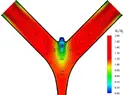
I've attached a diagram from a CFD study of two equal jets impinging to form a sheet. The diagram assumes parabolic velocity profiles in the jets prior to impingement whereas I am assuming flat profiles. However, the diagram shows that at the stagnation point (zone) the sheet velocity ##u_s## is effectively zero, but then accelerates to about the mean jet velocity (##u_j##) by the time the liquid reaches the end of the impingement zone.
 

Attachments

  • Velocity deceleration around stagnation point.webp
    Velocity deceleration around stagnation point.webp
    44.6 KB · Views: 35
  • Like
Likes   Reactions: erobz
rdemyan said:
I've attached a diagram from a CFD study of two equal jets impinging to form a sheet. The diagram assumes parabolic velocity profiles in the jets prior to impingement whereas I am assuming flat profiles. However, the diagram shows that at the stagnation point (zone) the sheet velocity ##u_s## is effectively zero, but then accelerates to about the mean jet velocity (##u_j##) by the time the liquid reaches the end of the impingement zone.
The impinging jets are coming down, the main outgoing jet appears to be accelerating (it appears to be converging under constant pressure), is this oriented vertically? The other outflow, (moving upward in this picture) is a sheet? Are you trying to find an analytical solution that predicts this for fun?
 
  • #10
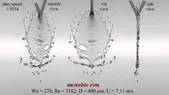
The CFD diagram is rotated 90 degrees from the diagram that I showed. What I showed is a horizontal plate and if the CFD diagram had a plate it would be vertical. The outgoing stream is actually a sheet that has approximately an elliptical shape. Here's a snapshot of an animation of two equal impinging jets producing a sheet.
 

Attachments

  • maxresdefault.webp
    maxresdefault.webp
    31.9 KB · Views: 29
  • #11
rdemyan said:
The CFD diagram is rotated 90 degrees from the diagram that I showed. What I showed is a horizontal plate and if the CFD diagram had a plate it would be vertical. The outgoing stream is actually a sheet that has approximately an elliptical shape. Here's a snapshot of an animation of two equal impinging jets producing a sheet.
Ok, so the CFD model is the side view in the last image, and you hope to get the "elliptical shape" of the discharge (top view) from the model you are after?

1746548381890.webp
 
  • #12
At this point my only question was about converting from the circular cross section to an elliptical cross section. I'm analyzing the impingement zone of equal impinging jets. The plane of symmetry of the impingement zone, I am assuming is effectively identical to the elliptical cross section through the jet.

I think you confirmed that what I am proposing to do in my original post is correct. Please let me know if that is not the case.

BTW: modeling the shape of the sheet as shown by your red ellipse has been heavily researched; however, it is quite complex and the sheet shape changes quite drastically once the velocities are high enough where aerodynamic waves on the sheet cause rapid breakup into droplets.
 
  • Like
Likes   Reactions: erobz

Similar threads

  • · Replies 2 ·
Replies
2
Views
3K
Replies
25
Views
3K
Replies
1
Views
790
  • · Replies 20 ·
Replies
20
Views
11K
  • · Replies 1 ·
Replies
1
Views
948
  • · Replies 1 ·
Replies
1
Views
2K
  • · Replies 4 ·
Replies
4
Views
4K
  • · Replies 3 ·
Replies
3
Views
3K
  • · Replies 9 ·
Replies
9
Views
3K
  • · Replies 11 ·
Replies
11
Views
3K