_Greg_
- 36
- 0
Hi folks, just joined the forums 
Hope you don't mind me firing a few questions now and again, i have some reports to do over the weekend which is the last of my HNC in Chemical Engineering :!)
A lot of it is basic physics which iv done in the past but its just the odd bit that catches me out.
So anyway, iv done an expeiment with a converging lens where you alter the object distance and image distance ( U & V ) to get focused images on the screen.
With these results iv plotted a graph of V against U which produces a curved slope (diagram 1)

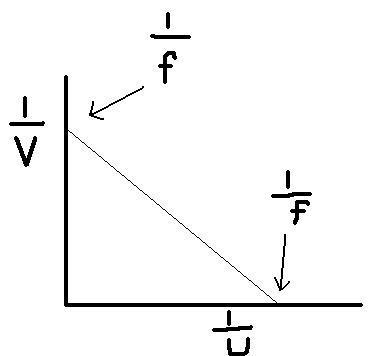
Then i done a graph of 1/V and 1/U which produces a straight line which intercepts the x and y axis, these values being 1/f (diagram 2)
My question is
Why is the graph of U and V not useful for finding the focal length of the lens accurately?
probably an easy question but i just can't put my finger on it :shy:
cheers
Hope you don't mind me firing a few questions now and again, i have some reports to do over the weekend which is the last of my HNC in Chemical Engineering :!)
A lot of it is basic physics which iv done in the past but its just the odd bit that catches me out.
So anyway, iv done an expeiment with a converging lens where you alter the object distance and image distance ( U & V ) to get focused images on the screen.
With these results iv plotted a graph of V against U which produces a curved slope (diagram 1)
Then i done a graph of 1/V and 1/U which produces a straight line which intercepts the x and y axis, these values being 1/f (diagram 2)
My question is
Why is the graph of U and V not useful for finding the focal length of the lens accurately?
probably an easy question but i just can't put my finger on it :shy:
cheers