Focusing of a 2D Parabolic Mirror

  • Context: Graduate 
  • Thread starter Thread starter DonLumpo
  • Start date Start date
  • Tags Tags
    2d Mirror
Click For Summary

Discussion Overview

The discussion revolves around the focusing properties of a 2D parabolic mirror, specifically in the context of third-order aberration theory and its implications for the behavior of scattered fields resulting from plane wave incidence at various angles. The scope includes theoretical aspects of optics and potential applications in engineering.

Discussion Character

  • Exploratory
  • Technical explanation
  • Debate/contested

Main Points Raised

  • One participant describes observations from full-wave simulations indicating that the maxima of the scattered field from shallow parabolic reflectors bend towards the reflector as the angle of incidence increases.
  • The same participant references the Petzval curvature and the relationship between sagittal and tangential focal surfaces in the context of third-order Seidel aberration theory.
  • Another participant questions the mixing of ray and wave optics models, asking for clarification on whether the inquiry pertains to aberration coefficients, wave optics treatment of parabolas, or detailed computations for parabolic mirrors.
  • A later reply mentions that coma is typically the largest off-axis aberration for parabolic reflectors, rather than field curvature.
  • There is a discussion about the classification of optics within electrical engineering and whether photonics is considered part of that field.

Areas of Agreement / Disagreement

Participants express differing views on the relationship between ray optics and wave optics in the context of the problem, and there is no consensus on how to approach the explanation of the focusing properties of the 2D parabolic mirror.

Contextual Notes

Some assumptions about the definitions of terms like "coma" and "field curvature" may not be universally agreed upon, and the discussion does not resolve the complexities of applying third-order aberration theory to a 2D scenario.

DonLumpo
Messages
1
Reaction score
0
Summary: How to explain the focusing properties of a 2D parabolic mirror based on third-order aberration theory?

Hello everyone,

I am currently studying with full-wave simulations the focusing properties of a 2D parabolic mirror, i.e. the scattered fields resulting from plane wave incidence at oblique angles.

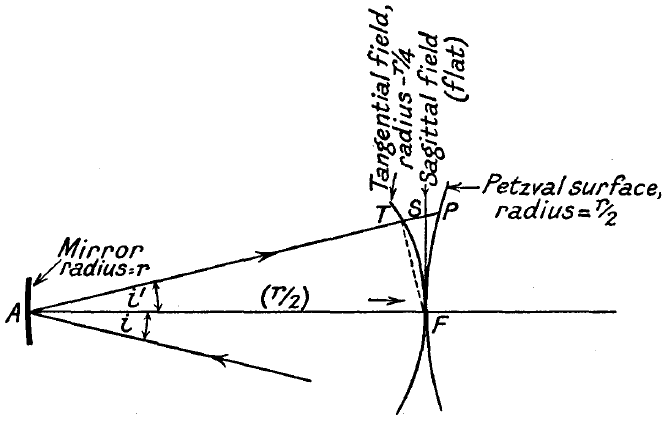
What I observe for shallow reflectors is that the maxima of the scattered field generally lie on a curve that bends towards the reflector for increasing angles of incidence, just as the tangential focal surface shown in the attached figure.
243253


What I learned for the 3D case (paraboloid mirror) is the following:
- As every optical system, the mirror has associated with it a sort of basic field curvature, called the Petzval curvature. When there is no astigmatism, the sagittal and tangential image surfaces coincide with each other and lie on the Petzval surface

- The sagittal focal surface from third-order Seidel aberration theory is the focal plane, and the tangential focal surface lies between the focal plane and the mirror

- As in any optical system, the tangential surface is three times as far from the Petzval surface as the sagittal surface

Now my question is, how can the focusing contour that I observe for the 2D case (obviously astigmatism is not defined in 2D) be explained with this/third-order aberration theory?

Many thanks
 
Last edited:
Science news on Phys.org
I'm curious. Why did you choose Electrical Engineering for your optics question?
 
DonLumpo said:
Summary: How to explain the focusing properties of a 2D parabolic mirror based on third-order aberration theory?
<snip>

I am currently studying with full-wave simulations the focusing properties of a 2D parabolic mirror, i.e. the scattered fields resulting from plane wave incidence at oblique angles.

I'm not entirely sure what you are asking- for one thing, you seem to be mixing ray (third-order aberrations) and wave optics models. Are you asking how aberration coefficients are computed in general? Are you asking how parabolas are handled in wave optics? Are you asking for detailed computations of aberration coefficients for a parabolic mirror?

The largest off-axis aberration of parabolic reflectors is usually coma, not field curvature:

https://www.telescope-optics.net/Newtonian_off_axis_aberrations.htm
 
anorlunda said:
I'm curious. Why did you choose Electrical Engineering for your optics question?
Hm, it's not a bad choice given that optics is entirely a subject of (quantum) electrodynamics and its applications, I'd call "electrical engineering". Well nowadays one talks about "photonics" in analogy to "electronics". Whether you consider photonics also as part of electrical engineering is just a matter of choice. I'm not sure whether the standard electrical-engineering curriculum today also already contains some photonics ;-)).
 

Similar threads

  • · Replies 8 ·
Replies
8
Views
2K
  • · Replies 3 ·
Replies
3
Views
4K
  • · Replies 21 ·
Replies
21
Views
7K
  • · Replies 9 ·
Replies
9
Views
2K
  • · Replies 3 ·
Replies
3
Views
5K
  • Poll Poll
  • · Replies 15 ·
Replies
15
Views
23K
Replies
8
Views
5K
Replies
8
Views
3K
  • · Replies 6 ·
Replies
6
Views
2K
  • · Replies 35 ·
2
Replies
35
Views
11K