Force of a bar to stop a rotating cylinder

Click For Summary
SUMMARY

The discussion focuses on calculating the force required to stop a rotating cylinder using a bar, with specific parameters including a cylinder mass of 14 kg, radius of 6.5 cm, and a friction coefficient of 0.33. The calculations involve using the equations of motion and torque, specifically M=Jα and M=μN, leading to the determination of the necessary force F1 to achieve a stop from 1200 RPM in 12 seconds. The final calculated force for part a is approximately 4.1 N, while for part b, where the cylinder rotates counter-clockwise, the force is approximately 3.7 N.

PREREQUISITES
  • Understanding of rotational dynamics and torque
  • Familiarity with the equations of motion for rigid bodies
  • Knowledge of frictional forces and their impact on motion
  • Ability to perform calculations involving angular acceleration and moment of inertia
NEXT STEPS
  • Study the principles of rotational dynamics in detail, focusing on torque and angular momentum
  • Learn about the effects of friction in mechanical systems, particularly in braking scenarios
  • Explore advanced topics in dynamics, such as the integration of forces over curved surfaces
  • Practice solving similar problems involving rotational motion and braking forces
USEFUL FOR

Students in mechanical engineering, physics enthusiasts, and professionals involved in dynamics and mechanical design will benefit from this discussion, particularly those focusing on rotational motion and braking systems.

whatdoido
Messages
48
Reaction score
2
Hi, I'm having conceptual problems for solving this one.

1. Homework Statement

I drew a picture of this problem, which should show up below. Lengths x,a and b were given in the original picture.

A rotating closed cylinder is braked with a bar. Its brake shoe is pressed in respect of point B without friction. The bar AB presses the cylinder. Force F_1 is used in point A.

Calculate the needed force when cylinder stops from a rotational speed of 1200 RPM clockwise in 12 seconds. Cylinder's mass is 14 kg, radius 6,5 cm and frictional coefficient 0,33.
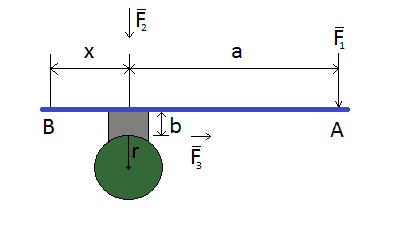
cylinder.png


r=6,5 cm= 0,065m
\mu=0,33
x=7,0 cm=0,07m
a=19 cm=0,19m
b=1,2 cm=0,012m
m=14kg
\Delta t=12s
n=1200 RPM=20r/s

Homework Equations


M=J\alpha
M=Fr
J=\frac{1}{2}mr^2
\sum M=0

The Attempt at a Solution


Well I know how to calculate the force needed to stop the rotating cylinder

M=J\alpha\hspace{30mm}M=\mu Nr
J\alpha=\mu Nr
.
.
.
N=\frac{mr2\pi n}{t \mu}
=28,877... N

F_1 can be calculated with torques I'm pretty sure, but this is the spot where I am stuck at. Something like F_2 x=F_1 (x+a) won't do. I should somehow take in the consideration the clockwise movement of cylinder (in part b of this problem it is supposed to calculate F_1 in counter-clockwise movement). Cylinder has a torque F_3, right? So I thought that is what I am supposed to use, but I'm not sure how to proceed.. I tried using some angles and make it work, but I cannot think something that would make me think "oh of course! That's how I can solve it" and give me the correct answer, eventually.
 
Physics news on Phys.org
How can the sum of the torques be zero if rotatational motion is being slowed to a stop?
 
whatdoido said:
##F_2 x=F_1 (x+a)## won't do.
Quite so. What point are you taking moments about? What other force acting on the bar has a moment about that point?

(There is something not quite right in the question, though. A brake shoe has a curved surface. The 'normal' acts in different directions around the curve. While the net force is F2, the frictional torque depends on the integral of the frictional force around the curve, so will be greater than ##\mu F_2##. To answer the question fully you would need to know the angle the shoe subtends at the cylinder's centre.)
 
haruspex said:
Quite so. What point are you taking moments about? What other force acting on the bar has a moment about that point?

Okay, then the best point would be probably between A and B. Let's call it C.

cylinder2.png


There is a moment F_1 a at least. Then I think the other moment is cylinder's moment, which is M=J \alpha=0,309...Nm, right? The moment F_2 x should make the cylinder stop rotating. F_2 x creates a moment F_3 b and ##M## resists that moment. So the moments acting in point C are F_1 a, F_3 b and ##M##. Or is this how it is?

Yeah, the curve made me think. But since it has no special dimensions, I ignored it.
 
whatdoido said:
Okay, then the best point would be probably between A and B. Let's call it C.
That would leave you with an unknown force at the fulcrum, B. What point does that suggest?
 
haruspex said:
That would leave you with an unknown force at the fulcrum, B. What point does that suggest?
Yes, you are right.. So B then, right? But I need to change the equation ##F_2 x=F_1 (x+a)## somehow. Dr. Courtney mentioned that the sum of torques should not be zero.
 
whatdoido said:
Yes, you are right.. So B then, right? But I need to change the equation ##F_2 x=F_1 (x+a)## somehow. Dr. Courtney mentioned that the sum of torques should not be zero.
The sum of torques acting on the cylinder cannot be zero, but the bar does not rotate, so the sum of torques on that will be zero.
 
haruspex said:
The sum of torques acting on the cylinder cannot be zero, but the bar does not rotate, so the sum of torques on that will be zero.
Okay, I got a bit confused earlier. But is the sum of the torques on cylinder \mu xF_2?

Then I could calculate the needed moment by \mu xF_2=J\alpha+F_3b

I tried that, but still the answer is wrong a little bit
 
whatdoido said:
Okay, I got a bit confused earlier. But is the sum of the torques on cylinder \mu xF_2?
The force tangential to the cylinder is clearly ##F_3=\mu F_2##. But I don't see how you bring x into it to get the torque. How far is the frictional force from the cylinder's centre?
 
  • #10
haruspex said:
How far is the frictional force from the cylinder's centre?
##6,5 cm (=r)## I would think
 
  • #11
whatdoido said:
##6,5 cm (=r)## I would think
Right, so what torque does it apply to the cylinder?
 
  • #12
haruspex said:
Right, so what torque does it apply to the cylinder?
F_3 r, right?

By the way, can I write a torque ##F_3b## in relation to ##B##? Like ##F_2x+F_3b-F_1(x+a)=0## and since ##F_3=\mu F_2##, it would make ##F_2x+\mu F_2b=F_1(x+a)##
 
Last edited:
  • #13
whatdoido said:
F_3 r, right?

By the way, can I write a torque ##F_3b## in relation to ##B##? Like ##F_2x+F_3b-F_1(x+a)=0## and since ##F_3=\mu F_2##, it would make ##F_2x+\mu F_2b=F_1(x+a)##
Yes to both.
 
  • #14
haruspex said:
Yes to both.
And J\alpha=\mu F_2r
F_2=\frac{mr\pi n}{t \mu}
So I get
##F_1=\frac{F_2(x+\mu b)}{x+a}=\frac{\frac{mr\pi n}{t \mu}(x+\mu b)}{x+a}=4,107..N##
##≈4,1N##
That is the correct answer according to my book.

In part b the movement of cylinder is counter-clockwise, thus I figured that I just subtract the frictional moment of cylinder because less torque is needed

##F_2x+\mu F_2b-\mu M-F_1(x+a)=0##
where ##M=J \alpha##

This gives me ##F_1≈3,7N## which it should be

Did I get it correctly?
 
  • #15
whatdoido said:
In part b the movement of cylinder is counter-clockwise, thus I figured that I just subtract the frictional moment of cylinder because less torque is needed

##F_2x+\mu F_2b-\mu M-F_1(x+a)=0##
where ##M=J \alpha##

This gives me ##F_1≈3,7N## which it should be

Did I get it correctly?
You don't seem to have used the same method that was successful in part a.
By what logic do you subtract ##\mu M##?
Think about which way F3 acts. Is it the same as before? Will its contribution to the moments about B be the same?
 
  • #16
haruspex said:
You don't seem to have used the same method that was successful in part a.
By what logic do you subtract ##\mu M##?
Think about which way F3 acts. Is it the same as before? Will its contribution to the moments about B be the same?
I see! ##F_3## decreases the moment in relation to B.

That would give:
##F_2x-\mu F_2b=F_1(x+a)##

Now that I think about it, subtracting ##\mu M## does not make so much sense.. My logic was that cylinder's moment decreases B's moments. But ##F_3r## is cylinder's moment, so I should have thought about it more. I just saw a convenient answer.. :oops:
 
  • #17
whatdoido said:
I see! ##F_3## decreases the moment in relation to B.

That would give:
##F_2x-\mu F_2b=F_1(x+a)##

Now that I think about it, subtracting ##\mu M## does not make so much sense.. My logic was that cylinder's moment decreases B's moments. But ##F_3r## is cylinder's moment, so I should have thought about it more. I just saw a convenient answer.. :oops:
OK!
 
  • #18
haruspex said:
OK!
Alright, thanks for help
 

Similar threads

  • · Replies 21 ·
Replies
21
Views
1K
  • · Replies 11 ·
Replies
11
Views
5K
Replies
5
Views
2K
  • · Replies 7 ·
Replies
7
Views
4K
Replies
13
Views
2K
  • · Replies 22 ·
Replies
22
Views
3K
  • · Replies 2 ·
Replies
2
Views
2K
  • · Replies 1 ·
Replies
1
Views
2K
Replies
1
Views
2K