What Track Should the Second Disk Follow in This Mechanism?

Click For Summary
SUMMARY

The discussion focuses on designing a mechanism that utilizes a stationary disk and a rotating second disk to move a piece vertically towards the center. The user seeks guidance on determining the appropriate track for the second disk to ensure effective motion. Key suggestions include plotting a graph of radial pin position against the disk rotation angle to visualize the mechanism's functionality. The conversation emphasizes the need for a clear diagram to better illustrate the intended design.

PREREQUISITES
  • Understanding of mechanical design principles
  • Familiarity with rotational motion dynamics
  • Basic graph plotting techniques
  • Experience with CAD software for diagram creation
NEXT STEPS
  • Research mechanical design principles for rotating mechanisms
  • Learn about rotational motion dynamics and their applications
  • Explore graph plotting techniques for visualizing mechanical movements
  • Utilize CAD software to create detailed diagrams of the proposed mechanism
USEFUL FOR

Mechanical engineers, product designers, and anyone involved in the design of rotational mechanisms or seeking to understand the dynamics of moving parts in machinery.

ddddd28
Messages
73
Reaction score
4
Hello,
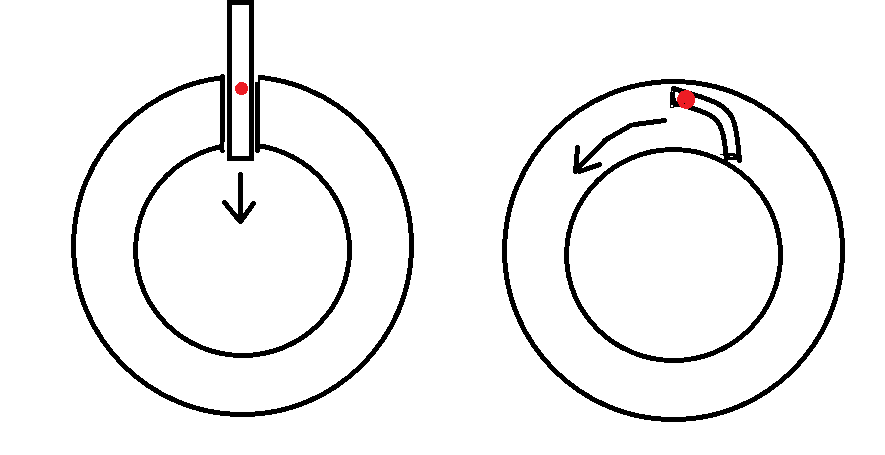
I am trying to design a mechanism that moves a piece towards the center of a disk by rotating a second disk as described in the picture below.
There is a stationary disk which restricts the motion of the piece, so it can move vertically only. There is also a second disk that it is located on the first one and it can rotate. As it rotates, it pushes the red pin and causes to the vertical motion of the piece. So far in theory.
I am struggling to figure out what is the right track of the second disk, or any track will go?
1602101945931.png
 
Engineering news on Phys.org
Start by plotting a graph of radial pin position against disk rotation angle.
 
Can you provide a better diagram? I really cannot follow what you hope to accomplish here at all.
 
  • Like
Likes berkeman
I have encountered a vertically oriented hydraulic cylinder that is designed to actuate and slice heavy cabling into sections with a blade. The cylinder is quite small (around 1.5 inches in diameter) and has an equally small stroke. The cylinder is single acting (i.e. it is pressurized from the bottom, and vented to atmosphere with a spring return, roughly 200lbs of force on the spring). The system operates at roughly 2500 psi. Interestingly, the cylinder has a pin that passes through its...

Similar threads

  • · Replies 5 ·
Replies
5
Views
3K
  • · Replies 5 ·
Replies
5
Views
4K
Replies
3
Views
2K
Replies
9
Views
3K
Replies
4
Views
2K
  • · Replies 24 ·
Replies
24
Views
4K
  • · Replies 8 ·
Replies
8
Views
4K
Replies
17
Views
2K
  • · Replies 9 ·
Replies
9
Views
3K
  • · Replies 6 ·
Replies
6
Views
2K