Formation of quarks in Feynman diagrams

Click For Summary
SUMMARY

The discussion focuses on the formation of quarks in Feynman diagrams, specifically addressing the conversion of an anti-strange quark into an anti-down and up quark via weak interaction. Participants emphasize the importance of adhering to conservation laws, including charge conservation and strangeness. The conversation highlights the necessity of understanding the role of weak gauge bosons, particularly W bosons, in weak processes involving flavor change. The conclusion stresses that the leading contribution in such interactions typically involves only one W boson.

PREREQUISITES
  • Understanding of Feynman diagrams and particle interactions
  • Knowledge of quark flavors and conservation laws
  • Familiarity with weak interactions and gauge bosons
  • Basic principles of quantum field theory
NEXT STEPS
  • Study the role of W and Z bosons in weak interactions
  • Learn about quark flavor changes and their implications in particle physics
  • Explore charge conservation in particle decays and interactions
  • Investigate the significance of Lorentz invariance in particle physics
USEFUL FOR

Particle physicists, students studying quantum field theory, and anyone interested in the dynamics of quark interactions and weak processes.

Sidsid
Messages
16
Reaction score
2
Homework Statement
Find the feynman diagrams for the following reactions (image)
Relevant Equations
None
Screenshot_20250105-231615~2.png
The first two went fine, but i got stuck at the third one and the rest. For the third: I had that the up quark remains the same as one is needed in a pion and that the anti-strange forms an anti-down and strange. But first, I dont know really why that exactly would be the case. Secondly I dont know where the other particles would be coming from. Can you help me?
 
Physics news on Phys.org
Consider what the incoming and outgoing particles are and what vertices could possibly convert the incoming particles to the outgoing ones. Also be careful to satisfy conservation laws.

For example:
Sidsid said:
I had that the up quark remains the same as one is needed in a pion and that the anti-strange forms an anti-down and strange.
An anti-strange forming an anti-down and a strange would violate Lorentz invariance, so that is already a big no-no.

In the outgoing particles you have (after writing out the quark content): ##u\bar d \bar u d e^+ \nu_e##. There is no strange here so it seems strange (pun intended) to convert anything to an anti-strange. However, you should note that there are no strange quarks in the out state! So where did the strange quark go? What vertex could possibly violate strangeness? (Or quark flavour in general ...)
 
Oh sorry that was a typo, i meant anti-strange -> anti-down and up via weak interaction.
 
1736151721531753365572440119153.jpg
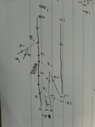
I now have this (sorry for bad quality, i ran out of paper), which feels ok? But I mostly googled possible antistrange decays to find this and dont know how to inuitively find that exact this happens. I do now understand why more quarks spring, this is because of the large mass difference between strange and up. EDIT: I see the errors in the arrow directions.
 
I have written down what I could interpret from your diagram with some additional annotation:
1736172577027.png

Charges are noted in red. As you can see, your diagram violates charge conservation and has the incorrect outgoing quark content. It also has two weak gauge bosons. These are very massive and will generally lead to suppressed amplitudes. You should consider if both are necessary to do what you want to do.
 
  • Like
Likes   Reactions: PhDeezNutz
I think i get it now. Are these correct? EDIT: i do have quite a lot of W bosons, but I think with so much you would not get the amount of quarks needed.
17362546746396567843592749897777.jpg
 

Attachments

  • 17362547656667752812913318884291.jpg
    17362547656667752812913318884291.jpg
    19.4 KB · Views: 54
Last edited:
Here is the last one. I would like to add by the wayy, that the exercise is focused on weak interaction.
17362567076665935049104082357792.jpg
 
It is a weak process as it involves flavour change (the strangeness in the in and out states are different). However, that does not mean that there is only Ws or Zs, only that there is at least one.

In this case, the leading contribution will have only one W. Try to find it!
 
  • Like
Likes   Reactions: PhDeezNutz

Similar threads

Replies
1
Views
2K
Replies
5
Views
2K
  • · Replies 3 ·
Replies
3
Views
6K
  • · Replies 1 ·
Replies
1
Views
4K
  • · Replies 3 ·
Replies
3
Views
3K
  • · Replies 10 ·
Replies
10
Views
5K
  • · Replies 3 ·
Replies
3
Views
2K
  • · Replies 14 ·
Replies
14
Views
9K
  • · Replies 2 ·
Replies
2
Views
3K
  • · Replies 1 ·
Replies
1
Views
4K