Hello Jakko,
I just joined this forum to answer this question. As chance would have it, I'm an astronomer (postdoc) and I have worked a bit on the formation of asteroids.
Jakko said:
So stoney and metalic asteroids formed from dust and gas condensed from plasma.
Not plasma. Plasma is fully ionized, and the protoplanetary disk is much colder than that.
Jakko said:
You would think they would be fluffy, dust piles, unless they had been part of a body large enough for its own gravity to melt it--large enough to form a sphere? Yet we're told that Sol's asteroid belt was never part of a larger body,
I actually suspect that many or most asteroids ARE dust piles. For sure, some of them aren't. Some of them are large enough to be compressed by gravity (e.g. Vesta), and some are fragments of larger bodies. Note that asteroids don't need to be spherical to be compressed. This picture is a close-up of a meteorite. The little round things are called chondrules, and they often make up the majority of some of the most primitive (earliest) meteorites. Notice how a lot of the chondrules have been deformed and they fit together like a jigsaw puzzle. This is evidence that the chondrules were once hot enough that they could be deformed, and that this region of the asteroid was compressed; so the chondrules were squeezed into each other.
As you said, the asteroid belt was never all in a single body, but the asteroid belt is highly collisional. Asteroids have been smashing together for billions of years and a lot of asteroids are fragments of bigger ones.
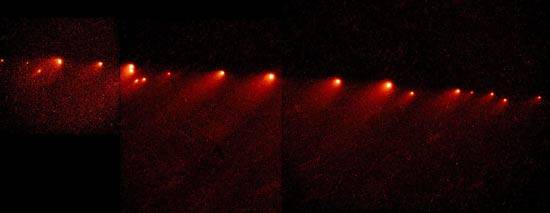
I don't have direct evidence that some asteroids are dust piles, but I do have evidence that at least (some?) comets probably are. Here is a picture of comet Shoemaker-Levy 9, some time before it hit Jupiter. Notice that the comet has broken into many fragments. How did that happen? Well, the tidal field of Jupiter's gravity stretched the comet and tore it to pieces. This is amazing because it gives us a way to measure the tensile strength of the comet. Because we were watching the comet, we know exactly when it began to break. We can compute the strength of Jupiter's tidal force at that point, and voila, you have just computer the tensile strength of the comet. So what did we learn? We learned that the comet has practically zero tensile strength. The tensile strength is 10,000 times smaller than solid ice. So this comet is *not* a solid lump of ice. It has to be a rubble pile, with the chunks of ice just sort of touching each other, but nothing really holding them together besides the comet's own feeble gravity.
The other piece of evidence that I'll give you that at least comets are probably rubble piles is comet 67P/Churyumov–Gerasimenko. This is the comet that was visited by ESA's Rosetta mission. While it was in orbit, Rosetta measured the comet's density at 0.5 g/cm^3. But water and ice have a density of 1.0 g/cm^3. How do you get a body made out of ice and other denser stuff to have a density of 0.5 g/cm^3? The comet has to be extremely porous, with roughly half of the volume of the comet being basically empty. Again, that sounds like a rubble pile.
So... there you have it. I hope this helped answer your question.
