Myphysicsteachershit
- 1
- 0
- Homework Statement
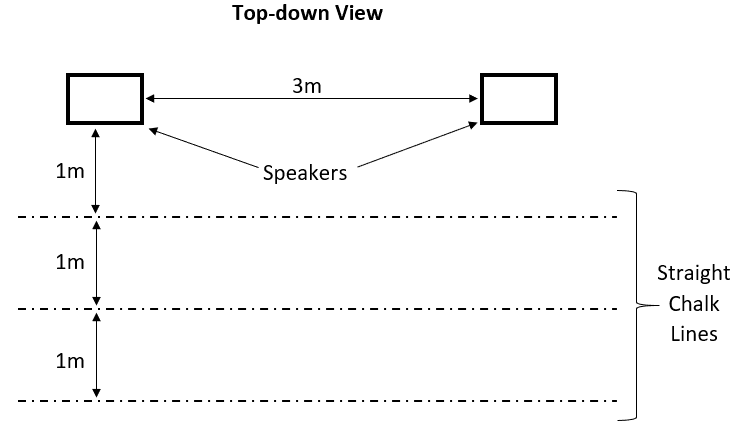
- We performed an experiment where 2 speakers were set up with 3 chalk lines spaced 1 metre apart from each other in front of the speakers. A 500 hz and then a 1000 hz sound was played through both speakers. We were to walk along the lines and mark the position of where the sound was the quietest (node) for both frequencies. After that we had to measure the distance between these nodes and calculate the wavelength.
- Relevant Equations
- For theoretical wavelength: lambda=340m/s divided by frequency
For experimental wavelength I used: lambda=2*distance between nodes
The values calculated was nowhere near the theoretical values, though I guessed they won't be as the results recorded was incredibly inaccurate. My teacher acknowledged the fact the final values won't be close to the theoretical ones but also said that my formula was wrong, that it works to find wavelength of the first line and not the other 2. I need help finding what formula to use, I have searched everyone but I don't really know what I'm looking for and our teacher said that it's not in the textbook that we use.
Here is a diagram of experiment:
Here is the results:
My analysis:
ƛ/2=D
∴ƛ=2D where ƛ=wavelength (cm)
D=distance between nodes/antinodes (the average,cm)
500hz:
Line 1: 506cm
2: 356cm
3: 210
100hz:
Line 1: 666cm
2: 876cm
3: none
As seen above the wavelengths are not same for the different lines, that's because I used the same formula. My guess is that there should be a third value in the equation, eg 'n' where n might equal number of lines/harmonics or whatever. But I'm not sure.
Any help would be appreciated.
Here is a diagram of experiment:
Here is the results:
| Average distance between nodes (cm) | |||
| Frequency (hz) | Line 1 | Line 2 | Line 3 |
| 500 | 253 | 176 | 105 |
| 1000 | 333 | 438 | None |
ƛ/2=D
∴ƛ=2D where ƛ=wavelength (cm)
D=distance between nodes/antinodes (the average,cm)
500hz:
Line 1: 506cm
2: 356cm
3: 210
100hz:
Line 1: 666cm
2: 876cm
3: none
As seen above the wavelengths are not same for the different lines, that's because I used the same formula. My guess is that there should be a third value in the equation, eg 'n' where n might equal number of lines/harmonics or whatever. But I'm not sure.
Any help would be appreciated.
 !
!