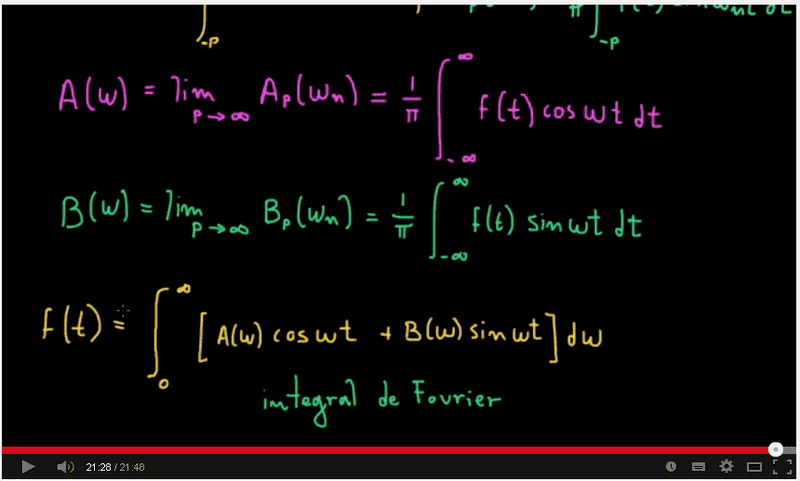
The Fourier integral is one way to calculate the Fourier transform of a function:
$$\hat{f}(\omega) = \int_{-\infty}^{\infty} f(x) e^{-i\omega x} dx$$
This definition only makes sense for certain kinds of functions. Since ##|f(x) e^{-i \omega x}| = |f(x)|##, the Fourier integral is defined if and only if ##|f|## is integrable. (In the case of Lebesgue integration, we say that ##f \in L^1##.)
But the Fourier transform can be defined for a larger class of functions, and even some objects that are not functions.
For example, we can define the Fourier transform of a function which is square-integrable but not integrable (i.e. ##f \in L^2 \setminus L^1##). To do this, we approximate ##f## by a sequence of functions ##f_n \in L^1 \cap L^2## and define ##\hat{f} = \lim \hat{f_n}##. Of course there are lot of details to check, such as the existence of such a sequence, and the fact that the limit does not depend on a particular choice for the sequence.
It is also possible to define the Fourier transform of certain types of distributions, which can be thought of as generalized functions. See here for example:
http://en.wikipedia.org/wiki/Fourier_transform#Tempered_distributions
We can also define a Fourier transform on other types of objects, such as groups (a special case of this is the discrete Fourier transform):
http://en.wikipedia.org/wiki/Fourier_transform_on_finite_groups
So, the Fourier transform is the more general concept, and the Fourier integral is how it is defined/computed in the case of integrable functions.