Redwaves
- 134
- 7
- Homework Statement
- A string of length = L with a mass = M fixed to a ring at each end, but the ring is free to move. The rings are massless and we neglected the gravity.
At t = 0 the rings are at y = 0 and the string has the same form that ##y(x,0) = Asin(\frac{2 \pi x}{L})##
We release the rings at t = 0
Find ##f(x)## from initials and boundaries conditions
- Relevant Equations
- ##f(x) = \frac{A_0}{2} + \sum A_n cos(\frac{n2 \pi x}{P} ) + \sum B_n sin(\frac{2n \pi x}{P}) )##
From the statement above, since the ring is massless, there's no force acting vertically on the rings. Thus, the slope is null.
##\frac{\partial y(0,0)}{\partial x} = \frac{\partial y(L,0)}{\partial x} = 0##
##\frac{\partial y(0,0)}{\partial x} = A\frac{2 \pi}{L}cos(\frac{2 \pi 0}{L}) = \frac{\partial y(L,0)}{\partial x} = A\frac{2 \pi}{L}cos(\frac{2 \pi L}{L}) = 0##
Here I have a problem, since ##A\frac{2 \pi}{L}cos(\frac{2 \pi 0}{L}) = 0## only If A = 0
Thus, ##f(x) = \frac{A_0}{2} + \sum 0 cos(\frac{n2 \pi x}{P} ) + \sum B_n sin(\frac{2n \pi x}{P}) ) = f(x) = \frac{A_0}{2} + \sum B_n sin(\frac{2n \pi x}{P}) )##
Since cos is a symmetric function, from the graph I made, the period should be 2L, since at every "0" and "L" the string must be symmetric at each side.
Now, with the initials conditions (position and velocity) .
I don't fully understand the periodic function. Is the second sum in the function about the initials conditions?
Here's what I got.
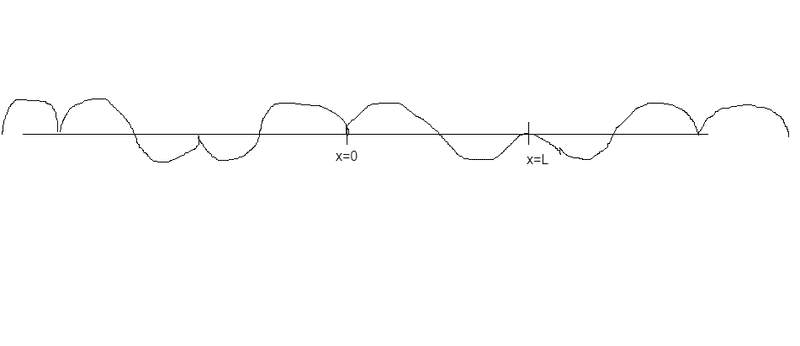
Edit: Can I say that the periodic function is
##f(x) = \frac{A_0}{2} + \sum_1^{\infty} A_n cos(\frac{n2 \pi x}{2L} ) + \sum_1^{\infty} B_n sin(\frac{2n \pi x}{2L})##
##\frac{\partial y(0,0)}{\partial x} = \frac{\partial y(L,0)}{\partial x} = 0##
##\frac{\partial y(0,0)}{\partial x} = A\frac{2 \pi}{L}cos(\frac{2 \pi 0}{L}) = \frac{\partial y(L,0)}{\partial x} = A\frac{2 \pi}{L}cos(\frac{2 \pi L}{L}) = 0##
Here I have a problem, since ##A\frac{2 \pi}{L}cos(\frac{2 \pi 0}{L}) = 0## only If A = 0
Thus, ##f(x) = \frac{A_0}{2} + \sum 0 cos(\frac{n2 \pi x}{P} ) + \sum B_n sin(\frac{2n \pi x}{P}) ) = f(x) = \frac{A_0}{2} + \sum B_n sin(\frac{2n \pi x}{P}) )##
Since cos is a symmetric function, from the graph I made, the period should be 2L, since at every "0" and "L" the string must be symmetric at each side.
Now, with the initials conditions (position and velocity) .
I don't fully understand the periodic function. Is the second sum in the function about the initials conditions?
Here's what I got.
Edit: Can I say that the periodic function is
##f(x) = \frac{A_0}{2} + \sum_1^{\infty} A_n cos(\frac{n2 \pi x}{2L} ) + \sum_1^{\infty} B_n sin(\frac{2n \pi x}{2L})##
Last edited:
 So, it's not really an acceptable shape. However, you can imagine that the initial shape of the string approximates the shape ##A\sin(\frac {n\pi x}{L})## to a high degree of approximation (except that very close to the endpoints the string bends to have zero slope).