Free-Space Path Loss Equation - finding the constant for d in km and f in MHz?

Click For Summary
SUMMARY

The discussion centers on the Free-Space Path Loss (FSPL) equation, specifically transforming equation 1 into equation 2 to demonstrate their equivalence. The constant used in the calculations is confirmed to be 32.45, as referenced from reliable sources such as Wikipedia. Participants emphasize the importance of correctly interpreting the variables, particularly noting that λm should equal cm/fHz. The conversation highlights the application of logarithmic properties in solving the equations.

PREREQUISITES
  • Understanding of Free-Space Path Loss (FSPL) equations
  • Familiarity with logarithmic properties and transformations
  • Knowledge of unit conversions in physics, specifically frequency and wavelength
  • Basic algebra skills for manipulating equations
NEXT STEPS
  • Study the derivation of the Free-Space Path Loss equation
  • Learn about unit conversions between frequency (MHz) and wavelength (cm)
  • Explore logarithmic identities and their applications in engineering
  • Investigate practical applications of FSPL in telecommunications
USEFUL FOR

Students in electrical engineering, telecommunications engineers, and anyone involved in radio frequency analysis will benefit from this discussion.

Phazall
Messages
2
Reaction score
0
1. Problem Statement
Transform equation 1 into equation 2 to show they're equivalent.
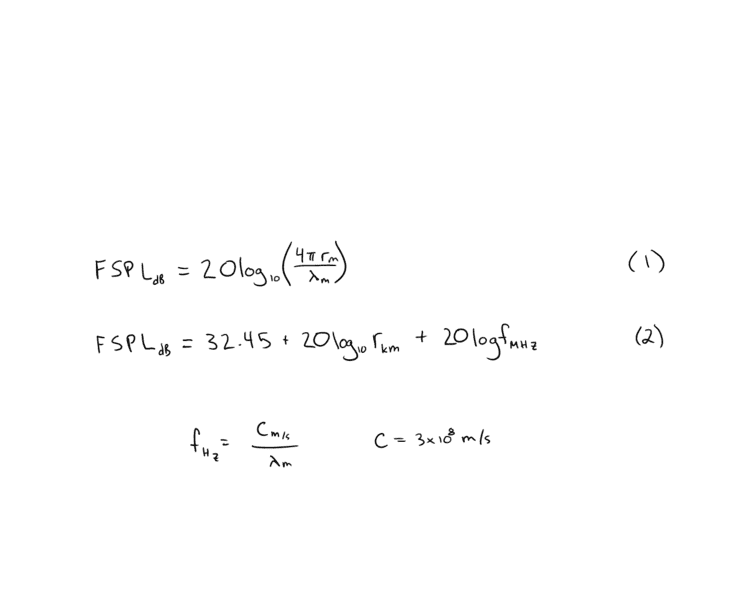

Homework Equations


relevent equations.png

*Please note that I added a subscript to each variable indicating the units.
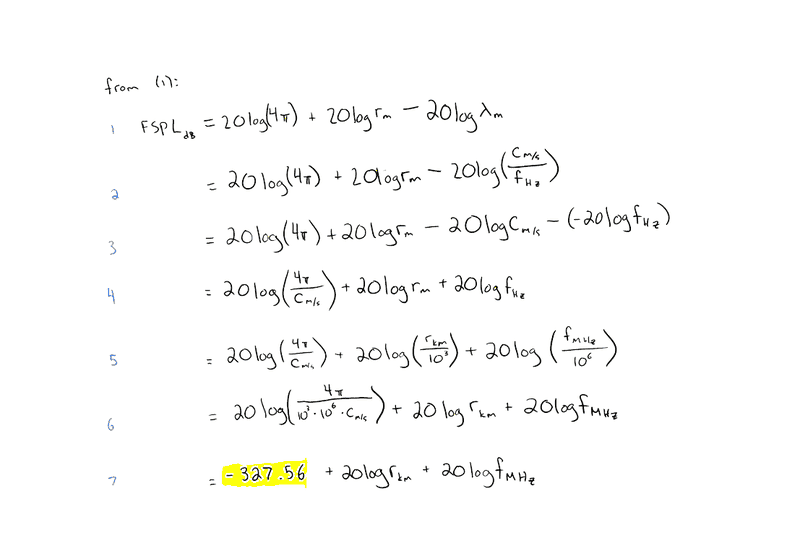
The Attempt at a Solution


the attempt at the solution.png


The highlighted constant shown in my attempt at the solution is supposed to be 32.45 according to both my notes and wikipedia http://en.wikipedia.org/wiki/Free-space_path_loss.

Thank you very much!
 
Physics news on Phys.org
log(ab) = log a + log b
log(abc) = log a + log b + log c
log(a/b) = log a - log b.
Etc.
OK I see you already know that.

I can't make out your writing but in your eq. 2, λm should = cm/fHz. Maybe that's where your problem lies.

I would have started by converting the original argument of the log function into the units
they want you to wind up with, but your way works too,
 
Last edited:

Similar threads

Replies
1
Views
3K
  • · Replies 16 ·
Replies
16
Views
2K
  • · Replies 10 ·
Replies
10
Views
4K
  • · Replies 8 ·
Replies
8
Views
2K
Replies
17
Views
4K
  • · Replies 1 ·
Replies
1
Views
2K
  • · Replies 5 ·
Replies
5
Views
4K
  • · Replies 1 ·
Replies
1
Views
8K
  • · Replies 1 ·
Replies
1
Views
2K
  • · Replies 2 ·
Replies
2
Views
4K