Friction, object pulled at an angle, given only (mue) and max tension hmmm

Click For Summary

Homework Help Overview

The discussion revolves around a physics problem involving friction, tension, and angles. Participants are exploring how to determine the angle at which the mass is maximized given the coefficient of friction and maximum tension.

Discussion Character

  • Exploratory, Conceptual clarification, Mathematical reasoning

Approaches and Questions Raised

  • Participants discuss the potential need for calculus to solve the problem, with suggestions to differentiate expressions related to tension and friction. There is also mention of alternative methods that do not rely on calculus, including the application of inequalities.

Discussion Status

Some participants have provided guidance on how to approach the problem, including rearranging equations and considering different mathematical techniques. There is a mix of interpretations regarding the best method to use, and while some participants express confidence in their calculations, others seek verification of their results.

Contextual Notes

Participants note the course's calculus component and express varying levels of familiarity with calculus, which may affect their approach to the problem. There is also mention of a specific answer from a textbook, which raises questions about the accuracy of individual calculations.

Beamsbox
Messages
61
Reaction score
0
Having difficulties with this, I assume that something's supposed to cancel out at some point, but I must be missing something important. If someone could point em in the right direction... Thanks for all your help, once again!
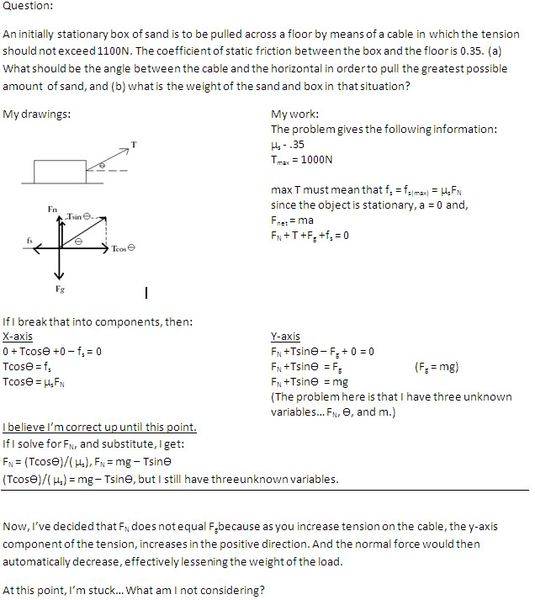
Math_Physics.jpg

(http://i51.photobucket.com/albums/f362/BeamsBox/Math_Physics.jpg)

Any ideas?
 
Physics news on Phys.org
Very interesting problem. Your initial thought patterns are the same as mine.

I would suggest you try using calculus. I'm not certain this will work though, I'm quite tired.

EDIT: Okay, just worket it through. You've said that Tcos(theta)=muFn.
Rearrange to get Fn.
Substitute this into Fn + Tsin(theta) = mg.

Differentiate mg with respect to theta and let it equal to 0 at maximum.
This should get you the required angle.

What is the correct answer?


BTW, there are probably easier methods, but this is the first one that came to mind.
 
Last edited:
Is this a calculus based physics course? Looking at this the only way i can think of how to do it is with calculus. I'm going to assume it is.
The question is asking at which angle is the mass maximized. There fore you need to find \frac{dm}{d\theta} and set it equal to zero. then you can solve for the angle.
 
The answer in the book is 19 degrees. The course sells itself as having a calculus component, but it's few and far in between in application. I haven't had calc for a handful of years, so I have to thank you all for your help!

I've showed my workings, but still have no verification that I did it correctly. I got 19.3 and assume the book just rounded down. Please let me know if you think this is correct, or if there's something else.
Chapter_6_Problem_17.jpg

(http://i51.photobucket.com/albums/f362/BeamsBox/Chapter_6_Problem_17.jpg)

Cheers!
 
Yes, you got it.
There is another way not using calculus. From the last equation (before you take the derivative of it): A=\frac{0.35mg}{T}=0.35sin\theta + cos\theta.
Apply the Bunyakovsky inequality: (ab+cd)^2\leq (a^2+c^2)(b^2+d^2), plus that sin^2\theta + cos^2\theta = 1, you will have A\leq \sqrt{1^2+0.35^2}. The both sides equal only when \frac{a}{c}=\frac{b}{d} or tan\theta = \frac{sin\theta }{cos\theta }=0.35.
 
Thanks for the feedback.

I've never heard of Bunyakovsky... I'll have to look into that.
Thanks once more!
 

Similar threads

Replies
5
Views
5K
Replies
5
Views
2K
Replies
6
Views
2K
Replies
5
Views
4K
  • · Replies 4 ·
Replies
4
Views
14K
  • · Replies 6 ·
Replies
6
Views
7K
  • · Replies 3 ·
Replies
3
Views
2K
  • · Replies 24 ·
Replies
24
Views
3K
  • · Replies 13 ·
Replies
13
Views
10K
  • · Replies 20 ·
Replies
20
Views
5K