From where did the ##ie\gamma## come into the picture? (QED)

  • Context: High School 
  • Thread starter Thread starter Wrichik Basu
  • Start date Start date
  • Tags Tags
    Picture Qed Qft
Click For Summary
SUMMARY

The discussion centers on the presence of the term ##ie\gamma## in the electromagnetic vertex function at one loop, as presented in "An Introductory Course in Particle Physics" by Palash B. Pal. Participants clarify that this term arises from the Feynman rule for the fermion-photon vertex, which is essential for calculating Feynman amplitudes. The conversation emphasizes the importance of understanding internal loops and the proper steps to derive the full Feynman amplitude, including the evaluation of Green's functions and the application of Wick's theorem. The insights shared are particularly valuable for beginners in quantum field theory (QFT).

PREREQUISITES
  • Understanding of Feynman diagrams and their components
  • Familiarity with quantum electrodynamics (QED) principles
  • Knowledge of Green's functions in quantum field theory
  • Experience with Wick's theorem and LSZ reduction technique
NEXT STEPS
  • Study the derivation of the three-point function in QED
  • Learn about the application of Wick's theorem in QFT calculations
  • Explore the LSZ reduction formula for obtaining scattering amplitudes
  • Review the Feynman rules for various particle interactions in QED
USEFUL FOR

This discussion is beneficial for students and researchers in quantum field theory, particularly those focusing on quantum electrodynamics, as well as anyone seeking to deepen their understanding of Feynman diagrams and vertex functions.

Wrichik Basu
Science Advisor
Insights Author
Gold Member
Messages
2,180
Reaction score
2,690
While reading the electromagnetic vertex function at one loop, the authors of the book I am reading, wrote down the following vertex function:

245873
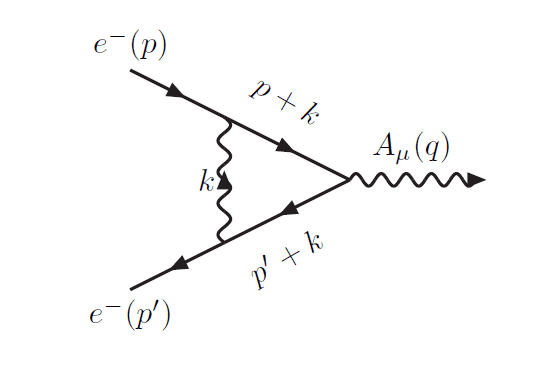
corresponding to this Feynman diagram:
245874
The superscript in ##\Gamma## is the number of loops being considered.

My problem is with the equation. I know that they are considering the loop only, leaving out the external Fermion and photon lines. I understand how the two propagators, ##iS_F(p' + k)## and ##iS_F(p + k)## have come, and also how the last term has come (from the propagator of photon field). But why are the ##ie\gamma## present before each propagator term? While writing the Feynman amplitude, we don't add these terms. Why are we adding them here?

N.B.: Sorry for not typing out the equation. It was a long one, and I thought you can understand from the scan itself, so I posted a screenshot. In case of any discrepancy, let me know, and I shall type it out.
 
Physics news on Phys.org
And the book you're reading is...?
 
haushofer said:
And the book you're reading is...?
This specific case is taken from the book An Introductory Course in Particle Physics by Palash B. Pal. I am actually reading the QFT book by the same author, but as I couldn't understand something in the latter, I referred to the former.

It is very much possible that I have missed something, as I am a beginner. Please point out the problems so that I can learn.
 
They simply come from the QED interaction term. You can try to calculate the three-point function to first order and see that it comes out this way.
 
  • Like
Likes   Reactions: vanhees71 and Wrichik Basu
HomogenousCow said:
They simply come from the QED interaction term.
I remembered as soon as you said that: they come from the vertices because the Feynman rule for the fermion-photon vertex is ##ie\gamma_\mu##. My foolishness.

Just tell me if I have got this correct:

When I am writing the Feynman amplitude from the Feynman diagram, the steps are:
  1. Check whether there are internal loops. If there are no loops but just simple internal boson or fermion (or photon) lines, I will proceed normally.
  2. If there are loops, I will first write down the "inner" vertex function for all the internal lines. This will include any vertex that occurs in the loop.
  3. Then I will proceed to write the full Feynman amplitude (for the whole diagram). This will include external lines and the "inner" vertex function which I have just computed.
This is actually making sense now.
 
Have you gone through the full derivation at least once by yourself? Because it really helps to see where everything is coming from.

By "full derivation" I mean something like:
1. Expanding the Greens function to some order
2. Evaluating the term(s) either with Wick's theorem or a path integral
3. Feed your results into the LSZ to obtain the scattering amplitude

It's a lengthy exercise but it really helps demystify the Feynman rules.
 
Wrichik Basu said:
This specific case is taken from the book An Introductory Course in Particle Physics by Palash B. Pal. I am actually reading the QFT book by the same author, but as I couldn't understand something in the latter, I referred to the former.

It is very much possible that I have missed something, as I am a beginner. Please point out the problems so that I can learn.
To be honest, it has been a while for me. I can see on the right hand side where the three factors of ##i e \gamma ## come from, since you have three vertices there. But why the left hand side has only one single factor of ##i e ##, I can't see. I guess it's in the definition of ##\Gamma##, but as I said, it has been a while and I'm probably overlooking something silly.
 
HomogenousCow said:
Have you gone through the full derivation at least once by yourself? Because it really helps to see where everything is coming from.

By "full derivation" I mean something like:
1. Expanding the Greens function to some order
2. Evaluating the term(s) either with Wick's theorem or a path integral
3. Feed your results into the LSZ to obtain the scattering amplitude

It's a lengthy exercise but it really helps demystify the Feynman rules.
Yes, I did that after posting my previous message in this thread. Things see now clear.
 

Similar threads

  • · Replies 6 ·
Replies
6
Views
5K
  • · Replies 1 ·
Replies
1
Views
1K
  • · Replies 5 ·
Replies
5
Views
3K
  • · Replies 4 ·
Replies
4
Views
2K
  • · Replies 4 ·
Replies
4
Views
2K
  • · Replies 10 ·
Replies
10
Views
2K
  • · Replies 2 ·
Replies
2
Views
3K
  • · Replies 7 ·
Replies
7
Views
4K
  • · Replies 3 ·
Replies
3
Views
2K
  • · Replies 4 ·
Replies
4
Views
3K