Discussion Overview
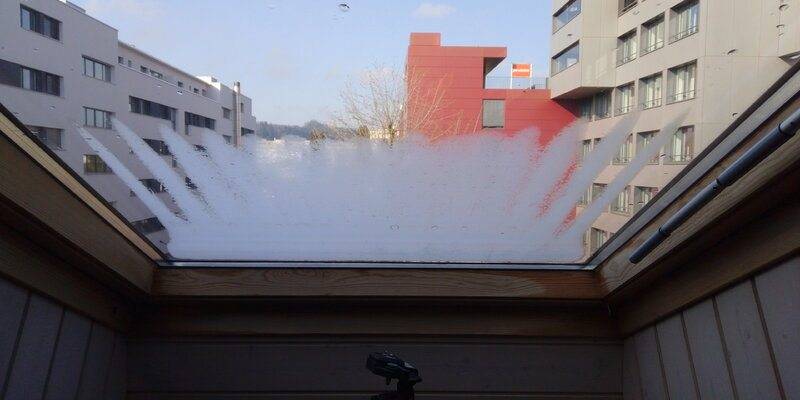
The discussion revolves around the phenomenon of frost melting in regular lines on a roof window. Participants explore potential causes, including the properties of the glass, environmental factors, and the influence of sunlight. The scope includes conceptual reasoning and exploratory hypotheses regarding the observed pattern.
Discussion Character
- Exploratory
- Conceptual clarification
- Debate/contested
Main Points Raised
- One participant suggests that the glass may be slightly wavy, leading to the observed melting pattern.
- Another proposes that the manufacturing process of glass could leave slight differences in thickness, contributing to the lines.
- A question is raised about whether the window is flat glass or a domed skylight, indicating a need for clarification on the type of glass.
- Some participants speculate that streaks from running water could create preferential freezing patterns, although this is questioned as too regular for that explanation.
- There is a hypothesis regarding the possibility of thermal convection cells forming due to a leak in the vacuum between the glass sheets, although this is met with skepticism.
- One participant suggests that sunlight reflecting off a corrugated metal roof might be responsible for the pattern, but acknowledges the need for closer investigation.
- Another participant mentions the potential influence of dirt on the window and its effect on the melting pattern.
Areas of Agreement / Disagreement
Participants express multiple competing views regarding the cause of the melting pattern, and the discussion remains unresolved with no consensus reached.
Contextual Notes
Some limitations include the lack of clarity on the type of glass and the specific environmental conditions during the observation. There are also unresolved questions about the influence of external factors such as sunlight and dirt on the window.