Functional representation of the oscillating graph

Click For Summary
SUMMARY

The forum discussion centers on finding a functional representation for a symmetrical oscillating graph derived from an evolutionary algorithm. Participants suggest various functions, including x \sin(\omega x), x^2 \sin x, and x \cos x, with the latter being identified as a suitable odd function that fits the graph's characteristics. The discussion emphasizes the need for a function that mirrors for negative x values without using absolute values or conditionals. Ultimately, x \cos x is recognized as a strong candidate for accurately representing the graph.

PREREQUISITES
  • Understanding of oscillating functions and their properties
  • Familiarity with evolutionary algorithms and their applications
  • Knowledge of trigonometric functions and their graphical representations
  • Basic skills in data analysis and curve fitting techniques
NEXT STEPS
  • Explore the properties of odd and even functions in mathematical analysis
  • Learn about curve fitting techniques using tools like Python's SciPy library
  • Investigate the application of evolutionary algorithms in function approximation
  • Study the characteristics of AM modulated sine waves and their mathematical representations
USEFUL FOR

Mathematicians, data scientists, and engineers interested in function representation, curve fitting, and the application of evolutionary algorithms in problem-solving.

yilmaz
Messages
8
Reaction score
0
Homework Statement
this is actually not a homework
Relevant Equations
tsin(ct)
Hi;

This is in fact not a homework question, but it rather comes out of personal curiosity.
If you look at the graph of the two functions in the image attached, what is the simplest functional representation for such a symmetrical pattern?
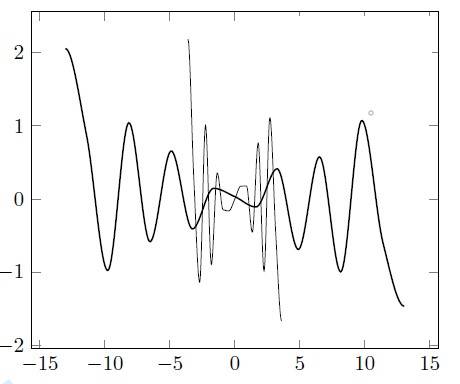
image.jpg
 
Physics news on Phys.org
Welcome to PF. :smile:

Can you tell us more about where you got these plots? What do they represent? Can you give a link to the website or paper where you found them? Thanks.
 
  • Like
Likes   Reactions: yilmaz
They look like ##x \sin(\omega x)##, which I see you have indicated already. What is wrong with that?
 
haruspex said:
They look like ##x \sin(\omega x)##, which I see you have indicated already. What is wrong with that?
Hi @haruspex,

It actually works, but only for positive x. For negative x, I want to see it mirrored, and in addition I would like to avoid using abs or conditionals in the function.
 
berkeman said:
Welcome to PF. :smile:

Can you tell us more about where you got these plots? What do they represent? Can you give a link to the website or paper where you found them? Thanks.
hi berkeman,

It’s actually my plot, so there’s no link. It’s the result of an evolutionary algorithm for a specific problem , where I consistently get such graphs. Since I’m not a physicist, I wanted to consult if there is any simple function representation that fits the shape.
 
How about ##x^2 \sin x##?
 
  • Like
Likes   Reactions: yilmaz
yilmaz said:
It’s actually my plot, so there’s no link. It’s the result of an evolutionary algorithm for a specific problem , where I consistently get such graphs.
What is the difference between the two plots? Did you just squeeze the horizontal axis to make the 2nd plot?

Also, it looks a lot like an AM modulated sine wave to me...

1666558014744.png

https://ccrma.stanford.edu/~jos/rbeats/img34.png
 
  • Like
Likes   Reactions: yilmaz
vela said:
How about ##x^2 \sin x##?
Good point.. it is not ##x \sin (x)## since that is an even function whereas the graphs show an odd function. But whether the peaks show a quadratic behaviour is unclear. Could be something like ##x^{\frac 23} \sin (x)##
 
  • Like
Likes   Reactions: yilmaz
vela said:
How about ##x^2 \sin x##?
Thanks @vela, that’s pretty close but when plotted, it doesn’t cut the origin like a diagonal as in the two sample graphs, but rather becomes tangent. But that’s a nice clue.
 
  • #10
You want an odd function, so try ##x \cos x##.
 
  • Like
Likes   Reactions: yilmaz
  • #11
vela said:
You want an odd function, so try ##x \cos x##.
great, I think this really looks the same! thanks a lot!
 
Last edited:
  • #12
yilmaz said:
Thanks @vela, that’s pretty close but when plotted, it doesn’t cut the origin like a diagonal as in the two sample graphs, but rather becomes tangent. But that’s a nice clue.
Do you have the curves as datapoints? If you figure out the frequency (looks sort of constant) you could divide by ## \sin(\omega x)## and try to fit the resulting curve.
 
  • Like
Likes   Reactions: yilmaz
  • #13
berkeman said:
What is the difference between the two plots? Did you just squeeze the horizontal axis to make the 2nd plot?

Also, it looks a lot like an AM modulated sine wave to me...

View attachment 315930
https://ccrma.stanford.edu/~jos/rbeats/img34.png
thanks @betk
haruspex said:
Do you have the curves as datapoints? If you figure out the frequency (looks sort of constant) you could divide by ## \sin(\omega x)## and try to fit the resulting curve.
yes i have the datapoints, I’ll try to figure out then…
 
  • #14
  • #15
yilmaz said:
the difference of the two plots are coming from two different random runs.
Why the big difference in spatial frequency? What are the units for your two axes?
 
  • #16
berkeman said:
Why the big difference in spatial frequency? What are the units for your two axes?
Actually since the x-axis (the domain of the function) is also subject to evolution, the result may come in different shapes. But you can take only one of them as reference. However, as @vela stated, xcos(x) works quite well, I guess this is the function that I was looking for.
 

Similar threads

Replies
9
Views
2K
  • · Replies 2 ·
Replies
2
Views
3K
Replies
2
Views
956
  • · Replies 9 ·
Replies
9
Views
7K
Replies
2
Views
2K
Replies
1
Views
3K
  • · Replies 7 ·
Replies
7
Views
2K
Replies
2
Views
3K
  • · Replies 1 ·
Replies
1
Views
2K
Replies
3
Views
850