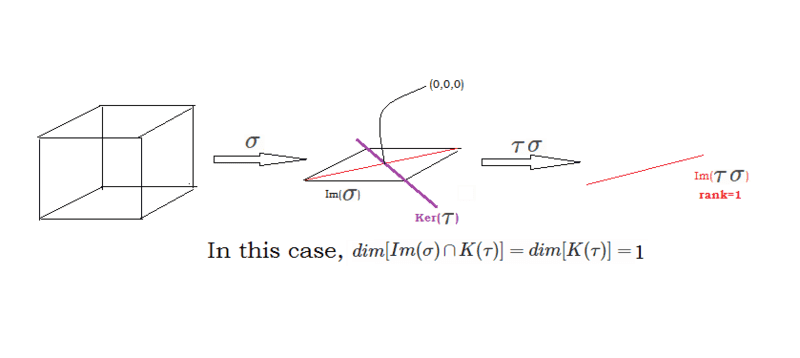
I'm not certain of what your picture is trying to get across, but a nice underlying idea would be of the use of the projection operator. They exist over many fields though I think you're talking about Reals here for geometry.
In your example's case it would be a 3x3 matrix, but in general its some ##n## x ##n## matrix, where ##\mathbf P^2 = \mathbf {PP} = \mathbf P##. If you play around with it a little, you see it must be diagonalizable (over reals) and only has 0s and 1s for eigenvalues (technically you could include the identity matrix and zero matrix, but they aren't really what people mean when talking about projectors). From here there are a lot of similarity transforms that can be done. My sense is your picture is showing the application of two different projectors.
- - - -
I actually think your picture is wrong. From what I can tell the LHS is a cube with non-zero volume (hence non-zero determinant) and thus full rank. It gets mapped down to a parallelogram given by those two black lines. It seems to be showing that they are linearly independent and if you add them together you get the red line. (It actually seems to be showing an affine space -- I don't get the motivation for not having the vectors oriented at zero or why the origin is only referenced in the middle picture.) The nullspace / kernel / purple line should be perpendicular to this plane, though it doesn't really look like it is to me.
Full circle / meta take:
it strikes me as almost perverse to have a picture showing a 3d space being mapped to a 2d space then mapped to a 1d space, when the original picture is "3d" but is in fact itself projected onto a 2d space (i.e. a piece of paper or your computer screen). So stepping back, the geometric intuition is: when you have a structure that is 3d but project it down/ try to represent it in 2d, you lose some information, making it harder to interpret clearly. In algebraic terms we call this a decrease in rank. And when you project from 2d to 1d you lose even more information.
Conversely, if you wanted an example showing the above phenomenon, and for the example itself to not be rank deficient, I think you'd either (a) want to build a 3d model yourself (perhaps with toothpicks) or (b) have an interactive 3d graphics program that while technically any given picture is 2d, it would allow you to drag and rotate enough to get some appreciation for depth and angles, etc. There is a big difference between being actually 3d and just drawing something on a piece of paper.