Geroler Motor Displacement Calc | Hobby Project

  • Thread starter Thread starter Stormer
  • Start date Start date
  • Tags Tags
    Calculations
Click For Summary
SUMMARY

This discussion focuses on calculating the displacement and torque of a custom Geroler motor for a hobby project. Key calculations involve determining the areas opposing input and output pressures, the crank radius, and the differential fluid pressure. The torque formula is defined as T = R * 2 * dP * A, where A is the face area of the gear teeth. The conversation also highlights the advantages of using rollers over traditional gears to reduce friction and wear.

PREREQUISITES
  • Understanding of Geroler motor mechanics
  • Familiarity with torque calculations and fluid dynamics
  • Knowledge of CAD software for design and area calculations
  • Basic principles of pressure differentials in fluid systems
NEXT STEPS
  • Research Geroler motor design principles and specifications
  • Learn about CAD software capabilities for calculating areas
  • Study fluid dynamics, particularly in compressible fluids like air
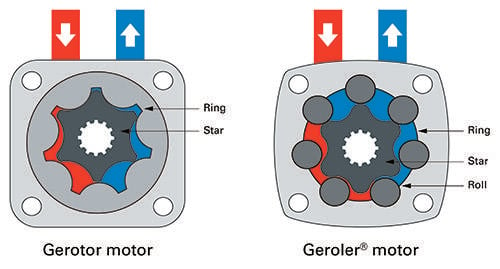
  • Explore the differences between Geroler and Gerotor motors
USEFUL FOR

Engineers, hobbyists, and designers interested in custom motor design, particularly those focused on optimizing torque and efficiency in fluid-driven systems.
Stormer
Messages
121
Reaction score
22
Hi. I want to design a custom Geroler motor for a hobby project of mine, but I want to calculate the torque it can produce at a given pressure and for that i need to calculate the motors displacement, but how do i do that?
eaton3.jpg
 
Engineering news on Phys.org
Stormer said:
Hi. I want to design a custom Geroler motor for a hobby project of mine, but I want to calculate the torque it can produce at a given pressure and for that i need to calculate the motors displacement, but how do i do that?
To find the torque, you must look at the areas that oppose the input and output pressures. You must also look at the radius to those areas. For a geroler, those areas are the sides of the gear teeth multiplied by the axial length of the gear. The radius of the geroler crank is important in computing torque.

Stormer said:
Also does it matter in any way that i will feed it a compressible fluid (gas) like air i stead of a liquid like oil or water that it usually uses other than the clearances for leakage?
If the inlet pressure and the outlet pressure are fixed, then the torque will be due to the differential areas. But pressures are determined by external connections.
 
Baluncore said:
To find the torque, you must look at the areas that oppose the input and output pressures. You must also look at the radius to those areas. For a geroler, those areas are the sides of the gear teeth multiplied by the axial length of the gear. The radius of the geroler crank is important in computing torque.
Well the CAD program does not output the area. So how can i calculate it?
 
Stormer said:
Well the CAD program does not output the area. So how can i calculate it?
When the tip of the tooth touches the fixed roller, the exposed faces of the tooth oppose the differential pressure.
The pressure on the centre of the tooth face is on the other side of the rotor from fixed rollers. The centre of the rotor is on the crank pin and applies twice the tooth force to the crank.
The depth of a tooth multiplied by it's length, is the face area = A;
The differential fluid pressure is = dP;
The tooth force is; F = A * dP;
The crank force is 2 * F;
The crank radius is R;
The torque is T = R * 2 * dP * A;
 
Last edited:
I can't think of a more difficult motor to make. You will need a set of valves machined into the shaft to direct the fluid. You will need a diagonal shaft with modified splines at both ends, or a crank.

If one gear rotates against another rotating gear it is a gear motor, or a gerotor.
If one gear rotates inside a fixed gear it is some type of vane motor, or a geroler.

It would be easier to make a traditional two-gear motor, or a gerotor with a rotating spool to carry the rollers, with an inner rotor profiled like the rotor in a geroler. Those ways your inlet and exhaust ports can remain fixed.
 
Baluncore said:
or a gerotor with a rotating spool to carry the rollers, with an inner rotor profiled like the rotor in a geroler.
So are you saying that a geroler with a rotating outer housing (and inner rotor) is not a geroler?

The reason for wanting a geroler over a gerotor is because the "pins" can be rollers that can reduce friction and wear. And they can be hardened steel. And because it will be easier to machine the housing with the pins than making a gerotor housing. Because presision pins is off the shelf parts, and drilling and reaming a hole to a precision fit is pretty easy.
 
Stormer said:
So are you saying that a geroler with a rotating outer housing (and inner rotor) is not a geroler?
Geroler is not a technical term, it is a Trade mark. You will need to ask the holder how they define a geroler.

Will the centre of the rotor in your motor be fixed, or will it orbit the shaft?
That has implications to the valves you will use to direct the fluid.
 

Attachments

  • Geroler_vs_Roller Gerotor Design.png
    Geroler_vs_Roller Gerotor Design.png
    20.2 KB · Views: 239
Last edited:
I was thinking the housing with the rollers would rotate together with the "star" yes. So i can have a simple fixed valveplate.
 
If you look at the roller-gerotor diagram in my post #7, you will see that there is a maximum fluid volume between two rollers when two rotor lobes touch those two rollers. That area is at the top of the rotor.
You will also see that there is a minimum fluid volume at the bottom of the rotor where a rotor lobe is between two rollers.
For a 6 lobe rotor, the displacement per shaft revolution is 6 times the difference between those volumes.
For an air motor, the compression ratio will be the ratio of those volumes.
 

Similar threads

  • · Replies 2 ·
Replies
2
Views
2K
  • · Replies 3 ·
Replies
3
Views
1K
  • · Replies 2 ·
Replies
2
Views
4K
Replies
11
Views
4K
  • · Replies 19 ·
Replies
19
Views
3K
  • · Replies 33 ·
2
Replies
33
Views
4K
  • · Replies 6 ·
Replies
6
Views
3K
  • · Replies 11 ·
Replies
11
Views
2K
  • · Replies 17 ·
Replies
17
Views
4K
  • · Replies 10 ·
Replies
10
Views
2K