[Grade 12 Physics] Gravitational/circular motion #2

Click For Summary

Homework Help Overview

The discussion revolves around gravitational and circular motion concepts, particularly focusing on the relationship between normal force and apparent weight in a scenario involving circular motion. Participants are examining the calculations related to forces acting on an object in motion.

Discussion Character

  • Conceptual clarification, Assumption checking

Approaches and Questions Raised

  • Participants explore the definitions of apparent weight and normal force, questioning the assumptions made about these concepts in the context of the problem. There is a focus on understanding the relationship between forces when an object is in circular motion.

Discussion Status

Some participants have provided feedback on the original poster's calculations, noting areas of confusion and seeking clarification on the definitions of terms used. The discussion is ongoing, with multiple interpretations of the concepts being explored.

Contextual Notes

There is mention of the apparent weight being one-fifth of the actual weight, which raises questions about the assumptions made regarding the forces involved. Participants are also discussing the implications of motion on the measurement of weight and normal force.

hobbes1235
Messages
13
Reaction score
0
Homework Statement
A certain asteroid has a radius of 7.0x10^3 m and a mass of 5.0x10^15 kg. How fast would a cyclist have to travel on the surface of this asteroid in order for her apparent weight to be one-fifth of her weight when stationary.
Relevant Equations
Fcentripetal = ma
a = v^2 / r
Fg = GMm / r^2

Potential Energy = -GMm / r
Kinetic Energy = 0.5(mV^2)
Total Energy (Ek + Ep) = -0.5(GMm) / r

g = Fg / m
Diagram for question 2:
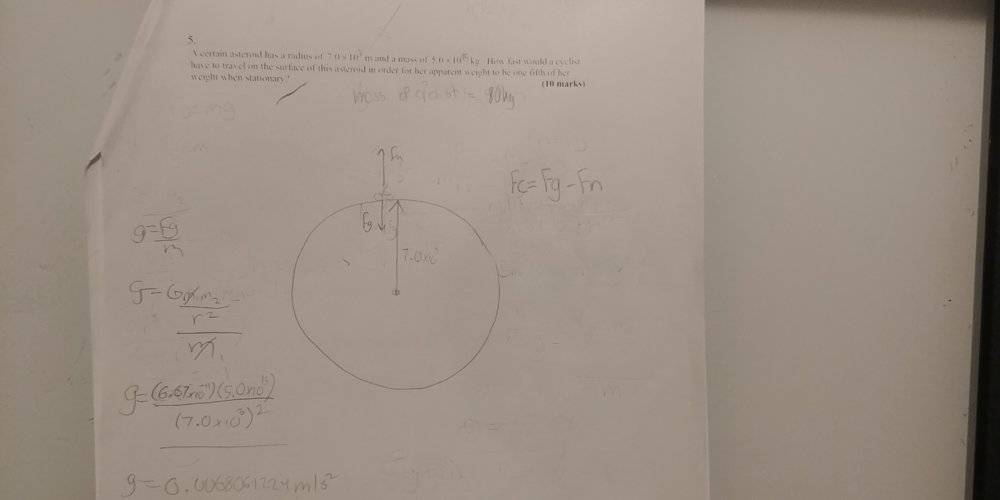
rotated2-jpg.jpg


Please check if my work is correct.
Main equation: Fc = Fg - Fn
Fn = Fg - Fc
I assume that: Fn = Fg when stationary
Fg = mg
I divide by 5 because the apparent weight must be one fifth of her weight when stationary
Fg = mg / 5
Fn = Fg
Fn = mg / 5
Now to substitute back into the equation Fn = Fg - Fc
Fn / m = g - V^2 / r

Fn(r) / m = g(r) - V^2

mgr / 5m = gr - V^2

-(gr / 5) + gr = V^2

V = 6.17 m/s^2
 
Physics news on Phys.org
Your work looks correct to me. However, I found the following lines a little confusing:

hobbes1235 said:
I assume that: Fn = Fg when stationary
Fg = mg
I divide by 5 because the apparent weight must be one fifth of her weight when stationary
Fg = mg / 5
Fn = Fg
Fn = mg / 5

You got to the correct result: Fn = mg/5. But I didn't quite follow your logic.

The apparent weight is given by the normal force Fn. And you want this to be 1/5 of the actual weight. Hence,
Fn = mg/5. Maybe that's what you were thinking?
 
I actually didn't know that the apparent weight was Fn but it turned out to be correct. What even is "apparent weight" I thought it was the weight when moving.
 
hobbes1235 said:
I actually didn't know that the apparent weight was Fn but it turned out to be correct. What even is "apparent weight" I thought it was the weight when moving.
Your phrase "weight when moving" is vague. Many would say that it is still the attraction due to gravity, which is not changed by the motion. The problem says "apparent weight" to imply ##F_n##.
 
hobbes1235 said:
I actually didn't know that the apparent weight was Fn but it turned out to be correct. What even is "apparent weight" I thought it was the weight when moving.
Weight is the force with the which the Earth, or the asteroid in this case, attracts the object. Apparent weight is the force that a bathroom scale would measure. Contrary to popular belief, a bathroom scale measures the normal force exerted on its surface, not the weight of an object placed on it. When you push on a bathroom scale with your hand, it does not display your weight, does it?

Thus, if you stand on a bathroom scale in a moving elevator, it will display more than your weight if the elevator is accelerating up, less than your weight if accelerating down and your weight if moving at constant speed up or down or is at rest. The same situation applies here except that the normal force is different from the weight not because the mass is accelerating in a straight line but because it is going around in a circular path while maintaining contact with the surface.
 

Similar threads

  • · Replies 21 ·
Replies
21
Views
3K
Replies
8
Views
2K
  • · Replies 14 ·
Replies
14
Views
2K
  • · Replies 19 ·
Replies
19
Views
4K
  • · Replies 8 ·
Replies
8
Views
2K
  • · Replies 1 ·
Replies
1
Views
3K
  • · Replies 7 ·
Replies
7
Views
2K
  • · Replies 9 ·
Replies
9
Views
4K
Replies
17
Views
2K
  • · Replies 4 ·
Replies
4
Views
2K