Gram-Schmidt Orthonormalization .... Garling Theorem 11.4.1 .

  • Context: High School 
  • Thread starter Thread starter Math Amateur
  • Start date Start date
  • Tags Tags
    Theorem
Click For Summary

Discussion Overview

The discussion revolves around the proof of Theorem 11.4.1 from D. J. H. Garling's book on metric and topological spaces, specifically focusing on the Gram-Schmidt orthonormalization process. Participants seek clarification on the implications of certain equations and the relationships between spans of vectors in the context of this theorem.

Discussion Character

  • Technical explanation
  • Debate/contested
  • Mathematical reasoning

Main Points Raised

  • Peter requests a rigorous demonstration of how the equations involving ##f_j## and ##e_j## lead to the conclusion that the spans of certain sets of vectors are equal.
  • Some participants suggest using induction on the size of the basis as a method to approach the proof.
  • Peter reflects on previous discussions and claims to have formulated a proof, detailing the relationships between the vectors and their spans.
  • Peter acknowledges the need to show that the list of vectors ##e_1, e_2, \ldots, e_j## is orthonormal, and provides reasoning for this claim.
  • Another participant notes that ##f_j## is orthogonal to the previous vectors, which may support the argument regarding the spans.

Areas of Agreement / Disagreement

Participants express varying levels of understanding regarding Garling's proof, with some agreeing on the use of induction while others remain uncertain about specific logical steps. The discussion does not reach a consensus on the clarity or correctness of the proof presented by Peter.

Contextual Notes

Participants highlight the importance of demonstrating orthonormality and the implications of linear independence in the context of the proof, indicating that certain assumptions and definitions are critical to the discussion.

Math Amateur
Gold Member
MHB
Messages
3,920
Reaction score
48
I am reading D. J. H. Garling's book: "A Course in Mathematical Analysis: Volume II: Metric and Topological Spaces, Functions of a Vector Variable" ... ...

I am focused on Chapter 11: Metric Spaces and Normed Spaces ... ...

I need some help with an aspect of the proof of Theorem 11.4.1 ...

Garling's statement and proof of Theorem 11.4.1 reads as follows:
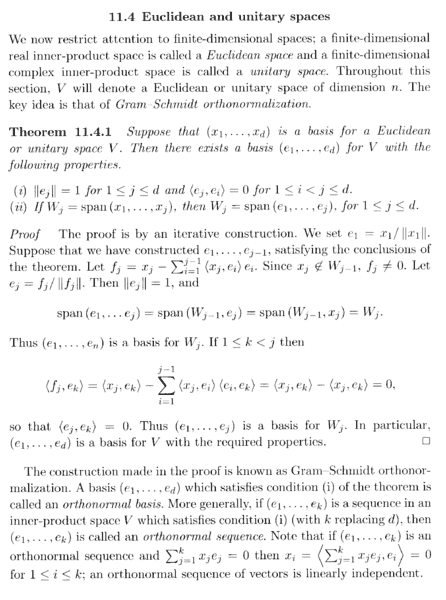
Garling - Theorem 11.4.1 ... .png


In the above proof by Garling we read the following:

" ... ... Let ##f_j = x_j - \sum_{ i = 1 }^{ j-1 } \langle x_j , e_i \rangle e_i##. Since ##x_j \notin W_{ j-1 }, f_j \neq 0##.

Let ##e_j = \frac{ f_j }{ \| f_j \| }## . Then ##\| e_j \| = 1## and

##\text{ span } ( e_1, \ ... \ ... \ e_j ) = \text{ span } ( W_{ j - 1 } , e_j ) = \text{ span }( W_{ j - 1 } , x_j ) = W_j##

... ... "
Can someone please demonstrate rigorously how/why##f_j = x_j - \sum_{ i = 1 }^{ j-1 } \langle x_j , e_i \rangle e_i##

and

##e_j = \frac{ f_j }{ \| f_j \| }##imply that##\text{ span } ( e_1, \ ... \ ... \ e_j ) = \text{ span } ( W_{ j - 1 } , e_j ) = \text{ span }( W_{ j - 1 } , x_j ) = W_j##
Help will be much appreciated ...

Peter
 

Attachments

  • Garling - Theorem 11.4.1 ... .png
    Garling - Theorem 11.4.1 ... .png
    38.1 KB · Views: 560
Physics news on Phys.org
Have you tried inducting on the size of the basis?
 
Hi WWGD ... thanks for the hint ...

I've seen and followed a proof by induction in Axler: Linear Algebra Done Right ...

But ,,, I still do not follow Garling's logic ... particularly the part i quoted ...

Can you help further ...?

Peter
 
Hi again WWGD ...

Reflecting on your advice and on Axler's proof ... I now believe that I understand Garling's statement that I quoted ...

I will post the proof of Garling's statement later ...

Thank you for your help ...

Peter
 
  • Like
Likes   Reactions: WWGD
Reflecting on my post above I have formulated the following proof of Garling's statement ... ...##\text{ span } ( e_1, \ ... \ ... \ e_j ) = \text{ span } ( W_{ j - 1 } , e_j ) = \text{ span }( W_{ j - 1 } , x_j ) = W_j##

We have ##e_1 = \frac{ f_1 }{ \| f_1 \| } ## and we suppose that we have constructed ##e_1, \ ... \ ... \ e_{j - 1 }## , satisfying the conclusions of the theorem ...Let ##f_j = x_j - \sum_{ i = 1 }^{ j-1 } \langle x_j , e_i \rangle e_i##Then ##e_j = \frac{ f_j }{ \| f_j \| } = \frac{ x_j - \sum_{ i = 1 }^{ j-1 } \langle x_j , e_i \rangle e_i }{ \| x_j - \sum_{ i = 1 }^{ j-1 } \langle x_j , e_i \rangle e_i \| }##

So ...

##e_j = \frac{ x_j - \langle x_j , e_1 \rangle e_1 - \langle x_j , e_2 \rangle e_2 - \ ... \ ... \ ... \ - \langle x_j , e_{ j - 1 } \rangle e_{ j - 1 } }{ \| x_j - \sum_{ i = 1 }^{ j-1 } \langle x_j , e_i \rangle e_i \| }##Therefore ...

##x_j = \| x_j - \sum_{ i = 1 }^{ j-1 } \langle x_j , e_i \rangle e_i \| e_j + \langle x_j , e_1 \rangle e_1 + \langle x_j , e_2 \rangle e_2 + \ ... \ ... \ ... \ + \langle x_j , e_{ j - 1 } \rangle e_{ j - 1 }##Therefore ##x_j \in \text{ span } ( e_1, e_2, \ ... \ ... \ , e_j )## ... ... ... ... ... (1)

But ##W_{j-1} = \text{ span } ( x_1, x_2, \ ... \ ... \ , x_{ j - 1 } ) = \text{ span } ( e_1, e_2, \ ... \ ... \ , e_{ j - 1} )## ... ... ... ... ... (2)Now (1) (2) ##\Longrightarrow \text{ span } ( x_1, x_2, \ ... \ ... \ , x_j ) \subseteq \text{ span } ( e_1, e_2, \ ... \ ... \ , e_j )##But ... both lists are linearly independent (x's by hypothesis and the e's by orthonormality ...)

Thus both lists have dimension j and hence they must be equal ...That is ##\text{ span } ( x_1, x_2, \ ... \ ... \ , x_j ) = \text{ span } ( e_1, e_2, \ ... \ ... \ , e_j )##
Is that correct ...?

Can someone please critique the above proof pointing out errors and/or shortcomings ...Peter

*** EDIT ***

Above I claimed that the the list of vectors ##e_1, e_2, \ ... \ ... \ , e_j## was orthonormal ... and hence linearly independent ... but I needed to show that the list ##e_1, e_2, \ ... \ ... \ , e_j## was orthonormal ...To show this let ##1 \le k \lt j ## and calculate ##\langle e_j, e_k \rangle## ... indeed it readily turns out that ##\langle e_j, e_k \rangle = 0## for all ##k## such that ##1 \le k \lt j ## and so the list of vectors ##e_1, e_2, \ ... \ ... \ , e_j## is orthonormal ...Peter
 
Last edited:
Math Amateur said:
##f_j = x_j - \sum_{ i = 1 }^{ j-1 } \langle x_j , e_i \rangle e_i##
You just have to note that ##f_j## is orthogonal to ##e_{j-1}, ... ,e_0##.
 
  • Like
Likes   Reactions: FactChecker and Math Amateur

Similar threads

  • · Replies 1 ·
Replies
1
Views
1K
Replies
6
Views
2K
  • · Replies 2 ·
Replies
2
Views
2K
  • · Replies 2 ·
Replies
2
Views
2K
  • · Replies 5 ·
Replies
5
Views
2K
Replies
2
Views
2K
Replies
2
Views
2K
  • · Replies 2 ·
Replies
2
Views
2K
  • · Replies 9 ·
Replies
9
Views
2K
  • · Replies 2 ·
Replies
2
Views
2K