SUMMARY
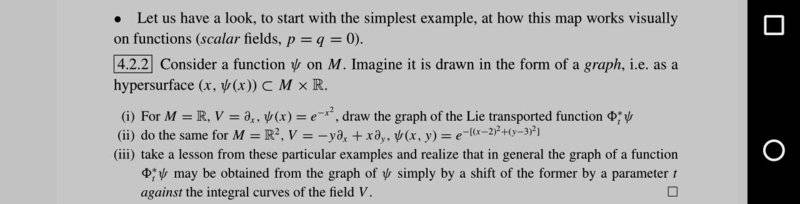
The discussion focuses on calculating the Lie derivative for a specific case in differential geometry, particularly using the Fecko textbook. The process involves applying the pullback operator ##\phi^*## to a function ##\psi## and understanding how it transforms under the flow of a vector field. The Lie derivative is defined as $$\lim_{t \longrightarrow 0} \frac{ \phi^*_t f - f}{t}$$, with the procedure requiring the identification of integral curves and displacement of the curve by an infinitesimal amount. For case (i), the example provided shows that if ##f(x) = \exp(-x^2)##, then ##\mathcal L_V \exp(-x^2) = -2x \exp(-x^2)##.
PREREQUISITES
- Understanding of differential geometry concepts
- Familiarity with the Lie derivative and pullback operator ##\phi^*##
- Knowledge of integral curves and vector fields
- Basic calculus, particularly limits and derivatives
NEXT STEPS
- Study the application of the pullback operator ##\phi^*## in differential geometry
- Learn about integral curves of vector fields in detail
- Explore the calculation of Lie derivatives in various contexts
- Practice exercises from the Fecko textbook on differential geometry
USEFUL FOR
Students and researchers in differential geometry, particularly those learning about Lie derivatives and vector fields, as well as educators looking for exercises to enhance understanding of these concepts.