Graphite Touch Button: High Conductivity & Faster Response

Click For Summary
SUMMARY

The discussion focuses on creating a touch button using graphite due to its high conductivity. Users report that the resistance between the ends of the graphite pattern is greater than 200 MΩ when untouched and drops to 1.3 MΩ when pressed, but experiences a delay in voltage output. Suggestions include using electroconductive ink pens as a more reliable alternative to graphite, despite their higher cost. Additionally, research from Trinity College Dublin highlights the potential of graphene-infused Silly Putty as a highly sensitive strain detector, outperforming traditional materials.

PREREQUISITES
  • Understanding of electrical resistance and conductivity
  • Familiarity with touch sensor technology
  • Knowledge of materials like graphite and graphene
  • Basic electronics, including the use of transistors
NEXT STEPS
  • Research the properties and applications of electroconductive ink pens
  • Explore the use of graphene-infused materials in sensor technology
  • Investigate alternative conductive materials for touch sensors
  • Learn about the principles of designing touch-sensitive circuits
USEFUL FOR

This discussion is beneficial for electronics hobbyists, materials scientists, and engineers interested in developing innovative touch sensor solutions using conductive materials.

hackhard
Messages
183
Reaction score
15
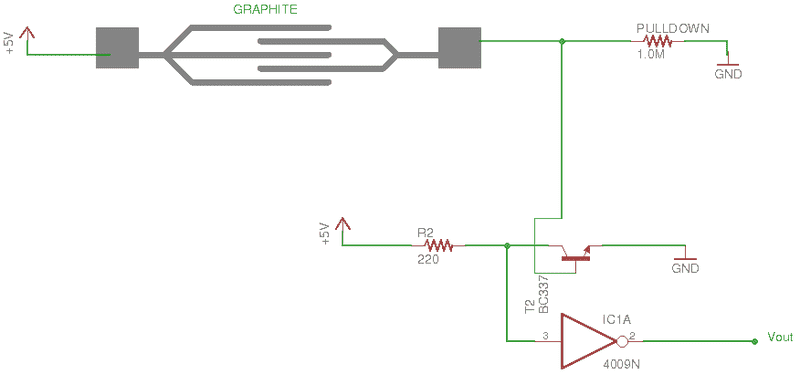
graphite has high conductivity , so i though of making a touch button out of a pencil drawn pattern on the wall.the pattern is shown below.
when not touched -resistance between ends of the pattern >200Mohm (exceeds dmm limit)
when fully pressed - resistance between ends of the pattern = 1.3 Mohm.
but Vout rises after delay or falls after delay of some 100 ms.due to high impedance
this pattern connects skin resistances in parallel
can someone suggest a better pattern ( of lower end to end resistance) ?
for faster response
jjj.png
 
Last edited:
Engineering news on Phys.org
Hi hackhard. You probably have the transistor drawn incorrectly on your schematic.

I like your experimental bent, but a problem with a graphite pattern is that it will sooner or later probably smudge and establish a bridge between the tracks.

In future please keep images to under about 1000 pixels across, otherwise the thread gets displayed in tiny sized print to accommodate the oversized image on our screen.
 
Search : ' electroconductive ink pens '
 
Nidum said:
Search : ' electroconductive ink pens '
its very costly
mine is a cheaper solution
 
hackhard said:
its very costly
mine is a cheaper solution
.
but not reliable ... cheapness come with disadvantages as @NascentOxygen said
 
Here is a very different approach to do what you are doing. Perhaps you could have fun with a project to do that.

Jonathan Coleman's research group at Trinity College Dublin discovered that Silly Putty "becomes an incredibly sensitive strain detector that can track blood pressure, heart rate, and even a spider's footsteps" when mixed with graphene.

Popular Science reports:That graduate student, Connor Boland -- who has since earned his doctorate -- made a batch of graphene in water and added the Silly Putty polymer. As he mixed them, the graphene sheets stuck to the polymer, creating a black goo the researchers dubbed "g-putty." When they ran an electrical current through the g-putty -- graphene-infused polymers can conduct electricity -- they discovered an extraordinary sensitivity. "If you touch it even with the slightest pressure or deformation, the electrical resistance will change significantly," Coleman says. "Even if you stretch or compress the Silly Putty by one percent of its normal size, the electrical resistance will change by a factor of five. And that's a huge change." That change makes g-putty about 500 times more sensitive than other deformation-detecting materials, which would respond to a similar compression with a mere one-percent change in electrical resistance. The results were published in the journal Science.

Graphene has been made with pencil lines and scotch tape. https://en.wikipedia.org/wiki/Graphene#History
 
thanks for help. I've decided to use conductive ink
 
conducting paint is too expensive.
are there any other alternatives to copper foil strips or Bare conducting paint
 
  • #10
If you want resolution try making a lense to spread out a cheap dollar store solid state laser onto a inner reflective box frame and lining the inside parameter with a grid of cut mirror reflector's each precisely cut at width and angle's prime to each other and spaced at exact intervals, with incident angles toward two or more LDR(light dependent resistors) and coordinates of blocked pulse's like finger tips can be extracted easily though any serial adc.
 
  • #11
Try increasing R2 to 220K and pulldown to 10 meg ?
 

Similar threads

  • · Replies 13 ·
Replies
13
Views
8K
  • · Replies 4 ·
Replies
4
Views
3K
  • · Replies 2 ·
Replies
2
Views
3K
  • · Replies 2 ·
Replies
2
Views
4K