Gravitational Collapse of a Star

Click For Summary
SUMMARY

The discussion centers on the gravitational collapse of stars, emphasizing that while stars like the Sun lose mass over time, this loss is negligible compared to the gravitational forces at play. The core of a star acts as a furnace, generating pressure that counteracts gravitational collapse until the core cools significantly. The conversation also touches on the distinction between force and energy, clarifying that gravity does not require energy to maintain its effect, unlike lifting an object against gravity, which does require energy. The complexities of gravity and quantum mechanics are highlighted, with references to General Relativity and the ongoing search for a unified theory of gravity and quantum behavior.

PREREQUISITES
  • Understanding of gravitational forces and their role in stellar dynamics
  • Familiarity with the concepts of mass-energy equivalence (E=mc²)
  • Basic knowledge of thermodynamics as it relates to stellar cores
  • Awareness of General Relativity and its implications for gravity
NEXT STEPS
  • Research the mechanisms of stellar evolution and the lifecycle of stars
  • Study the principles of General Relativity and its predictions regarding gravity
  • Explore the concept of Hawking radiation and its implications for quantum gravity
  • Investigate current theories and models regarding the graviton and quantum gravity
USEFUL FOR

Astronomers, astrophysicists, students of physics, and anyone interested in the fundamental principles of gravity and stellar dynamics.
Michel_vdg
Messages
107
Reaction score
1
Hello,

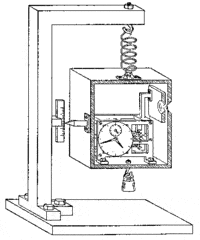
I was reading a book on Quantum Mechanics by Manjit Kumar, and read at the part of the Bohr–Einstein debates about Einstein's box to measure the weight of a photon.

Now I was wondering, how can a Star collapse if it's constantly losing so much weight?

200px-Ebohr4.gif
 
Astronomy news on Phys.org
Hello Michel! :smile:
Michel_vdg said:
… how can a Star collapse if it's constantly losing so much weight?

Loosely speaking, the "furnace" in the middle is supplying the pressure that stops it collapsing.

When the furnace starts to cool down, that has a far more catastrophic effect than the continuous loss of a small amount amount of mass. :wink:
 
And to put things into perspective, the amount of mass a star like our Sun loses in a billion years is about 6/100000 of its mass.
 
Ok, thanks!

An other slightly similar question: If gravity is a force, than doesn't the Sun also loose a lot of weight, keeping in mind the law of conservation of energy. Like if I want to keep a heavy weight from falling to the ground, I have to keep on burning a lot of calories before I let go and it falls, or is that also just a very tiny percentage?
 
Michel_vdg said:
Ok, thanks!

An other slightly similar question: If gravity is a force, than doesn't the Sun also loose a lot of weight, keeping in mind the law of conservation of energy. Like if I want to keep a heavy weight from falling to the ground, I have to keep on burning a lot of calories before I let go and it falls, or is that also just a very tiny percentage?

The reason that you burn calories holding a weight has to to do with the way muscles work. If you were to lay the object on a table, the table would also keep the object from falling to the ground, but uses up no energy in doing so.

For similar reasons a helicopter hovering a few feet off the ground burns fuel supporting its weight and will eventually fall, but a platform could support the same helicopter indefinitely and never use up any part of itself.
 
Janus said:
The reason that you burn calories holding a weight has to to do with the way muscles work. If you were to lay the object on a table, the table would also keep the object from falling to the ground, but uses up no energy in doing so.

For similar reasons a helicopter hovering a few feet off the ground burns fuel supporting its weight and will eventually fall, but a platform could support the same helicopter indefinitely and never use up any part of itself.
But if there is no gravity the helicopter could be lifted with a little puff, so a lot of force is applied to hold it down.
 
Michel_vdg said:
But if there is no gravity the helicopter could be lifted with a little puff, so a lot of force is applied to hold it down.

Force is not energy. Energy is force times distance. In other words, if I apply a force in moving an object across a distance I expend energy, but if I apply a force without moving it, no energy is involved.

Lifting a weight a distance against the pull of gravity uses energy. Merely suspending it at a set height does not.


The Earth does not expend any energy holding the helicopter down.
 
Janus said:
Force is not energy. Energy is force times distance. In other words, if I apply a force in moving an object across a distance I expend energy, but if I apply a force without moving it, no energy is involved.

Lifting a weight a distance against the pull of gravity uses energy. Merely suspending it at a set height does not.

The Earth does not expend any energy holding the helicopter down.
But if you have an apple hanging on a tree it could keep on hanging there forever if no constant force or energy was applied, so gravity is constantly pulling. The same thing happens when you drop a coin in water, it keeps on falling to the bottom, the difference with the table is just that the structure of water is more flexible.

And if you say that 'Force is not Energy', isn't that the same as saying that 'Energy is not Mass' while E=mc^2 is thought of as the Mass–energy equivalence.
 
Michel_vdg said:
And if you say that 'Force is not Energy', isn't that the same as saying that 'Energy is not Mass' while E=mc^2 is thought of as the Mass–energy equivalence.

The difference is that the c^2 is a universal constant, while the d in E=fd is a variable.
 
  • #10
Janus said:
The difference is that the c^2 is a universal constant, while the d in E=fd is a variable.
Thanks for your replies Janus.

I think for a layman the difference between Energy and Force is hard to get, so I googled a bit, and guess where I ended, yep ... PhysicsForums.com :smile:

And more specific https://www.physicsforums.com/showthread.php?t=7356"

And I liked this quote:

Also important: there is a "conservation of energy" law. There is no "conservation of force". In order to lift an object with weight 1 Newton a height of 1 meter, I MUST do 1Newton* 1 meter= 1 Joule of work. But if I use an inclined plane instead of lifting it straight up, I can reduce the force necessary.

I'm still slightly confused ... I'll have to give it some time :smile:
 
Last edited by a moderator:
  • #11
Energy and force are not the same thing. Force requires energy, energy does not require force.
 
  • #12
Chronos said:
Energy and force are not the same thing. Force requires energy, energy does not require force.
mh, now you are bringing the confusion back regarding my original question; if the sun is getting lighter (as in weight) because it is using up energy to apply gravitational force.
 
  • #13
Chronos said:
Energy and force are not the same thing. Force requires energy, energy does not require force.

I'm confused :confused:

surely we're talking about change in energy?

And change in energy requires a force and a movement of the point of application of that force.
 
  • #14
the core is also becoming denser
 
  • #15
Michel_vdg said:
mh, now you are bringing the confusion back regarding my original question; if the sun is getting lighter (as in weight) because it is using up energy to apply gravitational force.

The Sun does not burn fuel to manufacture gravity. Gravity is a property that is associated with mass, and doesn't require renewal. Analogously, electrons do not grow lighter with time in order continuously 'manufacture' their electric fields. If they did, we'd see electrons of a whole continuum of mass values depending on their individual ages. We don't see that; all electrons ever measured, even those newly created in particle accelerators, have the same charge, and the same mass.
 
  • #16
gneill said:
The Sun does not burn fuel to manufacture gravity. Gravity is a property that is associated with mass, and doesn't require renewal. Analogously, electrons do not grow lighter with time in order continuously 'manufacture' their electric fields. If they did, we'd see electrons of a whole continuum of mass values depending on their individual ages. We don't see that; all electrons ever measured, even those newly created in particle accelerators, have the same charge, and the same mass.

If that is the case than gravity is probably an outer body property, like a ball that bounces of a wall ... and it might be like Descartes postulated a screw-like particle, perhaps like the rotating knot in the image below, that moves like light through space, having a screw-like wave property that pushes surrounding matter (mass) down, and bouncing back of mass. Is such an idea acceptable, or how is the 'graviton' that is often mentioned thought of?[PLAIN]http://www.800million.org/images/800.gif
 
Last edited by a moderator:
  • #17
Michel_vdg said:
If that is the case than gravity is probably an outer body property, like a ball that bounces of a wall ... and it might be like Descartes postulated a screw-like particle, perhaps like the rotating knot in the image below, that moves like light through space, having a screw-like wave property that pushes surrounding matter (mass) down, and bouncing back of mass. Is such an idea acceptable, or how is the 'graviton' that is often mentioned thought of?

There is as yet no standard, accepted theory or model for the graviton. I am not aware of any observational evidence that would make one necessary or enable one to distinguish between competing models (other than rule out models that make obviously 'bad' predictions that are self contradictory or fail to obey various conservation laws or other laws of physics). The Le Sage type models of particle-based gravity (gravity as the result of a pressure of a space-filling 'gas' of particles), for example, fail on a number of counts.

General Relativity, a classical model, is the best we have so far, and as yet there are no observational contradictions to its predictions. That said, we expect there to be difficulties reconciling gravity and quantum behavior at scales where both need to be considered. It would certainly be nice to have gravity unified with quantum theory so that they would form a single coherent model for the universe.
 
  • #18
gneill said:
That said, we expect there to be difficulties reconciling gravity and quantum behavior at scales where both need to be considered. It would certainly be nice to have gravity unified with quantum theory so that they would form a single coherent model for the universe.

What about Stephen Hawking's look on gravity, isn't there a consensus that they work in regard to Quantum theory?
Hawking's analysis became the first convincing insight into a possible theory of quantum gravity. In September 2010, Hawking radiation has been claimed to be observed. http://en.wikipedia.org/wiki/Hawking_radiation"
 
Last edited by a moderator:
  • #19
An "insight into a possible theory" is not a theory (complete predictive mathematical model).

I think that there are some interesting hints and glimpses of what will go into such a theory, but we're not there yet.
 

Similar threads

  • · Replies 3 ·
Replies
3
Views
3K
  • · Replies 5 ·
Replies
5
Views
3K
  • · Replies 31 ·
2
Replies
31
Views
7K
  • · Replies 49 ·
2
Replies
49
Views
5K
  • · Replies 21 ·
Replies
21
Views
3K
  • · Replies 0 ·
Replies
0
Views
3K
  • · Replies 1 ·
Replies
1
Views
3K
  • · Replies 51 ·
2
Replies
51
Views
9K
  • · Replies 6 ·
Replies
6
Views
3K
  • · Replies 8 ·
Replies
8
Views
7K