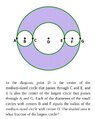
-gre.ge.3 Circles Find the shaded area as a fraction

Click For Summary

Discussion Overview

The discussion revolves around a GRE geometry problem involving the calculation of the shaded area formed by three circles of different sizes. Participants explore methods to express the area as a fraction, considering the relationships between the radii of the circles.

Discussion Character

  • Mathematical reasoning
  • Debate/contested

Main Points Raised

  • Some participants note the absence of dimensions in the problem and suggest using the radius of the largest inner circle as a variable, r.
  • One participant proposes that the radii of the smaller circles are r/2 and the radius of the outer circle is 2r, aiming to derive a ratio that cancels out r.
  • Another participant suggests a method of calculating the area by subtracting the areas of the inner circles from the area of the outer circle.
  • A participant calculates the area ratio using specific values for the radii, suggesting that if the radius of the big circle is 2, the total of the interior circles' radii is 1.
  • One participant challenges the accuracy of the radii used in the calculations and proposes a different approach by setting the radius of one of the small circles to 1.
  • A later reply presents a detailed calculation of the areas of the circles and arrives at a ratio of 5/8 for the shaded area, indicating this as a potential solution.
  • Another participant confirms that the ratio of 5/8 is correct.

Areas of Agreement / Disagreement

There is no consensus on the approach to solving the problem, as participants propose different methods and calculations. While one participant asserts that the ratio of 5/8 is correct, others have not confirmed this or may have differing views on the calculations.

Contextual Notes

Participants express uncertainty regarding the correct values for the radii and the overall approach to the problem, indicating that assumptions about the dimensions and relationships between the circles may affect the calculations.
karush
Gold Member
MHB
Messages
3,240
Reaction score
5
View attachment 9352

Ok this is considered a "hard" GRE geometry question... notice there are no dimensions
How would you solve this in the fewest steps?
 

Attachments

  • Screenshot_20191109-122447_Docs.jpg
    Screenshot_20191109-122447_Docs.jpg
    54 KB · Views: 160
Mathematics news on Phys.org
karush said:
Ok this is considered a "hard" GRE geometry question... notice there are no dimensions
How would you solve this in the fewest steps?
You have three circles inside. Call the radius of the largest inner circle r. Then the radius of the two smaller circles are r/2 and the radius of the big circle on the outside is 2r.

You are supposed to give the answer as a ratio so the r's eventually cancel out.

Can you finish?

-Dan
 
topsquark said:
You have three circles inside. Call the radius of the largest inner circle r. Then the radius of the two smaller circles are r/2 and the radius of the big circle on the outside is 2r.

You are supposed to give the answer as a ratio so the r's eventually cancel out.

Can you finish?

-Dan

Kinds I know that the area of a circle is
$A=\pi r^2$
 
Come on ... you can do this

Big circle - (medium circle + 2 small circles)
 
If the radius of the big circle is 2 then the total of the 3 interior radius' is 1 since they are all on the diameter of the big circle.

$\dfrac{\pi(1)^2}{\pi(2)^2}=\dfrac{1}{4}$

Kinda...like..
 
karush said:
If the radius of the big circle is 2 then the total of the 3 interior radius' is 1 since they are all on the diameter of the big circle.

$\dfrac{\pi(1)^2}{\pi(2)^2}=\dfrac{1}{4}$

Kinda...like..
Check those radii again... Try calling the radius of one of the small circles to be r = 1 and give it another try. Then look at this:
Area of large circle in the center: [math]A =\pi r^2[/math]
Area of the two smaller circles: [math]2a = 2 ( \pi (r/2)^2 ) = (1/2) \pi r^2[/math]
Area of the whole circle: [math]A_{big} = \pi (2r)^2 = 4 \pi r^2[/math]

Sum of the area of the inner circles: [math]\pi r^2 + (1/2) \pi r^2 = (3/2) \pi r^2[/math]

So what is the ratio?

-Dan
 
topsquark said:
Check those radii again... Try calling the radius of one of the small circles to be r = 1 and give it another try. Then look at this:
Area of large circle in the center: [math]A =\pi r^2[/math]
Area of the two smaller circles: [math]2a = 2 ( \pi (r/2)^2 ) = (1/2) \pi r^2[/math]
Area of the whole circle: [math]A_{big} = \pi (2r)^2 = 4 \pi r^2[/math]
Sum of the area of the inner circles: [math]\pi r^2 + (1/2) \pi r^2 = (3/2) \pi r^2[/math]

$\dfrac{4 \pi r^2-(3/2) \pi r^2}{4 \pi r^2}=\dfrac{8 \pi r^2-(3) \pi r^2}{8 \pi r^2}=\dfrac{5}{8}$

maybe
 
Last edited:
not maybe ... 5/8 is correct
 
mahalo sorry my likes were so late
 
Last edited:

Similar threads

  • · Replies 2 ·
Replies
2
Views
1K
  • · Replies 1 ·
Replies
1
Views
2K
Replies
1
Views
3K
  • · Replies 2 ·
Replies
2
Views
2K
  • · Replies 10 ·
Replies
10
Views
2K
Replies
2
Views
2K
  • · Replies 8 ·
Replies
8
Views
2K
  • · Replies 2 ·
Replies
2
Views
2K
  • · Replies 1 ·
Replies
1
Views
2K
  • · Replies 8 ·
Replies
8
Views
2K