Griffiths Quantum Mechanics 2nd edition Chapter 8 equation is confusing

Click For Summary
SUMMARY

The discussion centers on a specific integral calculation in Griffiths Quantum Mechanics 2nd edition, Chapter 8, where a participant disagrees with the result presented on page 323. They question the transition from equation 8.24 to 8.25, particularly the assumption that sinϵ ≅ ϵ implies sin^(-1)ϵ ≅ ϵ. The resolution involves taking the inverse sine of both sides or applying a Taylor series expansion of sin^(-1)x around x=0, clarifying the mathematical reasoning behind the assumptions made in the text.

PREREQUISITES
  • Understanding of integral calculus, particularly in the context of quantum mechanics.
  • Familiarity with Taylor series expansions and their applications.
  • Knowledge of inverse trigonometric functions, specifically sin^(-1)x.
  • Proficiency in interpreting mathematical notation used in physics texts.
NEXT STEPS
  • Study the Taylor series expansion of sin^(-1)x and its implications in physics.
  • Review the derivation and applications of integral calculus in quantum mechanics.
  • Explore the assumptions made in Griffiths Quantum Mechanics, particularly in Chapter 8.
  • Examine the conditions under which sinϵ ≅ ϵ holds true and its significance in mathematical proofs.
USEFUL FOR

Students of quantum mechanics, physicists, and educators seeking clarity on integral calculations and assumptions in Griffiths Quantum Mechanics 2nd edition.

edfink1
Messages
3
Reaction score
5
Homework Statement
Griffiths Quantum Mechanics 2nd edition
Relevant Equations
Griffiths second edition equations 8.24 and 8.25
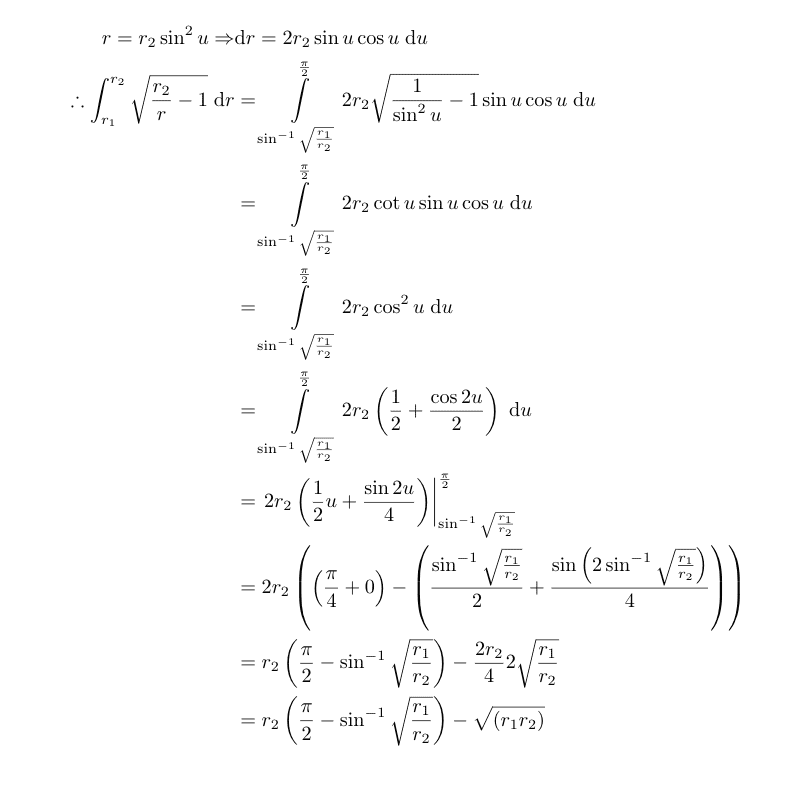
In Griffiths Quantum Mechanics 2nd edition, in Chapter 8 he calculates the following integral on page 323

Screen Shot 2020-10-10 at 7.52.17 PM.png

and he gets
Screen Shot 2020-10-10 at 7.57.06 PM.png

I disagree with this result, I think the integral should be
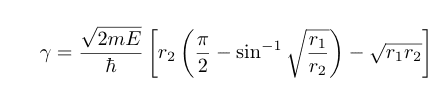
Screen Shot 2020-10-10 at 7.55.18 PM.png

since

Screen Shot 2020-10-10 at 8.17.16 PM.png

Maybe somebody can explain why I am wrong? Also, from equation 8.24 to 8.25, he makes the assumption that sinϵ ≅ ϵ, but how does that imply sin^(-1)ϵ ≅ ϵ, which seems to be what he assumes to get from 8.24 to 8.25. Any insight is greatly appreciated!
 

Attachments

  • Screen Shot 2020-10-10 at 3.19.14 PM.png
    Screen Shot 2020-10-10 at 3.19.14 PM.png
    6.1 KB · Views: 195
  • Screen Shot 2020-10-10 at 7.55.18 PM.png
    Screen Shot 2020-10-10 at 7.55.18 PM.png
    2.7 KB · Views: 197
  • Like
Likes   Reactions: Delta2
Physics news on Phys.org
edfink1 said:
I disagree with this result, I think the integral should be
View attachment 270765
Note that the integral must go to zero as ##r_2## approaches ##r_1##. But your result doesn't satisfy this condition.

Check the following:
1602385130516.png
Also, from equation 8.24 to 8.25, he makes the assumption that sinϵ ≅ ϵ, but how does that imply sin^(-1)ϵ ≅ ϵ, which seems to be what he assumes to get from 8.24 to 8.25. Any insight is greatly appreciated!
Take the inverse sine of both sides of sinϵ ≅ ϵ. Or, do a Taylor series of ##\sin^{-1} x## about ##x=0## .
 
  • Like
Likes   Reactions: Delta2
Thank you, I get it now!
 
  • Like
Likes   Reactions: berkeman, Delta2 and TSny

Similar threads

  • · Replies 6 ·
Replies
6
Views
997
  • · Replies 8 ·
Replies
8
Views
4K
Replies
4
Views
2K
  • · Replies 11 ·
Replies
11
Views
2K
  • · Replies 5 ·
Replies
5
Views
2K
  • · Replies 1 ·
Replies
1
Views
2K
  • · Replies 4 ·
Replies
4
Views
3K
  • · Replies 10 ·
Replies
10
Views
3K
  • · Replies 6 ·
Replies
6
Views
3K
  • · Replies 4 ·
Replies
4
Views
5K