Hall Sensor Output for Position of Rotor in BLDC Motor

  • Context: Engineering 
  • Thread starter Thread starter PhysicsTest
  • Start date Start date
  • Tags Tags
    Output Sensor
Click For Summary
SUMMARY

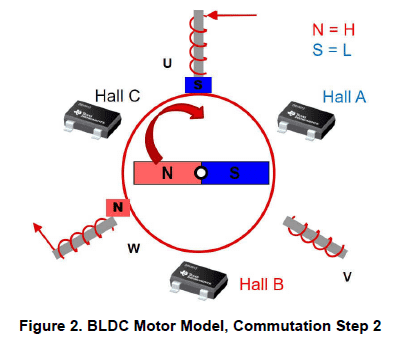
The discussion focuses on the output of Hall sensors A, B, and C in detecting the rotor position of a Brushless DC (BLDC) motor. Hall sensors are positioned 120 degrees apart and provide a 3-phase output that indicates the rotor's position. The output values are binary, with Hall A reading South (0), Hall B in transition, and Hall C reading North (1). Understanding the transition state of Hall B is crucial for determining the rotor's sector location during power-on when the motor is stationary.

PREREQUISITES
  • Understanding of Hall effect sensors and their application in motor control.
  • Familiarity with Brushless DC (BLDC) motor operation and control techniques.
  • Knowledge of signal processing for interpreting sensor outputs.
  • Basic understanding of electrical circuits and motor wiring configurations.
NEXT STEPS
  • Research the TI application notes on Hall sensor configurations for BLDC motors.
  • Learn about the principles of Hall effect sensing and its implications in motor control.
  • Explore the concept of rotor position sensing and its impact on BLDC motor performance.
  • Investigate the methods for handling sensor transition states in motor control algorithms.
USEFUL FOR

Engineers, motor control specialists, and hobbyists working with Brushless DC motors who need to understand rotor position sensing and Hall sensor outputs.

PhysicsTest
Messages
256
Reaction score
27
Homework Statement
I want to know the hall sensor output in a BLDC motor
Relevant Equations
Trapezoidal control of the BLDC motor
I wanted to understand the output of the hall sensor to detect the position of the rotor in the BLDC motor. The hall sensors are placed 120degrees apart. I downloaded one of the TI application notes and understanding it, and referring to the diagram
1673276502490.png

The rotor North and South is in a single straight line as per the diagram, now in this static condition what is the Hall A value does it read south pole? Hall B reads south or north pole? Please advise.
 

Attachments

Physics news on Phys.org
Hall sensors A, B and C produce a 3-phase output that identifies the position of the rotor.
The output voltages from the sensors are amplified and digitized, to indicate if they are more North or South.
In your example; Hall A = South; Hall B = in transition; Hall C = North.
 
Yes the output of hall sensor will be 1 for North and 0 for South, but i don't understand when you say transition, because during power on i should know the Hall A, B, C output (from 1 to 5, 0 and 6 being invalid) to know the sector location.
 
In transition simply means the Hall sensor B has just switched, or is about to switch, (from North to South, if in clockwise rotation). It is a line-call on the diagram, you must actually read Hall sensor B to know which side of the line it is on. At power on, the motor may not yet be turning.
 

Similar threads

  • · Replies 13 ·
Replies
13
Views
2K
  • · Replies 5 ·
Replies
5
Views
3K
  • · Replies 4 ·
Replies
4
Views
2K
Replies
3
Views
7K
Replies
1
Views
8K
  • · Replies 19 ·
Replies
19
Views
9K
  • · Replies 2 ·
Replies
2
Views
8K
  • · Replies 2 ·
Replies
2
Views
3K
  • · Replies 4 ·
Replies
4
Views
9K