Have you done PA=LU factorization?

  • Context: Graduate 
  • Thread starter Thread starter LongApple
  • Start date Start date
  • Tags Tags
    Factorization
Click For Summary
SUMMARY

The discussion centers on the necessity of permutations in PA=LU factorization, particularly in relation to pivoting to avoid division by small numbers. Participants emphasize that dividing by larger pivot elements, such as 10 or 5/2, enhances numerical stability during elimination steps. The conversation also touches on the non-uniqueness of permutation matrices (P) and the implications for LU decomposition, highlighting that multiple permutations can exist based on row swaps. The importance of avoiding small divisors is underscored with examples demonstrating potential inaccuracies in solutions.

PREREQUISITES
  • Understanding of LU decomposition and its applications in linear algebra.
  • Familiarity with pivoting techniques in numerical methods.
  • Knowledge of matrix operations, specifically row swaps and elimination methods.
  • Basic comprehension of numerical stability and its significance in computations.
NEXT STEPS
  • Research the role of pivoting in LU decomposition and its impact on numerical stability.
  • Explore the concept of permutation matrices and their applications in matrix factorization.
  • Learn about the implications of dividing by small numbers in numerical algorithms.
  • Investigate different methods for solving systems of linear equations using LU decomposition.
USEFUL FOR

Students and professionals in mathematics, engineering, and computer science who are involved in numerical analysis, particularly those focusing on linear algebra and matrix computations.

LongApple
Messages
68
Reaction score
0
I'm trying to figure out what this quote means and what our strategy is just looking at the matrix what kind of permutations we need to do.

Quotes: "The first permutation step is trivial (since the pivot element 10 is already the largest). The corresponding permutation matrix is the identity, and we need not write it down. The first elimination step is:"

Why do we need to do permutations at all? How do we know by looking?
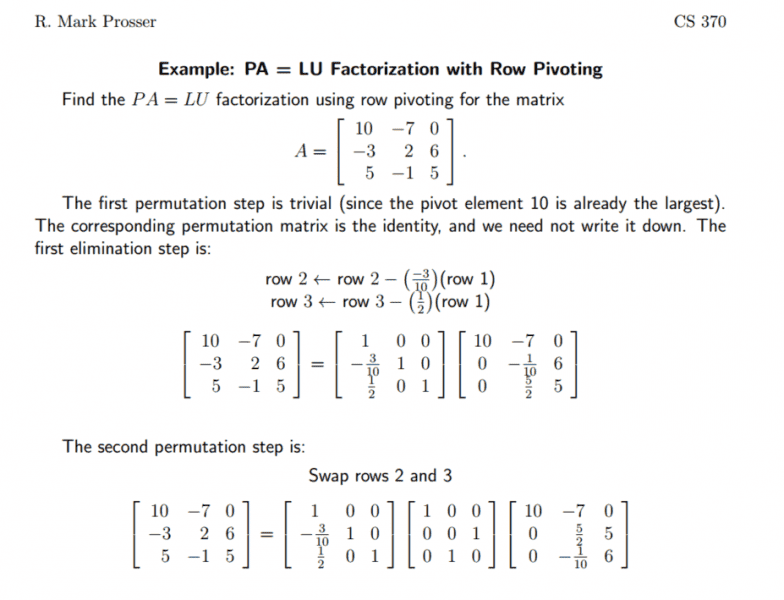
upload_2015-2-15_4-27-42.png


https://www.student.cs.uwaterloo.ca/~cs370/notes/LUExample2.pdf
 
Physics news on Phys.org
So as a start, why do we care at all that 10 is the largest?
 
Dividing by small numbers is bad. We do permutations so we may divide by a big number. In step 1 10 is already the biggest available. In step 2 5/2 is larger than 1/10 so we do a permutation so we can divide by 5/2 instead of 1/10.
 
"... what kind of permutations we need to do."
Are you referring to what permutations have to do in this setting (I may be grossly misunderstanding the thrust of your question)? If so, they are referring to rearranging (permuting is rearranging) the rows in order to bring a more desirable value to the pivot location.

If that wasn't your question - apologies.
 
lurflurf said:
Dividing by small numbers is bad. We do permutations so we may divide by a big number. In step 1 10 is already the biggest available. In step 2 5/2 is larger than 1/10 so we do a permutation so we can divide by 5/2 instead of 1/10.

1. Why is dividing by big numbers bad? Aside from inconvenient I don't see why big number necessarily necessitates row swaps

2. 10 is already the biggest available" <- available of _____ ? Of the numbers down the column

I'm a bit confused about P

Given a matrix A, does it always have a fixed P for LU factorization? Couldn't we have multiple different P's depending on how we RREF the problem ?
 
"Why is dividing by big numbers bad?"
Read again - dividing by small numbers is to be avoided

"Of the numbers down the column" Yes

"Given a matrix A, does it always have a fixed P for LU factorization? Couldn't we have multiple different P's depending on how we RREF the problem"
Yes, you can: each time rows are swapped there is another P: take a look here:
http://staff.imsa.edu/~fogel/LinAlg/PDF/17 Permutations and Row Swaps.pdf
 
statdad said:
"Why is dividing by big numbers bad?"
Read again - dividing by small numbers is to be avoided

"Of the numbers down the column" Yes

"Given a matrix A, does it always have a fixed P for LU factorization? Couldn't we have multiple different P's depending on how we RREF the problem"
Yes, you can: each time rows are swapped there is another P: take a look here:
http://staff.imsa.edu/~fogel/LinAlg/PDF/17 Permutations and Row Swaps.pdf

""Why is dividing by big numbers bad?"
Read again - dividing by small numbers is to be avoided"

Yup I read that the first time. Now - why do we want this or even if we want it why is it necessary? Maybe it is obvious to you

Aside from inconvenient I don't see why big number necessarily necessitates row swaps____________

upload_2015-2-15_20-38-44.png


1. Why does L have 1's down the diagonal? Couldn't it have anything down the diagonal?

2. Is P is not unique, then LU is not unique right. So how have linear algebra people been grading tests all these years? They can't enumerate all possible LU's can they or take the time to manually multiply every studetn's answer out can they?
 

Attachments

  • upload_2015-2-15_20-38-40.png
    upload_2015-2-15_20-38-40.png
    89.9 KB · Views: 1,126
""Why is dividing by big numbers bad?"
Read again - dividing by small numbers is to be avoided"

Yup I read that the first time. Now - why do we want this or even if we want it why is it necessary? Maybe it is obvious to you

not in wikipedia
 
  • #10
The wikipedia gives a classic example of the need for pivoting consider two systems
$$\left[ \begin{array}{cc|c}
0.00300 & 59.14 & 59.17 \\
5.291 & -6.130 & 46.78 \\
\end{array} \right]
\\
\left[ \begin{array}{cc|c}
5.291 & -6.130 & 46.78 \\
0.00300 & 59.14 & 59.17 \\
\end{array} \right]$$
If we work with 4 digits and no pivoting we get for the first system
{9873.3,4}
for the second
{10.00,1.000}
We see the two systems should have the same solution, but the first one came out wrong due to dividing by small numbers.
So we decide to divide by the largest number available.

Edit: I got something different when I checked the wikipedia result, I probably added wrong somewhere.
 
Last edited:
  • #11
LongApple said:
""Why is dividing by big numbers bad?"
Read again - dividing by small numbers is to be avoided"

Yup I read that the first time. Now - why do we want this or even if we want it why is it necessary? Maybe it is obvious to you

not in wikipedia
Why do we want the LU decomposition? As one example - look up LU and solving systems of linear equations
 

Similar threads

  • · Replies 1 ·
Replies
1
Views
2K
  • · Replies 1 ·
Replies
1
Views
5K
  • · Replies 4 ·
Replies
4
Views
2K
  • · Replies 1 ·
Replies
1
Views
2K
  • · Replies 34 ·
2
Replies
34
Views
3K
  • · Replies 1 ·
Replies
1
Views
9K
  • · Replies 22 ·
Replies
22
Views
3K
  • · Replies 32 ·
2
Replies
32
Views
3K
  • · Replies 5 ·
Replies
5
Views
2K
  • · Replies 6 ·
Replies
6
Views
2K