Heat bath and canonical ensembles

Click For Summary
SUMMARY

The discussion centers on the concept of a heat bath in statistical mechanics, particularly in relation to gas molecules and gravitational potential energy. The probability of finding a particle at height z is expressed as P(z) ∝ e^{-mgz/k_B T}, indicating that gravitational potential energy is influenced by the heat bath, which consists of surrounding gas molecules. Participants clarify that the probability of a particle being at an exact height is zero for continuous distributions, emphasizing the importance of considering intervals, such as [z, z+dz], when discussing number density.

PREREQUISITES
  • Understanding of Maxwell-Boltzmann speed distribution
  • Familiarity with Boltzmann distribution and canonical ensembles
  • Knowledge of gravitational potential energy concepts
  • Basic principles of kinetic theory and elastic collisions
NEXT STEPS
  • Study the derivation of the Maxwell-Boltzmann speed distribution
  • Explore the implications of canonical ensembles in statistical mechanics
  • Learn about the relationship between kinetic and potential energy in gas systems
  • Investigate the significance of probability intervals in continuous distributions
USEFUL FOR

Students and professionals in physics, particularly those focusing on statistical mechanics, thermodynamics, and kinetic theory, will benefit from this discussion.

WWCY
Messages
476
Reaction score
15
Hi all, I have encountered the idea of a heat bath but am slightly perplexed as to what it is.

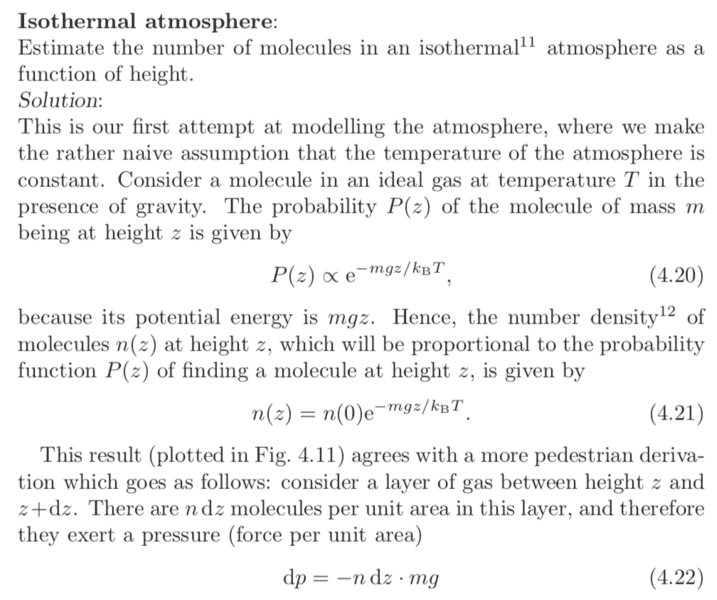
There was a textbook example that looked to find the number density expression for gas molecules as a function of position (image below). It then said that the probability ##P(z)## of finding the particle at height ##z## was given by
$$P(z) \propto e^{- mgz / k_B T}$$

a) Does this not mean that the particle is drawing gravitational potential energy from the heat bath? What sort of "object" would this heat bath be?

b) I might be being slightly pedantic here but isn't the probability of an event occurring at any point ##z## equal to ##0## for continuous distributions? If so, is the "proper" way of obtaining the expression to consider the probability in the interval ##[z, z+dz]##?

Many thanks in advance!
Screenshot 2019-01-24 at 12.36.23 AM.png
 

Attachments

  • Screenshot 2019-01-24 at 12.36.23 AM.png
    Screenshot 2019-01-24 at 12.36.23 AM.png
    44.4 KB · Views: 721
Science news on Phys.org
WWCY said:
Hi all, I have encountered the idea of a heat bath but am slightly perplexed as to what it is.

There was a textbook example that looked to find the number density expression for gas molecules as a function of position (image below). It then said that the probability ##P(z)## of finding the particle at height ##z## was given by
$$P(z) \propto e^{- mgz / k_B T}$$

a) Does this not mean that the particle is drawing gravitational potential energy from the heat bath? What sort of "object" would this heat bath be?

b) I might be being slightly pedantic here but isn't the probability of an event occurring at any point ##z## equal to ##0## for continuous distributions? If so, is the "proper" way of obtaining the expression to consider the probability in the interval ##[z, z+dz]##?

Many thanks in advance!View attachment 237713
I am not sure what you are referring to as a heat bath. The idea is to assume a column of the atmosphere all at the same temperature (so the speed distribution of the molecules follows a Maxwell-Boltzmann speed distribution). The molecules with the highest kinetic energy will be the ones that reach the highest elevation. So the author is just substituting mgz for mv^2/2 in the expression for the speed distribution.

AM
 
Hi Andrew, thanks for the response

Andrew Mason said:
I am not sure what you are referring to as a heat bath. The idea is to assume a column of the atmosphere all at the same temperature (so the speed distribution of the molecules follows a Maxwell-Boltzmann speed distribution). The molecules with the highest kinetic energy will be the ones that reach the highest elevation. So the author is just substituting mgz for mv^2/2 in the expression for the speed distribution.

AM

In the book I'm reading, it states that the speed distribution was derived from the assumption that each particle constitutes a system, and is in thermal contact to a "heat bath" at constant T, in the form of the gas molecules around it. Collisions with such particles would transfer energy from the "heat bath" to the system/particle.

In the case of the above example, each gas particle is able to exchange gravitational potential energy. But what would be the equivalent of the "heat bath" with which this energy is exchanged, in such a scenario?
 
WWCY said:
In the case of the above example, each gas particle is able to exchange gravitational potential energy. But what would be the equivalent of the "heat bath" with which this energy is exchanged, in such a scenario?

The heat bath are - so to speak - all other molecules in the column of gas. A nice visualization can be found in the Feynman Lectures, chapter 40-1: http://www.feynmanlectures.caltech.edu/I_40.html
 
Thanks for your response

Lord Jestocost said:
The heat bath are - so to speak - all other molecules in the column of gas. A nice visualization can be found in the Feynman Lectures, chapter 40-1: http://www.feynmanlectures.caltech.edu/I_40.html

In this case, how does a gas particle "exchange" gravitational potential energy with other gas particles?
 
WWCY said:
Thanks for your response
In this case, how does a gas particle "exchange" gravitational potential energy with other gas particles?
You don't have to have the molecules exchanging potential energies. The distribution of molecular speeds is derived from kinetic theory. That is all you need. The gas molecules can exchange kinetic energies through elastic collisions, but it doesn't matter because the molecules are treated as being indistinguishable.

AM
 
  • Like
Likes   Reactions: Lord Jestocost
WWCY said:
In this case, how does a gas particle "exchange" gravitational potential energy with other gas particles?

Gravitational potential energy arises from the gravitational interaction between the gas molecules and the Earth. It is – so to speak – no attribute of the gas molecules themselves. It changes when a molecule is moving upwards or downwards in the gravitational field. Due to energy conservation, this leads to corresponding change in the kinetic energy of the considered molecule which can be transferred to other molecules through elastic collisions.
 
Last edited:
I think I'm beginning to get it, many thanks!
 
WWCY said:
Hi all, I have encountered the idea of a heat bath but am slightly perplexed as to what it is.

There was a textbook example that looked to find the number density expression for gas molecules as a function of position (image below). It then said that the probability ##P(z)## of finding the particle at height ##z## was given by
$$P(z) \propto e^{- mgz / k_B T}$$

a) Does this not mean that the particle is drawing gravitational potential energy from the heat bath? What sort of "object" would this heat bath be?

b) I might be being slightly pedantic here but isn't the probability of an event occurring at any point ##z## equal to ##0## for continuous distributions? If so, is the "proper" way of obtaining the expression to consider the probability in the interval ##[z, z+dz]##?

Many thanks in advance!View attachment 237713
I wouldn't say you are pedantic at all, but the textbook you quote is definitely sloppy.
The probability that a molecule is exactly at height z is zero.
One should always state an interval.
So n(z) dz is the number density of molecules at heights between z and z + dz.
This turns out to be very important for example when you convert the Boltzmann distribution from f(E) dE to f(v) dv for example. Some textbooks get that wrong!

I would go for the "pedestrian derivation" starting after equation 4.21. That makes more sense.
However, the connection to canonical ensembles is interesting.
 
  • Like
Likes   Reactions: vanhees71 and dextercioby

Similar threads

  • · Replies 15 ·
Replies
15
Views
3K
  • · Replies 5 ·
Replies
5
Views
3K
  • · Replies 3 ·
Replies
3
Views
2K
  • · Replies 9 ·
Replies
9
Views
2K
  • · Replies 1 ·
Replies
1
Views
1K
  • · Replies 16 ·
Replies
16
Views
2K
  • · Replies 1 ·
Replies
1
Views
1K
  • · Replies 6 ·
Replies
6
Views
5K
  • · Replies 5 ·
Replies
5
Views
3K
  • · Replies 9 ·
Replies
9
Views
3K