Master1022
- 590
- 116
- Homework Statement
- What is the change in heating loss after adding the balcony to the 400 apartments?
- Relevant Equations
- Heat Transfer Equations
Hi,
I was recently attempting the following problem from heat transfer and I didn't really know how to include the fin amongst the other thermal resistances in the problem.
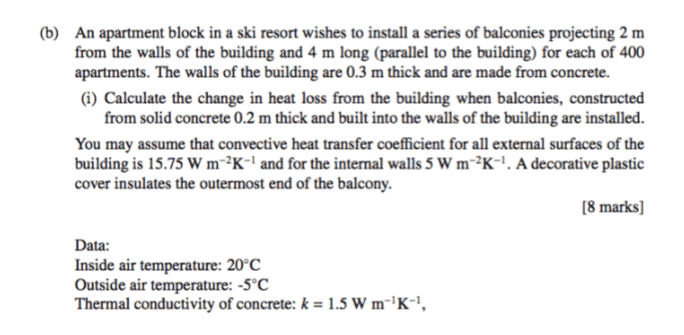
The key quantities are: ## T_{in} = 20 C ##, ## T_{out} = -5 C ##, ## h_{inner} = 5 W m^{-2} K^{-1} ##, ## h_{outer} = 15.75 W m^{-2} K^{-1} ##, ## t_{wall} = 0.3 m ##, ## t_{balcony} = 0.2 m ##, ## Width_{balcony} = 4 m ##, ## L_{balcony} = 2 m ##
In a previous part of the question, we derived the following equation for the temperature distribution of a heat fin with a base temperature of ## T_0 ## which was in surroundings of temperature ## T_{\infty} ## and the fin is insulated at the end (## x = L ##):
$$ T(x) - T_{\infty} = (T_0 - T_{\infty}) (cosh(mx) - tanh(mL) sinh(mx)) $$
where ## m^2 = \frac{hP}{k A_s} ## (## P ## is the perimeter of the fin and ## A_s ## is the cross sectional area; the other two symbols are the same as definitions above)
We used that equation to find out that the total heat transferred away from the fin was (the equation above is correct, but this following part is only my working, there is no solution to compare it against):
$$ -k \frac{\partial T}{\partial x} |_{x = 0} = km (T_0 - T_{\infty})tanh(mL) $$
My approach:
1. Work out the heat transferred for 1 balcony
We can work out the total thermal resistances as they add in series:
$$ R_{total} = \frac{1}{h_i} + \frac{t}{k} + \frac{1}{h_o} = \frac{1}{5} + \frac{0.3}{1.5} + \frac{1}{15.75} = 0.4634... m^2 K^{-1} W^{-1} $$
Thus, ## Q = U A \Delta T = \frac{1}{0.4634} \cdot (4 \cdot 0.3) \cdot (20 - (-5)) = 63.738... W ##
We can scale that up by 400 later on to get the 'total' heat loss.
2. Now for the scenario where we have the balcony
As above: ## A_s = 0.3 \cdot 4 = 1.2 metres^2 ##, ## m = \sqrt{\frac{hP}{kA_s}} = \sqrt{\frac{15.75 \cdot (4 + 4 + 0.3 + 0.3)}{(1.5) \cdot (1.2)}} = 8.6746 ##
Now I am a bit stuck as to what to do... These are my current ideas:
Idea 1:
Use ## km (T_0 - T_{\infty})tanh(mL) ## to get the heat loss from the fin. However, we know ## T_{\infty} ##, but not the base temperature ## T_0 ##. We could calculate ## T_0 ## either by assuming that it is the internal temperature (20 deg C), which seems like too much of an approximation. Otherwise, would it be correct do some sort of 'potential divider' equivalent using the thermal resistances to work out the temperature on the outer surface of the wall? With that information, we could evaluate the above expression and then use it?
Idea 2:
Try and use the expression for the heat transferred from the fin to derive a thermal resistance, such as:
$$ R_{th} = \frac{Driver}{Flux} = \frac{\Delta T}{Q} = \frac{1}{km \cdot tanh(mL)} $$ (the dimensions look correct to me) and then use this thermal resistance in the following way (i.e. swapping it out for the outer surface convective transfer term):
$$ R_{total} = \frac{1}{h_i} + \frac{t}{k} + \frac{1}{km\cdot tanh(mL)} = \frac{1}{5} + \frac{0.3}{1.5} + \frac{1}{(1.5 \cdot 8.6746) \cdot tanh(8.6746 \cdot 2)} = 0.47685... m^2 K^{-1} W^{-1} $$
which is a slight increase than the scenario without the balcony.
Thus ## Q = UA \Delta T = \frac{1}{0.4768} \cdot (4 \cdot 0.3) \cdot (20 - (-5)) = 62.919 W ##
I can then go on to calculate ratios and scale up for 400 balconies
Do any of those ideas seems like the best way to calculate the incorporate the fin into the heat transfer equations?
Any help is greatly appreciated. Thanks.
I was recently attempting the following problem from heat transfer and I didn't really know how to include the fin amongst the other thermal resistances in the problem.
The key quantities are: ## T_{in} = 20 C ##, ## T_{out} = -5 C ##, ## h_{inner} = 5 W m^{-2} K^{-1} ##, ## h_{outer} = 15.75 W m^{-2} K^{-1} ##, ## t_{wall} = 0.3 m ##, ## t_{balcony} = 0.2 m ##, ## Width_{balcony} = 4 m ##, ## L_{balcony} = 2 m ##
In a previous part of the question, we derived the following equation for the temperature distribution of a heat fin with a base temperature of ## T_0 ## which was in surroundings of temperature ## T_{\infty} ## and the fin is insulated at the end (## x = L ##):
$$ T(x) - T_{\infty} = (T_0 - T_{\infty}) (cosh(mx) - tanh(mL) sinh(mx)) $$
where ## m^2 = \frac{hP}{k A_s} ## (## P ## is the perimeter of the fin and ## A_s ## is the cross sectional area; the other two symbols are the same as definitions above)
We used that equation to find out that the total heat transferred away from the fin was (the equation above is correct, but this following part is only my working, there is no solution to compare it against):
$$ -k \frac{\partial T}{\partial x} |_{x = 0} = km (T_0 - T_{\infty})tanh(mL) $$
My approach:
1. Work out the heat transferred for 1 balcony
We can work out the total thermal resistances as they add in series:
$$ R_{total} = \frac{1}{h_i} + \frac{t}{k} + \frac{1}{h_o} = \frac{1}{5} + \frac{0.3}{1.5} + \frac{1}{15.75} = 0.4634... m^2 K^{-1} W^{-1} $$
Thus, ## Q = U A \Delta T = \frac{1}{0.4634} \cdot (4 \cdot 0.3) \cdot (20 - (-5)) = 63.738... W ##
We can scale that up by 400 later on to get the 'total' heat loss.
2. Now for the scenario where we have the balcony
As above: ## A_s = 0.3 \cdot 4 = 1.2 metres^2 ##, ## m = \sqrt{\frac{hP}{kA_s}} = \sqrt{\frac{15.75 \cdot (4 + 4 + 0.3 + 0.3)}{(1.5) \cdot (1.2)}} = 8.6746 ##
Now I am a bit stuck as to what to do... These are my current ideas:
Idea 1:
Use ## km (T_0 - T_{\infty})tanh(mL) ## to get the heat loss from the fin. However, we know ## T_{\infty} ##, but not the base temperature ## T_0 ##. We could calculate ## T_0 ## either by assuming that it is the internal temperature (20 deg C), which seems like too much of an approximation. Otherwise, would it be correct do some sort of 'potential divider' equivalent using the thermal resistances to work out the temperature on the outer surface of the wall? With that information, we could evaluate the above expression and then use it?
Idea 2:
Try and use the expression for the heat transferred from the fin to derive a thermal resistance, such as:
$$ R_{th} = \frac{Driver}{Flux} = \frac{\Delta T}{Q} = \frac{1}{km \cdot tanh(mL)} $$ (the dimensions look correct to me) and then use this thermal resistance in the following way (i.e. swapping it out for the outer surface convective transfer term):
$$ R_{total} = \frac{1}{h_i} + \frac{t}{k} + \frac{1}{km\cdot tanh(mL)} = \frac{1}{5} + \frac{0.3}{1.5} + \frac{1}{(1.5 \cdot 8.6746) \cdot tanh(8.6746 \cdot 2)} = 0.47685... m^2 K^{-1} W^{-1} $$
which is a slight increase than the scenario without the balcony.
Thus ## Q = UA \Delta T = \frac{1}{0.4768} \cdot (4 \cdot 0.3) \cdot (20 - (-5)) = 62.919 W ##
I can then go on to calculate ratios and scale up for 400 balconies
Do any of those ideas seems like the best way to calculate the incorporate the fin into the heat transfer equations?
Any help is greatly appreciated. Thanks.