Heat TransferAssigning direction to the temperature gradient

Click For Summary

Discussion Overview

This thread discusses the application of the finite difference scheme to a 1-dimensional heat transfer problem involving a non-uniform cross-sectional area. Participants explore the derivation of equations necessary for this scheme, particularly focusing on the definition and direction of the temperature gradient and the implications for heat flux calculations.

Discussion Character

  • Technical explanation
  • Debate/contested
  • Mathematical reasoning

Main Points Raised

  • Some participants express confusion about the sign convention for the temperature gradient and heat flux, particularly why the conduction term at point a is defined as T2 - T1.
  • Others propose that the gradient is inherently defined by the temperature difference, regardless of the assumed direction of flux.
  • A participant notes that Fourier's law indicates that heat flow is positive in the direction opposite to the temperature increase, leading to further questions about the correct sign for the conduction terms.
  • One participant suggests that the magnitude of the flux can be determined by K(dT/dx), with the sign depending on the assumed direction of the flux.
  • Another participant emphasizes that the direction of the heat flux should not be assumed as positive or negative, but rather defined by its effect on energy within the element.
  • Some participants discuss the need to keep track of multiple signs in their calculations and propose methods to simplify the process of determining the correct sign for conduction terms.

Areas of Agreement / Disagreement

Participants do not reach a consensus on the best approach to assign signs to the heat flux and temperature gradient. Multiple competing views remain regarding the treatment of flux direction and the implications for the finite difference scheme.

Contextual Notes

Participants highlight the complexity of sign conventions in heat transfer problems, noting that assumptions about temperature gradients and flux directions can lead to different interpretations and potential errors in calculations.

Saladsamurai
Messages
3,009
Reaction score
7
Hello again folks :smile:

This thread is regarding the Finite difference scheme for a 1-dimensional Heat transfer problem with non-uniform cross-sectional area. As seen in https://www.physicsforums.com/showthread.php?t=397891", when the element has constant cross-sectional area, things cancel nicely. But when this is not the case, some parts get tricky and I hope to have these areas (no pun intended :smile:) addressed.

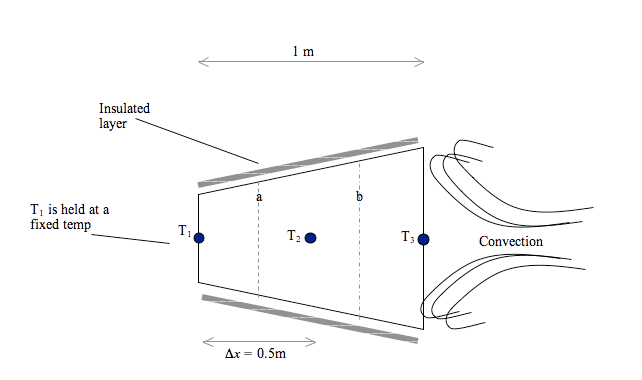
Shown below is a (super-awesome MS word) drawing of an object subjected to a fixed temperature at point 1 and convection at point 3. Now the dotted lines are simply a construct that we used in class to help deal with the area problem; I will explain how we used it shortly but for now just note that it is there and that I will commonly refer to it as the "pseudo-element" (PE2) that bounds point 2 (pseudo because this is not really an element since this os not FEA it is finite difference).
Picture3-19.png


Now I would like to derive the equations necessary for a finite difference scheme for this problem. Since the conditions at point 1 (p1) are known, I will move to p2 and p3 and write the corresponding energy balance for each point (pseudo-element).

Point 2:

Point 2 is lies at the center of dotted lines that bound the PE. Point 2 also lies at [itex]\Delta x = 0.5 m[/itex] with respect to the entire structure. The cross-sectional areas along the dotted lines a and b are given by Aa and Ab.

Writing the energy balance
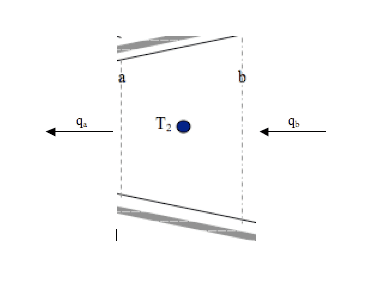
There is a conduction term due to the heat flux qa exiting (an assumption) at Aa and a conduction term due to the heat flux qb entering (an assumption) at Ab. There is also an energy storage term [itex]\Delta U = \rho*V_{element}\,dT[/itex].
Picture5-8.png


The sign-convention dictates that heat flux into the element and out of the element are negative.

Here is where I get confused:

The conduction heat flux at Aa is due to the temperature gradient between p1 and p2. My professor wrote that the conduction term at a is given by

[tex]-KA_a\frac{(T_2 - T_1)}{\Delta x}\qquad (1)[/tex]

and the conduction at b:

[tex]KA_b\frac{(T_3 - T_2)}{\Delta x}\qquad (2)[/tex]

I am just not sure how we define the temperature gradient? That is why in the first term is it T2 - T1 instead of T1 - T2 ?

Maybe a silly question, but it seems like if I assumed that the flux at 'a' was entering and at 'b' was exiting then some sort of switch would need to be made.

~Casey
 
Last edited by a moderator:
Engineering news on Phys.org
I guess maybe this was a silly question. I guess the gradient is just the gradient no matter what direction you assume that the flux is in. Since the positive x-direction is defined as going to the right, then since we would define the gradient of T in finite terms to be

[tex]\frac{\Delta T}{\Delta x}[/tex]

which by definition is

[tex]\frac{T_{p+1}-Tp}{x_{p+1} - x_p}=\fracfrac{T_{p+1}-Tp}{\Delta x}[/tex]

But there is still something bothering me before I move on; by Fourier's law of conduction, the heat flux is:

[tex]q_x = -K\frac{dT}{dx} \qquad(3)[/tex]

and as my text notes:
The minus sign in (3) implies that, by convention, heat flow is positive in the direction opposite of the temperature increase.

So in this particular problem, we do not know the direction of the flux nor the positive temperature gradient; so we made an assumption that the flux was leaving a.

Now I am trying to use this information along with (3) to determine what the correct sign on (1) should be? It has a negative sign due to the 'exiting' flux, but shouldn't there also be a negative sign from Fourier's law?

Or should I simply say instead that the magnitude of the flux is given by [itex]K\frac{dT}{dx}[/itex] and the sign is given by the assumed flux direction? I fell like the latter makes more sense, but I cannot seem to rationalize it.
 
Saladsamurai said:
Now I am trying to use this information along with (3) to determine what the correct sign on (1) should be? It has a negative sign due to the 'exiting' flux, but shouldn't there also be a negative sign from Fourier's law?

This is true, but it also has a negative sign because your arrow is pointing in the opposite direction of the x-direction. So the product of the three negatives is a negative.
 
OK! This is getting a little out of control for me :smile: There are 3 signs to keep track of. Do you see any problem with going with this approach:

the magnitude of the flux is given by [itex]K\frac{dT}{dx}[/itex] and the sign is given by the assumed flux direction

Would doing it like this bring about issues? I have a feeling this is what my professor has been doing without saying...but I am not sure.

Thanks for clarifying!
 
Last edited:
That would work for [itex]q_a[/itex], but it wouldn't work for [itex]q_b[/itex].
 
Saladsamurai said:
OK! This is getting a little out of control for me :smile: There are 3 signs to keep track of. Do you see any problem with going with this approach:

the magnitude of the flux is given by [itex]K\frac{dT}{dx}[/itex] and the sign is given by the assumed flux direction

Would doing it like this bring about issues? I have a feeling this is what my professor has been doing without saying...but I am not sure.

Thanks for clarifying!

OK, I'm a big boy; I can reason this out on my own. Let's spell out exactly what we are doing here:

In general
1)We are assuming that the 'origin' lies somewhere to the LHS of my diagram.

2)We, by convention, denote a heat flux into a surface is positive.

3)By Fourier's Law, heat flow is positive in the direction opposite the positive temperature gradient.

For this particular problem:
4) We have assumed that qa is flowing out of the element; this coincides with the -x axis.

5)By the assumption in (4) we must have also assumed that the temperature gradient is negative in the in the -x direction. Thus we are assuming that T1 < T2 (else heat would not flow).

6)So if we still denote the positive temperature gradient as:

[tex]\frac{dT}{dx} = \frac{T_2 - T_1}{\Delta x}\qquad\text{positive temp-gradient for this problem since we assumed T_2 > T_1}[/tex]

then

[tex]q_a =- K\frac{T_1 - T_2}{\Delta x}= K\frac{T_2 - T_1}{\Delta x}\qquad\text{by Fourier's Law}[/tex]

So this takes care of two of the sign conventions (Fourier's law and the +x-axis is to the right).

Finally, since the flux is OUT we denote:

[tex]q_a=-K\frac{T_2 - T_1}{\Delta x}[/tex]

Do we like this? I know I do, but I could use some backup on this.

:smile:
Casey

The tricky(ier) part is generallizing this so that I can say that
the magnitude of the flux is given by [itex]K\frac{dT}{dx}[/itex] and the sign is given by the assumed flux direction
will always work. I really did not address this here; I only showed that the sign on qa is indeed correct.

EDIT:
Mapes said:
That would work for [itex]q_a[/itex], but it wouldn't work for [itex]q_b[/itex].

Ok then! I am hoping I can reduce my proof above to some quick and dirty rules so that I can quickly assess the correct sign to assign to conduction terms. Perhaps some coffee is in order. :smile:
 
Last edited:
Here's how I do it: don't assume positive or negative flux. Just note that a heat flux arrow [itex]q[/itex] pointing toward an element adds energy at a rate [itex]q[/itex] into the element. [itex]q[/itex] can be positive or negative, but by definition it's [itex]-kA(dT/dx)\approx -kA\Delta T/\Delta x[/itex] Then [itex]\Delta T/\Delta x[/itex] can be written as [itex](T_1-T_2)/(x_1-x_2)[/itex] or [itex](T_2-T_1)/(x_2-x_1)[/itex]. So all you have to remember is

1. Arrow pointing in adds [itex]q[/itex].
2. Definition of [itex]q[/itex].
3. Match the subscript order.
 
Mapes said:
Here's how I do it: don't assume positive or negative flux. Just note that a heat flux arrow [itex]q[/itex] pointing toward an element adds energy at a rate [itex]q[/itex] into the element. [itex]q[/itex] can be positive or negative, but by definition it's [itex]-kA(dT/dx)\approx -kA\Delta T/\Delta x[/itex] Then [itex]\Delta T/\Delta x[/itex] can be written as [itex](T_1-T_2)/(x_1-x_2)[/itex] or [itex](T_2-T_1)/(x_2-x_1)[/itex]. So all you have to remember is

1. Arrow pointing in adds [itex]q[/itex].
2. Definition of [itex]q[/itex].
3. Match the subscript order.

Excellent! I also just ran into my professor who gave me another method:

1. Assume that x-axis to the right is positive (i.e. number nodes increasing from left to right).
2. Assume that temperature increases along the positive x-axis
3. Assume that all heat fluxes point to the left (no matter what initial conditions are given)
4. This schema will ensure that all fluxes out are negative and all heat fluxes in are positive

I will look at both of these methods and see which I like better! I think for now, my professor's is "easier" (involves little thinking) but yours actually encapsulates the physics better.

~Casey
 
Last edited:

Similar threads

  • · Replies 10 ·
Replies
10
Views
3K
  • · Replies 34 ·
2
Replies
34
Views
6K
Replies
2
Views
2K
  • · Replies 12 ·
Replies
12
Views
3K
  • · Replies 5 ·
Replies
5
Views
2K
Replies
2
Views
3K
  • · Replies 1 ·
Replies
1
Views
2K
  • · Replies 3 ·
Replies
3
Views
3K
  • · Replies 5 ·
Replies
5
Views
3K
  • · Replies 2 ·
Replies
2
Views
3K