Heights and distances problems

  • Context: MHB 
  • Thread starter Thread starter Drain Brain
  • Start date Start date
Click For Summary

Discussion Overview

The discussion revolves around solving heights and distances problems using trigonometry, specifically focusing on the application of the Law of Cosines and the construction of geometric diagrams to visualize the scenarios presented in the problems.

Discussion Character

  • Homework-related
  • Mathematical reasoning
  • Technical explanation
  • Debate/contested

Main Points Raised

  • One participant expresses difficulty in visualizing the problems and understanding the ratios involved, indicating a potential language barrier affecting comprehension.
  • Another participant suggests using diagrams to clarify the relationships between the variables, specifically asking for expressions of certain lengths in terms of height.
  • A different approach is proposed involving the Law of Cosines, with participants discussing how to express various sides of triangles in terms of height and other variables.
  • One participant attempts to create multiple right triangles with different angles to analyze the height of a building, noting that they observe the heights remain constant across these triangles.
  • There is a discussion about the angles involved in the triangles, with one participant questioning the assumption of a 90-degree angle in a specific scenario.
  • Several participants engage in deriving equations based on the Law of Cosines, with varying degrees of success and clarity, leading to some confusion about the relationships between the variables.
  • One participant expresses uncertainty about how to proceed after substituting values into their equations, leading to further clarification requests from others.
  • Another participant suggests using the double angle identity for cosine to simplify their equations, while others express confusion about the introduction of sine into their calculations.
  • There is a back-and-forth regarding the correctness of derived expressions and the necessity of finding numeric values versus keeping the expressions in terms of variables.

Areas of Agreement / Disagreement

Participants do not reach a consensus on the best approach to solve the problems, with multiple competing views on how to apply trigonometric principles and the Law of Cosines. Some participants express confusion and seek clarification, indicating that the discussion remains unresolved.

Contextual Notes

Participants reference specific angles and relationships in their diagrams, but there are unresolved assumptions regarding the configurations of the triangles and the angles involved. Some mathematical steps are not fully clarified, leading to potential gaps in understanding.
Drain Brain
Messages
143
Reaction score
0
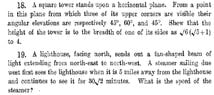
I got stuck with these problems from my trig book.
first I would like to elaborate what part of the problem is difficult for me. For the first problem I'm having a hard time producing a picture of the situation. Secondly, is the problem asking about a particular ratio? Maybe what's really hurting me the most is my reading comprehension since English is not my first language. I'm hoping that you can bear with that.

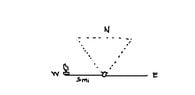
Now, for the second problem I tried drawing a picture of the situation given, but I am not quite sure if it is correct.

Here,
View attachment 3486

I couldn't deduce anything from this. Thanks!
 

Attachments

  • looney 18n19.jpg
    looney 18n19.jpg
    58 KB · Views: 104
  • tRIGOIMAGE.jpg
    tRIGOIMAGE.jpg
    5 KB · Views: 93
Mathematics news on Phys.org
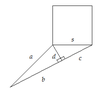
Here is a diagram to help get you started with the first problem:

View attachment 3487

If we let $h$ be the height of the tower, then what is $a$ in terms of $h$? What is $b+c$?
 

Attachments

  • drainbrain3.png
    drainbrain3.png
    949 bytes · Views: 84
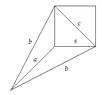
A better approach (in my opinion) would be to use the following diagram:

View attachment 3488

Now find $a$ and $b$ in terms of $h$, and $c$ in terms of $s$, then apply the Law of Cosines as follows:

$$s^2=a^2+b^2-2ab\cos(\theta)$$

$$c^2=b^2+b^2-2b^2\cos(2\theta)$$

From this, you can determine the ratio $$\frac{h}{s}$$.

You may need $$\left(\sqrt{5}+1\right)^2=6+2\sqrt{5}$$. :D
 

Attachments

  • drainbrain4.png
    drainbrain4.png
    1.3 KB · Views: 84
Hello, Drain Brain!

19. lighthouse facing north sends out a fan-shaped beam of light extending from NE to NW.
A steamer sailing due west first sees the lighthouse when it is 5 miles from the lighthouse
and continues to see it for 30\sqrt{2} minutes. .What is the speed of the steamer?
Code:
                   _
                 5√2
         B * - - - - - - - * A
            *            *
             5 *       * 5
                 * 90*
       - - - - - - * - - - - - -
The steamer travels from A to B.
We have an isosceles right triangle;
Its hypotenuse s 5\sqrt{2}.

The steamer travels 5\sqrt{2} miles in 30\sqrt{2} minutes \;=\:\tfrac{\sqrt{2}}{2} hours.

Therefore, its speed is: .\frac{5\sqrt{2}}{\frac{\sqrt{2}}{2}} \:=\:10 miles per hour.
 
I still don't get the method for solving problem 18. But what I did as an attempt is to create three different right triangles that lie on different planes the first two trianlges have one of their angle to be 45 degrees and the last one has 60 degrees . As I observed the heights of these three triangles are all the same and their heights refers to the height of the building.

I write the hypotenuse of first two triangles in terms of its height h. I found it to be $h\sqrt{2}$

Now, the hypotenuse of the last trianlge in terms of h is found to be $\frac{2h}{\sqrt{3}}$

I'm not quite sure how to relate all these infos that I get. Please help.

- - - Updated - - -

soroban said:
Hello, Drain Brain!


Code:
                   _
                 5√2
         B * - - - - - - - * A
            *            *
             5 *       * 5
                 * 90*
       - - - - - - * - - - - - -
The steamer travels from A to B.
We have an isosceles right triangle;
Its hypotenuse s 5\sqrt{2}.

The steamer travels 5\sqrt{2} miles in 30\sqrt{2} minutes \;=\:\tfrac{\sqrt{2}}{2} hours.

Therefore, its speed is: .\frac{5\sqrt{2}}{\frac{\sqrt{2}}{2}} \:=\:10 miles per hour.
Hi soroban!

How did you know that there is 90 degrees subtended by line joining A and B?
 
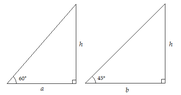
To determine $a$ and $b$, use the diagram:

View attachment 3489

And $c$ is the diagonal of a square, having side lengths $s$.

Using this information, what do the two equations from the Law of Cosines become?
 

Attachments

  • drainbrain5.png
    drainbrain5.png
    1.6 KB · Views: 79
MarkFL said:
To determine $a$ and $b$, use the diagram:

View attachment 3489

And $c$ is the diagonal of a square, having side lengths $s$.

Using this information, what do the two equations from the Law of Cosines become?

Hi MarkFl, just want to clarify something here, are you looking at the situation from the top of the building? I'm mean Top-view perspective.
 
The first two images I drew are a top-down perspective...this latest image is from the side.
 
MarkFL said:
The first two images I drew are a top-down perspective...this latest image is from the side.

Okay. Doing what you said in post #3

I express a & b in terms of h and I found that $a=\frac{h}{\sqrt{3}}$ and $b=h$. Now expressing c in terms of s, I got $c=s\sqrt{2}$. $\displaystyle s^2=(\frac{h}{\sqrt{3}})^2+h^2-2(\frac{h}{\sqrt{3}})h\cos(\theta)$

$\displaystyle c^2=h^2+h^2-2h^2\cos(2\theta)$

what to do next?
 
  • #10
Replace $c$ with $\sqrt{2}h$ and simplify your equations some, then apply the double angle identity for cosine:

$$\cos(2\theta)=2\cos^2(\theta)-1$$

What you are looking for is to solve for $$\frac{h}{s}$$.
 
  • #11
MarkFL said:
Replace $c$ with $\sqrt{2}h$ and simplify your equations some, then apply the double angle identity for cosine:

$$\cos(2\theta)=2\cos^2(\theta)-1$$

What you are looking for is to solve for $$\frac{h}{s}$$.

how did you get $c=\sqrt{2}h$?

when I replaced c with $\sqrt{2}h$ I get,

$(\sqrt{2}h)^2=h^2+h^2-2h^2\cos2\theta$

$2h^2=2h^2-2h^2\cos2\theta$

factoring out $2h^2$

$2h^2=2h^2(1-\cos2\theta)$

$1=(1-(2\cos^{2}\theta-1)$

$1=2(1-\cos^{2}\theta)= 2\sin^{2}\theta$? the h disappeared? what happened?
 
Last edited:
  • #12
I meant $c=\sqrt{2}s$.
 
  • #13
MarkFL said:
I meant $c=\sqrt{2}s$.

replacing $c=\sqrt{2}s$

I get after simplifying $s^2=2h^2\sin^{2}\theta$

$2h^2\sin^{2}\theta= (\frac{h}{\sqrt{3}})^2+h^2-2(\frac{h}{\sqrt{3}})h\cos(\theta)$

$2h^2\sin^{2}\theta=\frac{h^2(4\sqrt{3}-6\cos\theta)}{3\sqrt{3}}$ but from this $h^2$ will disappear. how is that?
 
  • #14
I get:

$$s^2=h^2\left(\frac{4-2\sqrt{3}\cos(\theta)}{3}\right)\tag{1}$$

$$s^2=h^2\left(1-\cos(2\theta)\right)\tag{2}$$

Now, apply the double-angle identity for cosine I gave above to (2), then solve (2) for $\cos(\theta)$, and substitute into (1), and then solve for $$\frac{h}{s}$$. :D
 
  • #15
that's what I did above.
 
  • #16
Drain Brain said:
that's what I did above.

No, you somehow introduced $\sin(\theta)$...
 
  • #17
MarkFL said:
No, you somehow introduced $\sin(\theta)$...

okay, I know this is getting very long . :)

$2h^2(1-\cos^2\theta)= h^2\left(\frac{4-2\sqrt{3}\cos(\theta)}{3}\right)\tag{1}$

$2-2\cos^{2}\theta=\left(\frac{4-2\sqrt{3}\cos(\theta)}{3}\right)$

$6-6\cos^{2}\theta=4-2\sqrt{3}\cos\theta$

$6-4=6\cos^{2}\theta-2\sqrt{3}\cos\theta$

$2=6\cos^{2}\theta-2\sqrt{3}\cos\theta$

$6\cos^{2}\theta-2\sqrt{3}\cos\theta-2$

solving for $\cos\theta$ using quadratic formula

I get $\cos\theta=\frac{\sqrt{3}+\sqrt{15}}{6}$

is this correct?
 
  • #18
You don't need to find the numeric value of $\cos(\theta)$...use (2) to get it in terms of $h$ and $s$, then substitute into (1), and then solve for $$\frac{h}{s}$$.
 
  • #19
Here is one way to finish up...

So, (2) becomes (applying the double-angle identity for cosine)

$$s^2=h^2\left(1-(2\cos^2(\theta)-1)\right)$$

$$s^2=h^2\left(2-2\cos^2(\theta)\right)$$

$$\left(\frac{h}{s}\right)^2=\frac{1}{2-2\cos^2(\theta)}$$

From (1), we find:

$$\cos(\theta)=\frac{4-3\left(\dfrac{h}{s}\right)^{-2}}{2\sqrt{3}}$$

Hence:

$$\left(\frac{h}{s}\right)^2=\frac{1}{2-2\left(\dfrac{4-3\left(\dfrac{h}{s}\right)^{-2}}{2\sqrt{3}}\right)^2}$$

$$\left(\frac{h}{s}\right)^2=\frac{1}{2-\dfrac{16-24\left(\dfrac{h}{s}\right)^{-2}+9\left(\dfrac{h}{s}\right)^{-4}}{6}}$$

$$\left(\frac{h}{s}\right)^2=\frac{6}{-4+24\left(\dfrac{h}{s}\right)^{-2}-9\left(\dfrac{h}{s}\right)^{-4}}$$

$$-4\left(\frac{h}{s}\right)^2+18-9\left(\dfrac{h}{s}\right)^{-2}=0$$

$$4\left(\frac{h}{s}\right)^4-18\left(\frac{h}{s}\right)^2+9=0$$

Applying the quadratic formula (and discarding the smaller root since we must have $h>s$), we find:

$$\left(\frac{h}{s}\right)^2=\frac{9+3\sqrt{5}}{4}$$

Thus:

$$\frac{h}{s}=\frac{\sqrt{9+3\sqrt{5}}}{2}=\frac{\sqrt{6}\sqrt{6+2\sqrt{5}}}{4}=\frac{\sqrt{6}\sqrt{\left(\sqrt{5}+1\right)^2}}{4}=\frac{\sqrt{6}\left(\sqrt{5}+1\right)}{4}$$
 
  • #20
Hello, Drain Brain! Updated - - -

Hi soroban!

How did you know that there is 90 degrees subtended by line joining A and B?
Code:
      B * - - - - - - - * A 
          *           * 
            *       *
           45 *   * 45 
      W - - - - * - - - - E
                L
We are told that LA is in the northeasterly direction.
. . Hence: \angle ALE = 45^o

We are told that LB is in the northwesterly direction.
. . Hence: \angle BLW = 45^o

Got it?
 

Similar threads

  • · Replies 2 ·
Replies
2
Views
1K
  • · Replies 13 ·
Replies
13
Views
3K
  • · Replies 9 ·
Replies
9
Views
2K
  • · Replies 8 ·
Replies
8
Views
2K
  • · Replies 26 ·
Replies
26
Views
5K
  • · Replies 30 ·
2
Replies
30
Views
10K
  • · Replies 8 ·
Replies
8
Views
2K
  • · Replies 3 ·
Replies
3
Views
1K
  • · Replies 1 ·
Replies
1
Views
2K
  • · Replies 16 ·
Replies
16
Views
6K