Homework Help Overview
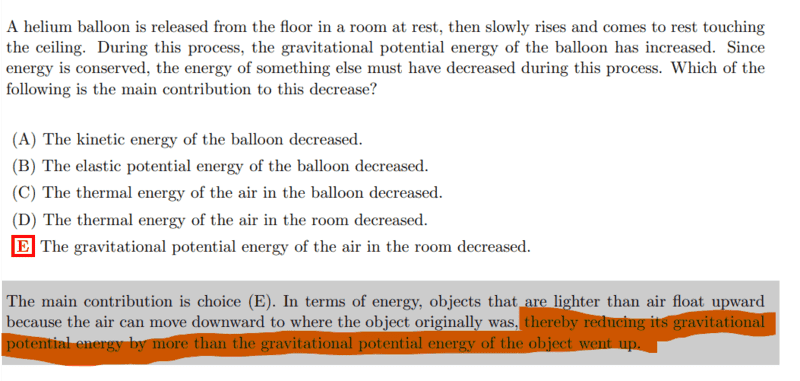
The discussion revolves around the conservation of energy in the context of a helium balloon's ascent and its interactions with air. Participants explore the implications of kinetic energy changes and potential energy transformations during the balloon's movement.
Discussion Character
- Exploratory, Conceptual clarification, Assumption checking
Approaches and Questions Raised
- Participants question how energy conservation applies when initial and final kinetic energies are zero. They discuss the role of internal energy and the effects of collisions and drag during ascent.
Discussion Status
The discussion is active, with participants providing insights into energy transformations and potential energy changes. Some have suggested that kinetic energy is converted to internal energy during interactions with air, while others have pointed out the need to account for various energy losses.
Contextual Notes
There are ongoing questions about the assumptions made regarding non-conservative forces and the treatment of potential energy in the problem setup. Participants are also considering the implications of different mass distributions in related scenarios.