Helmholtz theorem derivation question

Click For Summary
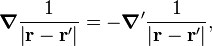
The discussion focuses on the derivation of the Helmholtz theorem, specifically addressing the transition from one mathematical expression to another. Participants clarify that ∇' denotes the gradient with respect to r', and they question the necessity of the Dirac delta function, traditionally associated with discontinuities. The conversation also touches on the interpretation of the volume integral of a vector field, confirming that it involves triple integrals of each vector component independently. Additionally, there is confusion regarding the application of the del operator in this context, with participants expressing frustration over missing steps in the explanation. Overall, the thread highlights the complexities and nuances involved in understanding the Helmholtz decomposition derivation.
DivergentSpectrum
Messages
149
Reaction score
15
http://en.wikipedia.org/wiki/Helmholtz_decomposition#Derivation
how do we go from

f8d3b3e44dfc58f31df26e57c121a22f.png

to

6f79acfa5e48004f3a3d8c262d7205db.png


also on the next step
f87a951aa4c1323f4886374808b14276.png

∇' just means the gradient with respect to r', right?
Also, why do i have to use the dirac delta function? i thought it was only used to deal with discontinuities?

also when we say

gif.gif

gif.gif

the volume integral of a vector field just means we do the triple integral on each component of the vector field independently right?
 
Last edited:
Physics news on Phys.org
image-jpg.jpg
del is an operator though? if i applied that to this case then id get stuff like
gif.gif
or
gif.gif


i don't know why theyd explain each step then leave one completely mising
 
Relativistic Momentum, Mass, and Energy Momentum and mass (...), the classic equations for conserving momentum and energy are not adequate for the analysis of high-speed collisions. (...) The momentum of a particle moving with velocity ##v## is given by $$p=\cfrac{mv}{\sqrt{1-(v^2/c^2)}}\qquad{R-10}$$ ENERGY In relativistic mechanics, as in classic mechanics, the net force on a particle is equal to the time rate of change of the momentum of the particle. Considering one-dimensional...

Similar threads

  • · Replies 20 ·
Replies
20
Views
4K
  • · Replies 8 ·
Replies
8
Views
3K
  • · Replies 8 ·
Replies
8
Views
3K
  • · Replies 4 ·
Replies
4
Views
1K
  • · Replies 3 ·
Replies
3
Views
3K
  • · Replies 2 ·
Replies
2
Views
3K
Replies
28
Views
2K
  • · Replies 5 ·
Replies
5
Views
2K
  • · Replies 1 ·
Replies
1
Views
2K
  • · Replies 10 ·
Replies
10
Views
2K