Help Finding Amplitude of Voltage Across Capacitor At Resonant Frequency

Click For Summary
SUMMARY

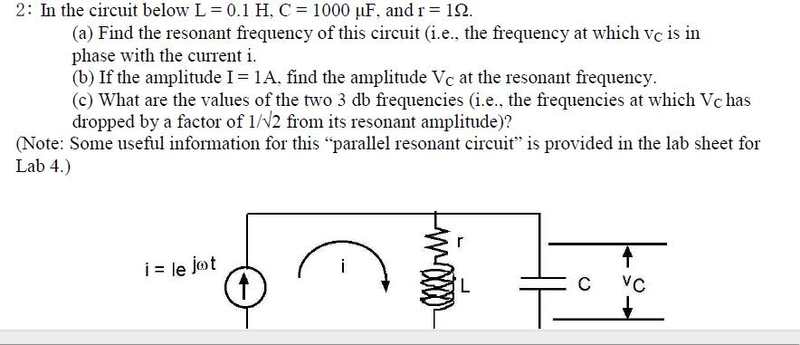
The discussion focuses on calculating the amplitude of voltage across a capacitor (Vc) at the resonant frequency in an RLC circuit with a current (I) of 1A. The user derived the equations for impedance (Zeq) and resonant frequency (ω) using the formulas Zeq = (jωL + R) / (jωRC - ω²LC + 1) and ω = √[(L - R²C) / (L²C)]. The solution involves multiplying both the numerator and denominator of the impedance by the complex conjugate of the denominator to eliminate the imaginary component, thereby simplifying the calculation of real impedance conditions.

PREREQUISITES
  • Understanding of RLC circuit theory
  • Familiarity with complex impedance calculations
  • Knowledge of resonant frequency concepts
  • Ability to manipulate complex numbers and equations
NEXT STEPS
  • Study the derivation of impedance in RLC circuits
  • Learn about the conditions for resonance in electrical circuits
  • Explore methods for calculating voltage across reactive components
  • Investigate the use of complex conjugates in circuit analysis
USEFUL FOR

Electrical engineers, students studying circuit theory, and anyone involved in analyzing RLC circuits and resonance phenomena.

mmmboh
Messages
401
Reaction score
0
Hi, here is the question:
29lz5t3.jpg


For part b) I have to find the amplitude of Vc at the resonant frequency with I=1A, I have found Zeq and well here are my equations:

\frac{jwL+R}{\ jwRC-w^2LC+1} and I have the equation for w at the resonance:w= \sqrt[2]{\frac{L-R^2C}{\L^2C}}

I know at the resonant the impedance is real..but I don't know what to do with my equations, can someone help please.
 
Physics news on Phys.org
Multiply both the numerator and the denominator of the impedance by the complex conjugate of the denominator. That makes the denominator real. Then it is easy to find the condition for real impedance: when the imaginary part of the numerator is zero.

ehild
 
Oh I figured it out...thanks!
 
Last edited:
The book claims the answer is that all the magnitudes are the same because "the gravitational force on the penguin is the same". I'm having trouble understanding this. I thought the buoyant force was equal to the weight of the fluid displaced. Weight depends on mass which depends on density. Therefore, due to the differing densities the buoyant force will be different in each case? Is this incorrect?

Similar threads

  • · Replies 21 ·
Replies
21
Views
1K
Replies
17
Views
3K
  • · Replies 10 ·
Replies
10
Views
1K
  • · Replies 3 ·
Replies
3
Views
2K
  • · Replies 3 ·
Replies
3
Views
3K
  • · Replies 14 ·
Replies
14
Views
3K
  • · Replies 1 ·
Replies
1
Views
2K
  • · Replies 3 ·
Replies
3
Views
2K
Replies
1
Views
2K