Help Force of a Spring for Small displacements

  • Thread starter Thread starter Saladsamurai
  • Start date Start date
  • Tags Tags
    Force Spring
Click For Summary

Homework Help Overview

The discussion revolves around understanding the force exerted by springs during small horizontal displacements of a mass. Participants are examining the application of trigonometric functions in resolving forces related to spring mechanics.

Discussion Character

  • Conceptual clarification, Mathematical reasoning

Approaches and Questions Raised

  • The original poster attempts to understand why the unresolved force includes a cosine factor of 45 degrees, linking it to the assumption of small horizontal displacements. Other participants explore the relationship between the horizontal displacement and the direction of the spring force.

Discussion Status

Participants are actively engaging with the problem, with some providing insights into vector components and trigonometric relationships. There appears to be a productive exploration of the geometry involved, though not all participants feel confident in their understanding.

Contextual Notes

There is an emphasis on the assumption of small displacements and the specific angles involved in the problem setup, which may influence the interpretation of the forces at play.

Saladsamurai
Messages
3,009
Reaction score
7
Help! Force of a Spring for "Small" displacements

Homework Statement


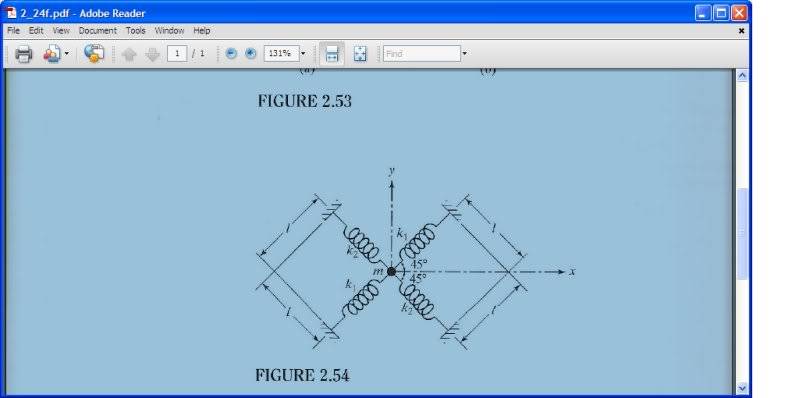
Okay, here is the diagram,
untitled.jpg


For "small horizontal displacements" of the mass:

For the force exerted by each spring (TOTAL, not resolved) they are using:

Fsp=kxcos(45) and then resolving it onto the x-axis they use

Fsp x=kxcos25*cos45

I do not understanding this at all.

Why is the unresolved force using cos*45 ?

I am thinking it has to do with the fact that we are assuming that we are making
only "small horizontal displacements" of the mass.
 
Physics news on Phys.org


Saladsamurai said:
Why is the unresolved force using cos*45 ?

I am thinking it has to do with the fact that we are assuming that we are making
only "small horizontal displacements" of the mass.

The key word is horizontal as-in 'along the x-axis'. The springs exert a force in response to displacements along their lengths. What component of the horizontal displacement points along the length of each spring?


Well, apparently x*cos(45)...

But I have drawn it out like 4 times and cannot seem to see it. Guess you cannot really help me with that part though.


Well, let's look at the spring in the first quadrant: the angle between the horizontal displacement (call the displacement [itex]\dec{d}=x\hat{i}[/itex]), and the unit vector along th length of the spring (call it [itex]\hat{n}[/itex]) is 45 deg. To get the component of d along n you take the dot product of the two vectors, and [itex]\vec{d}\cdot\hat{n}=||\vec{d}||*||\hat{n}||\cos(45)=(x)*(1)\cos(45)[/itex]

Alternatively you can just use trig:

http://img19.imageshack.us/img19/1719/springa.th.jpg
 
Last edited by a moderator:


Yes, I was using the wrong triangle like the jerk that I am. Thank you for that G... That offers a lot of insight into my problem-solving strategies.

Thanks again for your time,
Casey
 

Similar threads

Replies
17
Views
2K
Replies
6
Views
1K
  • · Replies 31 ·
2
Replies
31
Views
3K
Replies
29
Views
3K
  • · Replies 14 ·
Replies
14
Views
4K
  • · Replies 3 ·
Replies
3
Views
2K
  • · Replies 9 ·
Replies
9
Views
2K
  • · Replies 2 ·
Replies
2
Views
2K
Replies
6
Views
3K
Replies
2
Views
1K